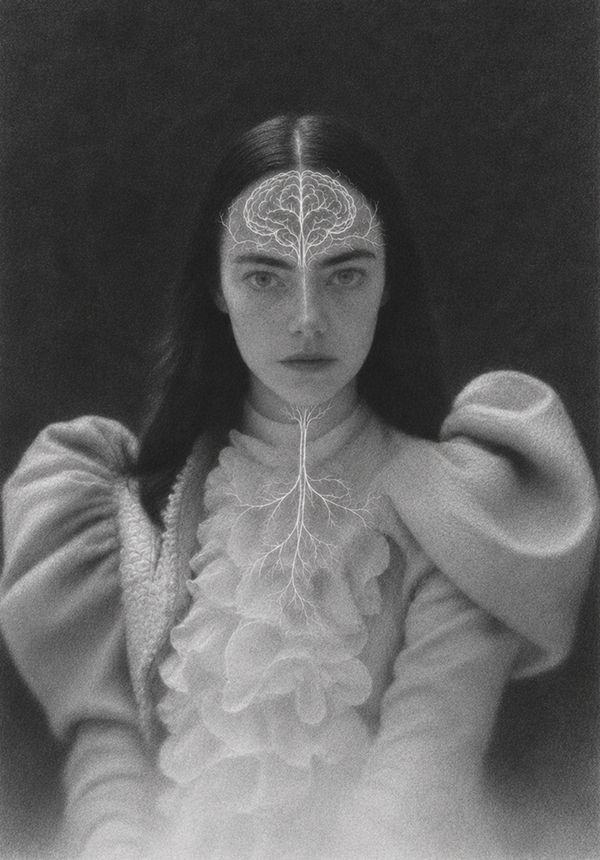
How does the shift in the film’s visual language reflect Bella Baxter’s developing self-awareness and her transition from dependency to autonomy?
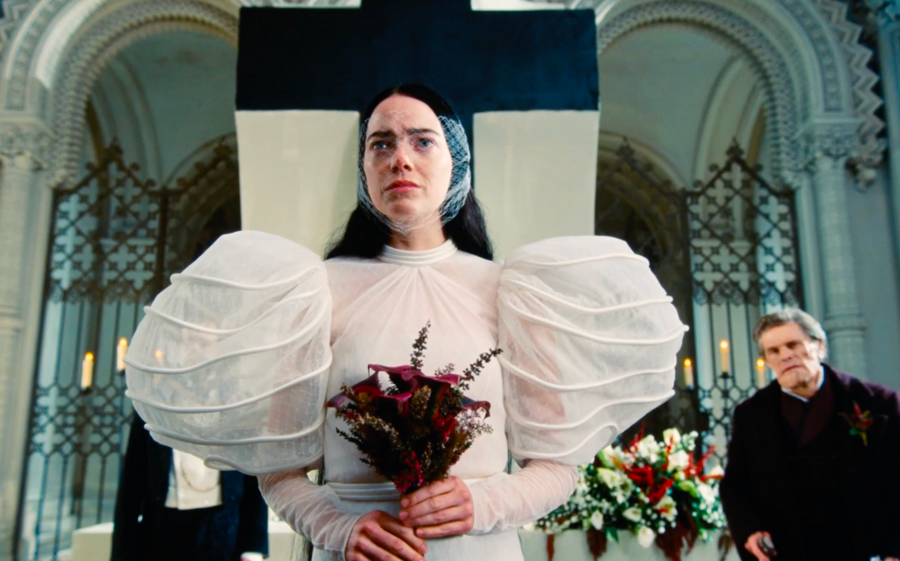
Wedding. A frame from the film «Poor Things, ” directed by Yorgos Lanthimos, cinematography by Robbie Ryan, 2023.
In many cinematic works, the visual environment functions as the space in which events unfold. Set design, color palettes, lighting, and composition help establish the atmosphere, denote the time of action, and convey the emotional state of the characters. However, there are films where the visual language becomes an independent mode of narration. The alteration of imagery does not merely accompany the plot’s progression; it allows the viewer to observe the hero’s internal transformations.
A prime example of such a film is «Poor Things» (2023), directed by Yorgos Lanthimos, which is based on the novel of the same name by Alasdair Gray.
Research Goal — to determine how the transformation of visual elements conveys the heroine’s journey and influences the perception of the narrative.
The research utilizes comparative visual analysis of specific movie sequences. It examines shifts in color palette, composition, spatial scale, optical characteristics, and costume design. The primary material consists of film frames, which are cross-referenced according to the heroine’s developmental stages. Supplementary sources include interviews with the production crew and professional publications regarding the film’s visual aesthetic.
Chapter I. The World Before Freedom
Bella and Godwin Baxter: The relationship between creator and creation. A still from the film «Poor Things,» directed by Yorgos Lanthimos, shot by Robbie Ryan, 2023.
Godwin Baxter’s house is the first visual environment the viewer encounters.The initial episodes of the story are shot in black and white. The absence of color establishes a visual distance between the viewer and the heroine’s surrounding reality. Bella exists in a world that is entirely organized without her involvement.
Distorted Perspective
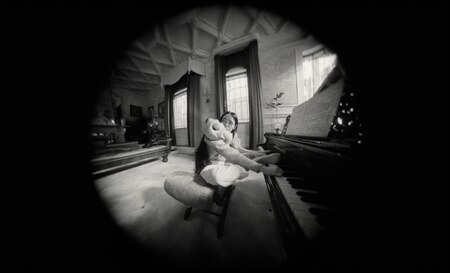
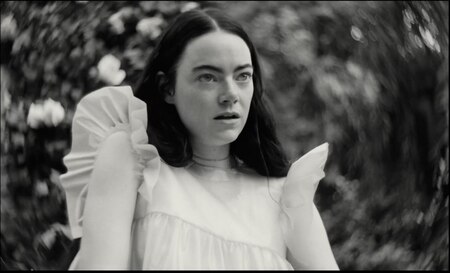
Bella Baxter at the beginning of the film: an image of childlike spontaneity. A still from the film Poor Things, directed by Yorgos Lanthimos, shot by Robbie Ryan, 2023.
The unusual «fisheye» effect—specifically using Nikkor 8 mm and Optex 4 mm lenses, as well as optics with pronounced vignetting—creates a contradiction: the camera captures more space than a typical lens, yet simultaneously distorts it. This can be paralleled with Bella’s perception, for whom the surrounding world is open to investigation but not yet fully understood.
Color Contrasts in the First Part
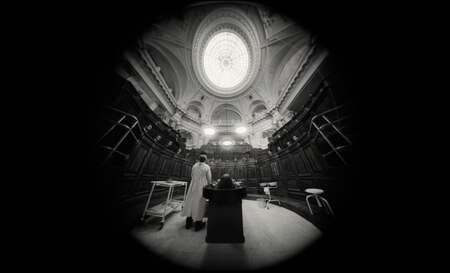
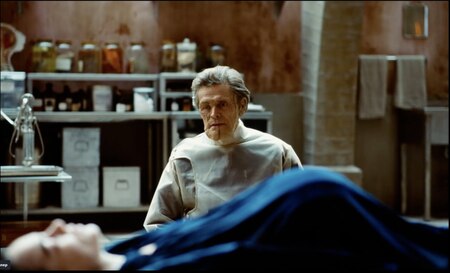
Godwin Baxter Laboratory: A space for scientific experimentation. Still from the film Poor Things, directed by Yorgos Lanthimos, photographed by Robbie Ryan, 2023.
The first chapter of the film also juxtaposes color and black-and-white footage, symbolizing the artificial world created for Bella versus reality (the events that happened to her).As we delve deeper into the film, we will see the reality Bella will confront.
Bella Baxter’s Costume
— Visualizing the Child MindThe costume reflects not the heroine’s independent choice, but rather the perception of others about how she should appear.
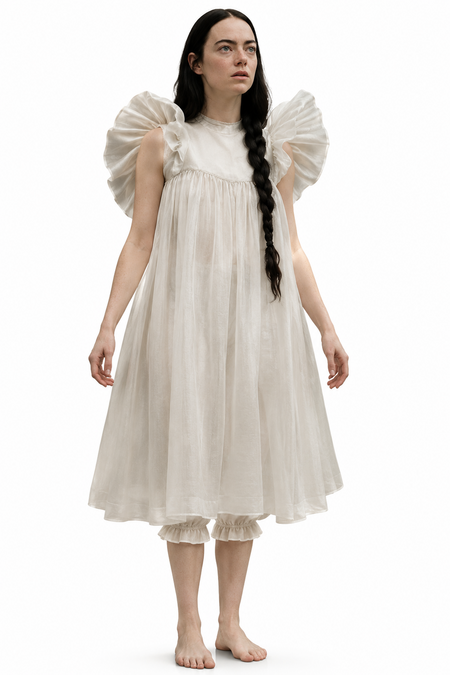
In the first part of the film, Belle wears a loose, white dress resembling a Victorian nightgown. The voluminous puff sleeves, soft fabric, high waistline, and lack of a defined silhouette give the costume a doll-like, almost childlike quality.The white color can be interpreted as a symbol of innocence and unformed identity. Belle is not yet familiar with social conventions and does not realize clothing as a means of self-expression.
According to costume designer Holly Woodington, the development of the wardrobe was deliberately constructed in parallel with the character’s development.
Baxter House
Baxter House
— this is the material continuation of his experimentsSet designers Sean Heath and James Price used human anatomy as the basis for the home’s architectural language: — The ceiling structures resemble the anatomy of the ear and oral cavity. — The combination of various architectural forms recalls the connection of individual body parts.
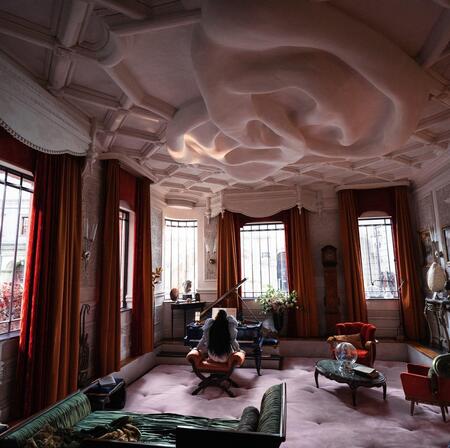
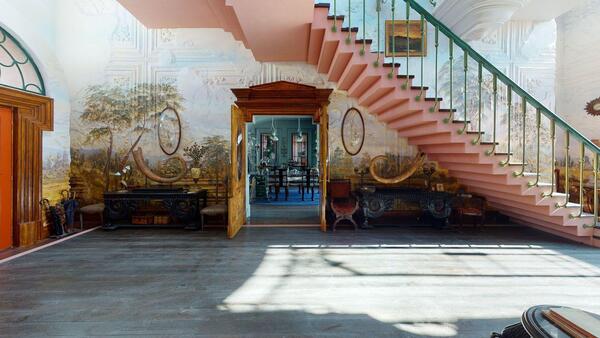
Living room and foyer of Godwyn Baxter’s house. Stills from the film Poor Things, directed by Yorgos Lanthimos, 2023. Production Designers: Shona Heath, James Price. Photographer: Atsushi Nishijima.
Godwin Baxter House Cafeteria. Set design photographs from the film «Poor Things, ” directed by Yorgos Lanthimos, 2023. Production Designers: Shona Heath, James Price. Photographer: Atsushi Nishijima
In the dining hall, the massive chairs that occupy a significant portion of the composition stand out. Bella’s adult figure appears small amidst the surrounding objects, which emphasizes the childlike state of her consciousness.Sean Heath mentioned that the furniture was intentionally made disproportionate. His inspiration came from chairs found in a Victorian dollhouse.
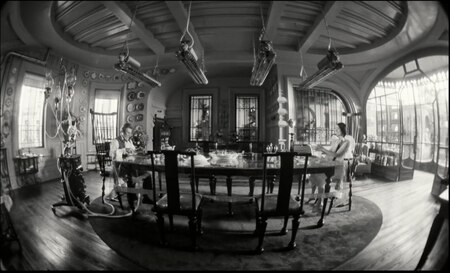
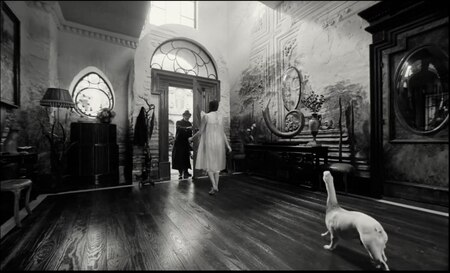
Dining room and entryway of Godwin Baxter’s house. Stills from the film «Poor Things,» directed by Yorgos Lanthimos, cinematography by Robbie Ryan, 2023
The collection of plates displayed on the wall symbolizes Baxter’s passion for collecting and systematizing objects. It also represents Bella to him—whether as a doll or as an experiment in his collection.By breaking objects, Bella disrupts not only the domestic order but also the system Baxter constructed for her.
Bella Baxter smashing dishes. A frame from the film «Poor Things,» directed by Yorgos Lanthimos, with cinematography by Robbie Ryan, 2023.
The interior is filled with objects, decorative details, and unusual forms. Despite its external richness, the space feels confined. The house functions as a metaphor for an artificially organized experience. Within it, one can study the surrounding objects, but one cannot grasp the structure of the external world.
Godwyn Baxter and Max lie on the soft floor. A still from the film Poor Things, directed by Yorgos Lanthimos, cinematography by Robbie Ryan, 2023.
The Baxter house living room resembles a vast playroom. The mattress-like soft flooring protects Bella, symbolizing an artificially created world where potential dangers have been eliminated. Bella is free to experiment, but only within the confines of the house itself. Baxter created a safe environment for Bella, yet he independently dictates the boundaries of her existence—a clear manifestation of both his care and his control.