This project is a student assignment from the School of Design. It is not a commercial piece and serves educational purposes.
«Emotion is conveyed not only through iconography; the colors themselves are imbued with expressiveness and pathos. […] The orchestration of the scene, the colors, and the interplay of light and shadow—everything is geared toward immersing the viewer in a state of reverent contemplation.» [1]
Most paintings are largely perceived by the public as merely a manifestation of the artist’s unique subject matter or a vehicle for conveying their creativity. However, the subject of the canvas is only the shell of what is transpiring inside. It depicts the «dialogue» between characters. In contrast, the softness of form, the direction of the gaze, the smooth transitions of light, or the choice of hues allow one to perceive how this is articulated. The use of pictorial techniques enables the viewer to feel the piercing intensity and tenderness of the image, filtering all the poetry through deep perception.
Any painting viewed by an engaged individual has the potential to prompt contemplation of its content. Yet, each piece possesses its own distinct character and conveys a specific message from the author. To evoke a particular atmosphere and the «aftertaste» of the work, the author also deliberates on the means of expression. Various painting techniques aid this process. But what might be special about them?
Titian Vecellio. Venus Urbina. Painting fragment. 1538. Uffizi Gallery, Florence.
I. Concept and Topic Selection
In this study, I am interested in how familiar hues, light, and other details can immerse a viewer in the depicted scene. The focus is not on the narrative, but on the work’s capacity for conveying and expressing mood. After all, the profound impression derived from what is seen on the canvas—the «quiet tenderness"—is not about a touching scene, but about a painterly mode of presentation created by a perceptive author. Within this research, «tenderness» is examined not as an everyday emotion or a sentimental characteristic of characters, but as an analytical category of visual perception. Here, «quiet tenderness» refers to a specific type of emotional expression created not through active action or narrative, but through formal artistic means: the softness of light transitions (sfumato), a muted color palette, compositional distance, and a frozen gesture. This concept serves as the study’s central hypothesis.The objective of my research is to examine each artistic technique individually in the works of 16th–17th-century painters, specifically how the softness of form, the transitions of light, and composition transform «tenderness» from a subjective feeling into an objective artistic device.The primary methodology employed is visual analysis: comparing the nature of the lighting, the coloristic decisions, and the techniques of material application.
Sensitivity doesn’t «shout» about itself; rather, it reveals itself through the viewer’s engagement with the artwork.
The basis of this research is the visual analysis of light, color, and emotional expressiveness in the works of 16th–17th-century artists. The material was primarily selected from the later works of these artists, where these techniques are particularly evident. The study is based on 16th–17th-century works held in the collections of the State Hermitage Museum, the Louvre, the Prado, the National Gallery of London, and the Uffizi. The work compares the lighting, coloristic, and compositional solutions of Leonardo da Vinci, Georges de La Tour, Rembrandt Harmenszoon van Rijn, Titian Vecelli, and Frans Hals.This specific period was chosen for study because the Renaissance, which swept across Europe, changed art forever. It was a long process, whose achievements formed the academic canons for the ideal depiction of the human body, space, and reality. However, perfection proved too monumental and universal. National schools developed in various European regions, each developing its own painting techniques within them. A noticeable development was that sensitivity no longer «shouts» about itself but manifested through the viewer’s engagement with the painting, utilizing specific painting techniques. For example, the soft gradations of light and shadow achieved through «sfumato”—a technique associated with Leonardo da Vinci—was used to smooth out forms and impart tenderness. Instead of the familiar scene, the master compels the viewer to feel distance and silence through deliberate and subtle techniques. As a result, painting schools developed in many countries during the 16th–17th centuries, which became benchmarks for subsequent generations of artists.
«…color and light themselves acquired an inspired character» [2].
Rembrandt Harmenszoon van Rijn. The Return of the Prodigal Son. Painting Fragment. c. 1668. State Hermitage Museum, St. Petersburg.
Navigation
The study is divided into five sections, three of which are dedicated to a specific pictorial technique that creates a «quiet tenderness»:I. Concept and Theme Selection II. Soft Light. Sfumato. Chiaroscuro III. Color Palette as a Vehicle for Emotional Expression IV. Texture and Brushwork: The Materiality of the Pictorial Surface V. Conclusion
II. Softness of Light. Sfumato. Chiaroscuro
In the latter half of the 15th and early 16th centuries, painting began to employ a new technique where the contour ceased to be a boundary, instead forming smooth transitions between light and shadow. This technique was named «sfumato.» Leonardo da Vinci introduced and theoretically justified the term. In his «Treatise on Painting,» he wrote that blurring allows objects to appear at a uniform distance, making them less ambiguous and doubtful. The same occurs with light and shadow. This effect is achieved by applying dozens of extremely thin glazes that are laid over each previously dried layer of paint [10]. When combined with soft, diffused light, this technique imparts vitality and sensuality to the figure.
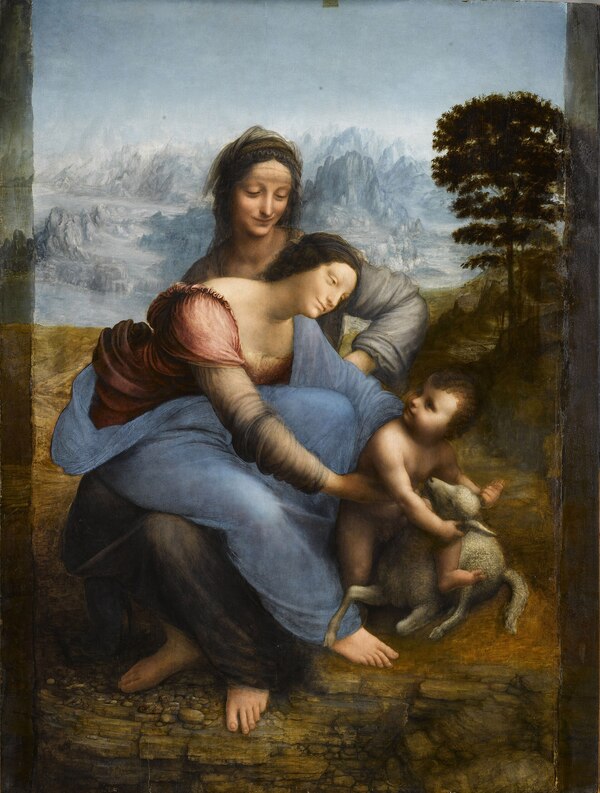
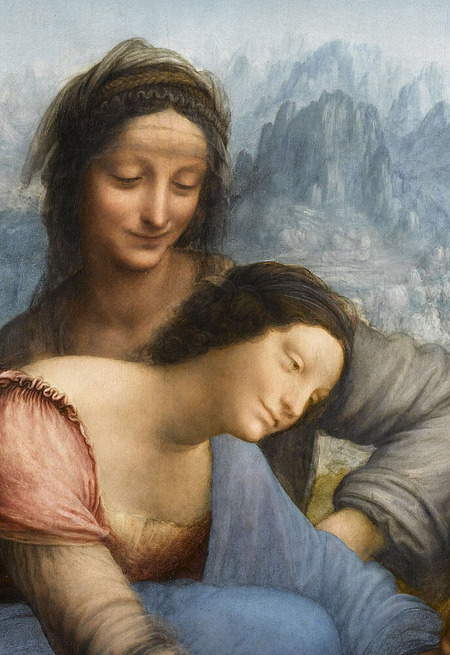
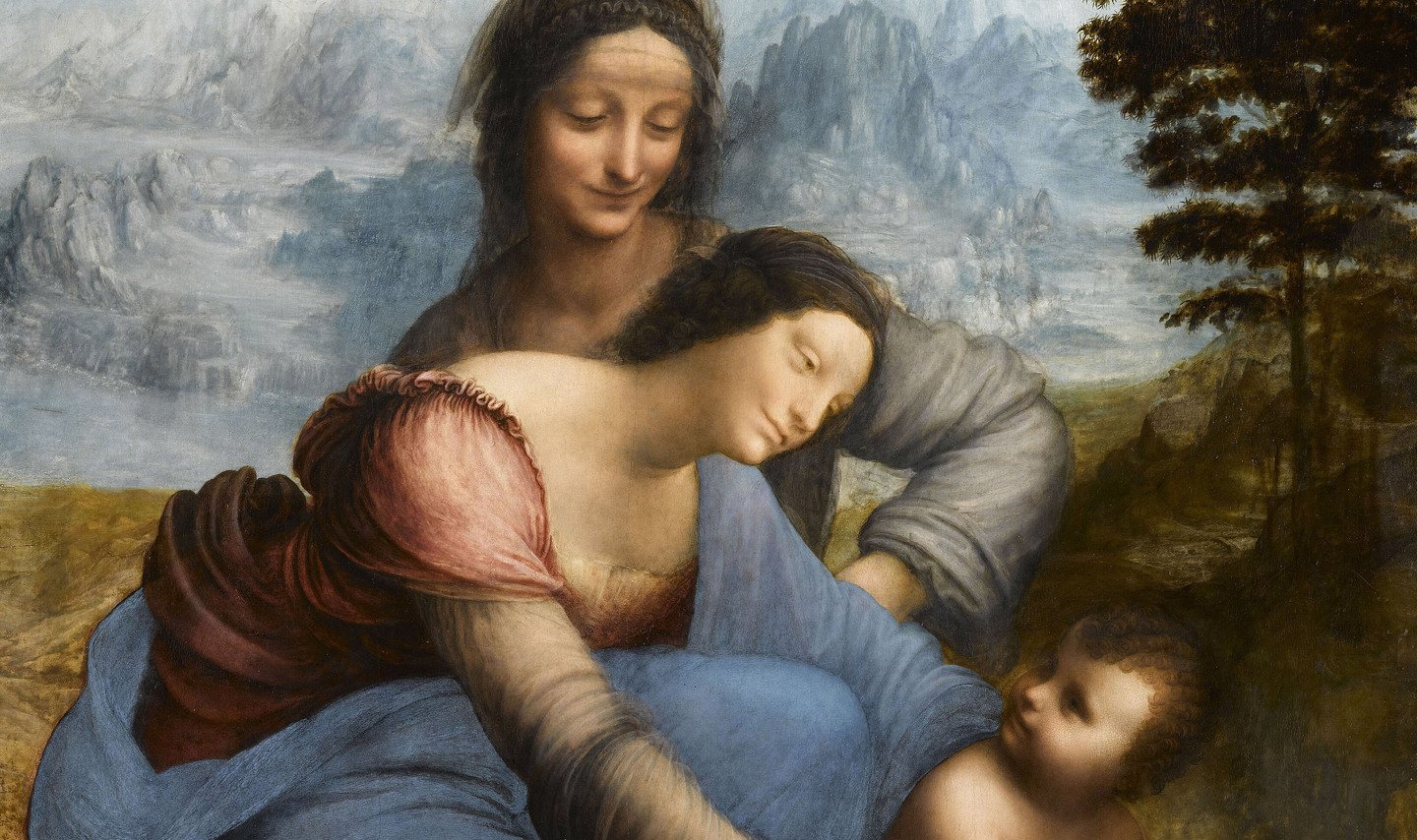
Leonardo da Vinci. Saint Anne with Mary and the infant Christ. Original and fragment. c. 1503–1519. Louvre, Paris.
To truly understand «sfumato, ” one should analyze it in the works of Leonardo da Vinci himself. „Saint Anne with the Virgin and Child Jesus“ (also known as „Virgin with Child and Saint Anne“ or „Seated Anne“) is an unfinished painting by Leonardo da Vinci from the late period of his career. In it, the artist depicts the Holy Family: Mary, Anne, and the infant Christ. Mary sits on her mother Anne’s lap, trying to hold the child who is reaching toward a lamb. In the painting, the lamb symbolizes Christ’s suffering. Compositionally, the work takes the form of a pyramid, which is characteristic of his style. In it, he demonstrated the softness of forms and the elegant curves of lines to convey the serenity of the scene.
«…Leonardo’s famous sfumato: that misty veil that envelops everything with a peculiar softness.» [3].
Leonardo da Vinci. Saint Anne with Mary and the infant Christ. Fragment of a painting. c. 1503–1519. Louvre, Paris.
Since this was one of his final works, his renowned «sfumato» technique was perfected. Using this technique, Leonardo da Vinci gave the painting a soft quality. He created a warm haze and dissolved the contours of the figures, making their faces appear as if they emanate a special tenderness and spiritual transformation. They were not static—a slight, barely perceptible mystery was hidden within them.«Sfumato» also conveys the softness of light. The transitions of light smoothly blur sharp contrasts on the canvas, enveloping the bodies and objects. The space becomes voluminous and «alive.» Thus, Leonardo da Vinci’s «sfumato» masks a moving and tender atmosphere, creating a sense of intimacy and the feeling of familial unity.
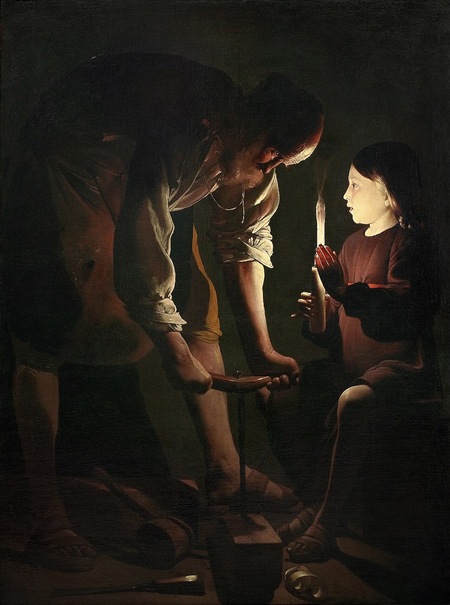
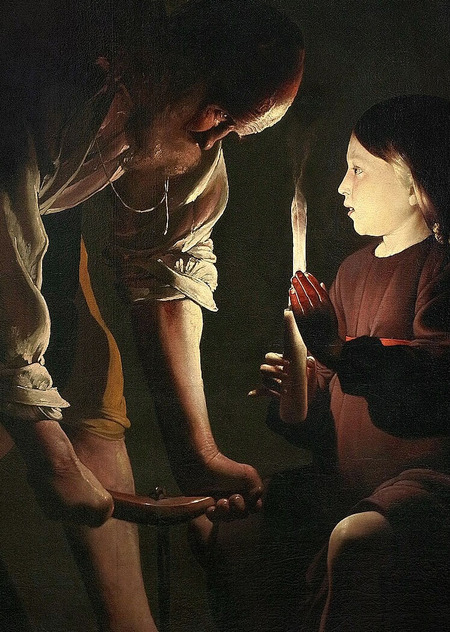
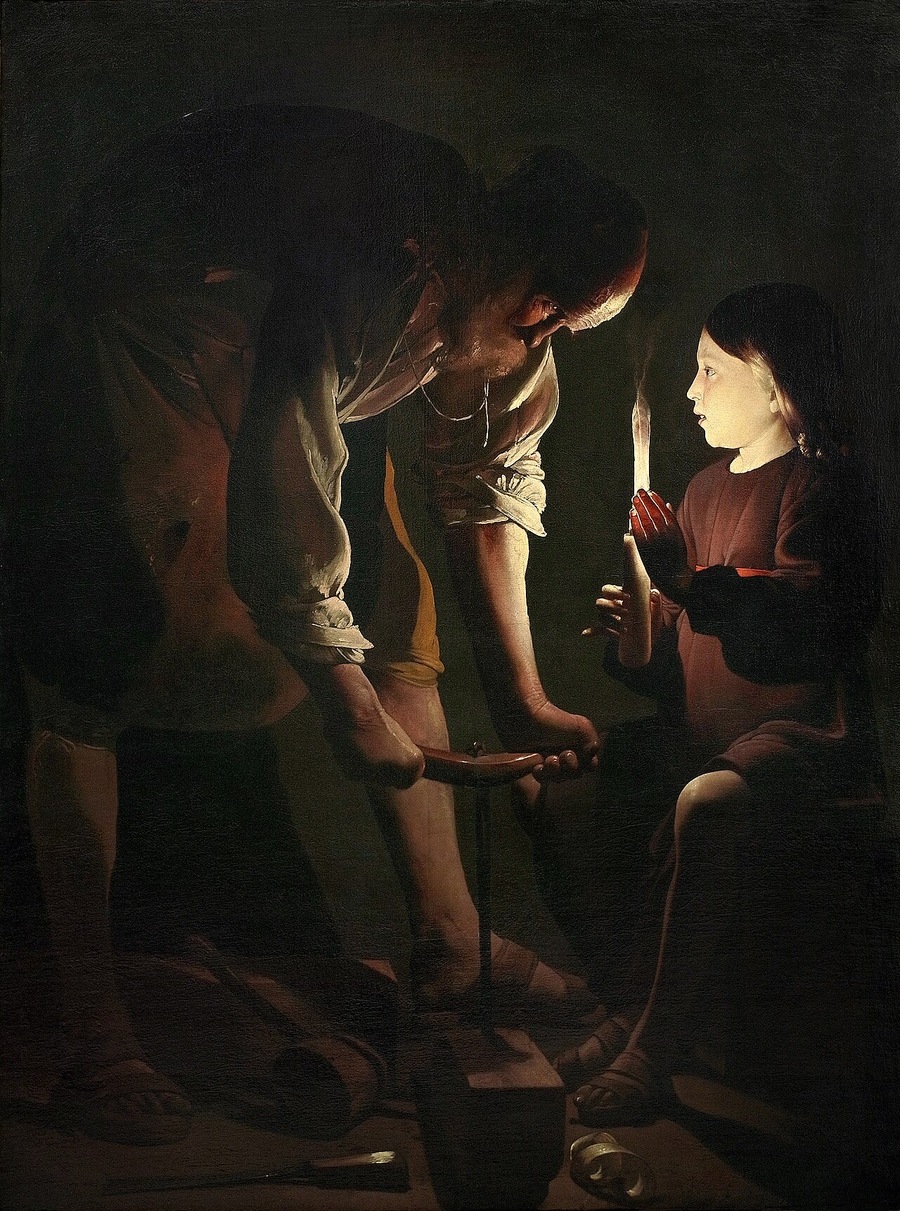
Georges de La Tour. Saint Joseph the Carpenter. Original and fragment of a painting. c. 1642. Louvre, Paris.
As light crafts an atmosphere, this is clearly visible in Georges de La Tour’s painting, «Saint Joseph the Carpenter.» The Louvre museum description calls this painting «one of Georges de La Tour’s most unforgettable images» [4]. It depicts a rare domestic scene from the life of Jesus Christ: his earthly father, Joseph, works in a carpentry shop, while the young Jesus sits nearby, holding a candle and covering it with his palm. They do not interact with each other; they merely gaze, engaging in a silent conversation. This painting also holds symbolic undertones. Joseph’s tool resembles a cross, and two wooden beams lying crossed on the floor visually frame the figure of the young Christ. This arrangement of details foreshadows the coming crucifixion of Christ, while Jesus himself sits humbly nearby, accepting his fate.
«The scene is silent and moving. The artist capitalizes on the dual contrast: on one side, the wrinkles of the old man, accentuated by the glancing light, are juxtaposed with the smooth, radiant skin of the child; on the other, the strong hands of the father gripping the tool stand next to the slender hands of his son, whose fingers appear almost translucent in the candlelight» [4].
Georges de La Tour. St. Joseph the Carpenter. Painting fragment. c. 1642. Louvre, Paris.
George de La Tour does not employ the sfumato effect as dramatically as Leonardo da Vinci. In this instance, the artist achieves the effect not through stark contrasts, but through the softness of the illumination—light becomes the primary technique here.A key objective of the work was to evoke an atmosphere of concentrated contemplation. The artist employs a dual contrast: on one hand, the wrinkles of the old man, highlighted by the grazing light, set against the smooth, radiant skin of the child; on the other hand, the father’s strong hands tightly gripping a tool, juxtaposed with his child’s delicate hands, whose fingers are almost translucent from the flame. La Tour deliberately conceals the light source, obscuring it with the child’s palm, thereby transforming the physical glow into a metaphysical phenomenon—the light does not enter the scene from the outside; rather, it is born from within the «heart» of the painting and the sacred moment itself. The light softly envelops Christ’s bowed head and Joseph’s hands, pulling the main details out of the darkness and creating an effect of reflected and diffused light. Through this technique, the artist succeeds in achieving a union of the earthly and the divine.
Section Summary:
Analysis of the reviewed paintings reveals how powerfully various techniques can convey the emotional expressiveness of a work. In the first case, sfumato blurs and veils the image to lend it a distinctive, ethereal softness. In the second, Georges de La Tour uses a single, strong light source as a central element to emphasize the depth of the everyday action, illuminating it with a divine glow. Despite the difference in technique application, the underlying principle remains the same—both approaches «capture souls» and «touch the hearts» of the viewers, thereby confirming the study’s hypothesis.
III. Color as a Vehicle for Emotional Expression
In 16th and 17th-century painting, color began to convey not just what was depicted in the artwork, but also emotions, drama, and the artist’s perspective on the subject matter. The tonal palette and color harmonies created a distinct emotional language that moved the viewer through the selection of hues, the use of associations, and the interplay of contrasts with the narrative. However, the key was not merely the presence of vibrant spots, but achieving a sense of unity and harmony within the overall composition. Among the artists who transformed color into atmosphere, Rembrandt and Titian stand out.
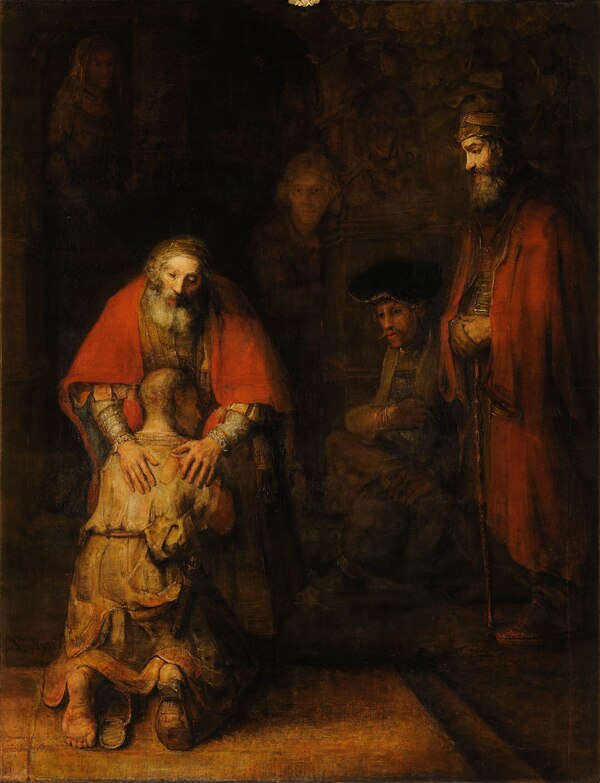
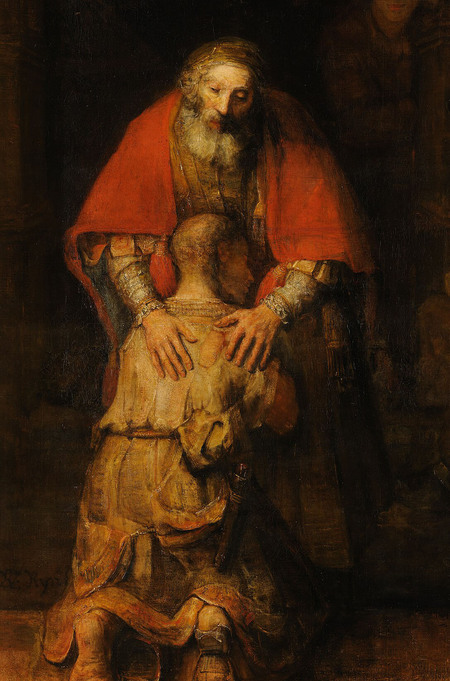
Rembrandt Harmenszoon van Rijn. The Return of the Prodigal Son. Original and fragment of the painting. c. 1668. State Hermitage Museum, Saint Petersburg.