Данный проект является учебной работой студента Школы дизайна или исследовательской работой преподавателя Школы дизайна. Данный проект не является коммерческим и служит образовательным целям
Проект принимает участие в конкурсе

1. Introduction

Since 2017, the Marmeladych brand has been delighting sweet-tooths across Russia with the freshest and most unusual marmalade, positioning itself as a creator of vibrant emotions and unique flavors.

Исходный размер 3840x1648

«Marmeladych» brand website

Marmeladich operates as a confectionery brand that behaves like an absurdist media outlet. Its persona is a deadpan expert with a chaotic alter ego — someone who knows every detail of marmalade production yet delivers that knowledge through tutorials on worm ear care. The brand rejects glossy food industry aesthetics in favour of raw factory confessionals, worker diaries, and public admissions of failure framed as comedy. The founder speaks not as a distant CEO but as a transparent, slightly unhinged narrator who tells you exactly how many packets were affected by an error, calls defective products names no legal department would approve, and then invites you to help fix the problem. This constructs radical intimacy: the audience is not marketed to; the audience is let in.

The brand speaks to a  young, digitally native generation — Generation Alpha and younger Gen Z, roughly 10 to 25 years old — for whom a brand’s willingness to embarrass itself publicly reads as the only acceptable way to communicate. These consumers grew up on YouTube, TikTok, and Telegram, developed near-total immunity to traditional advertising before their teens, and detect fake brand voices within seconds. They respond to layered, chaotic comedy that does not explain the joke and value transparency as a baseline expectation: if a brand is not showing the factory floor and admitting mistakes, it is hiding something. The sheer strangeness of the content — worm care guides, chili bear manhunts, pea soup holidays — functions as a discovery mechanism, pulling in viewers who click from curiosity and stay because they have never seen a brand talk to them like this.
Исходный размер 3840x1648

Project objective: To analyze how Marmeladych uses modern communication channels (in particular, vertical videos on social media) to create meaning, build a loyal community, and persuade consumers.

2. Communication Channels

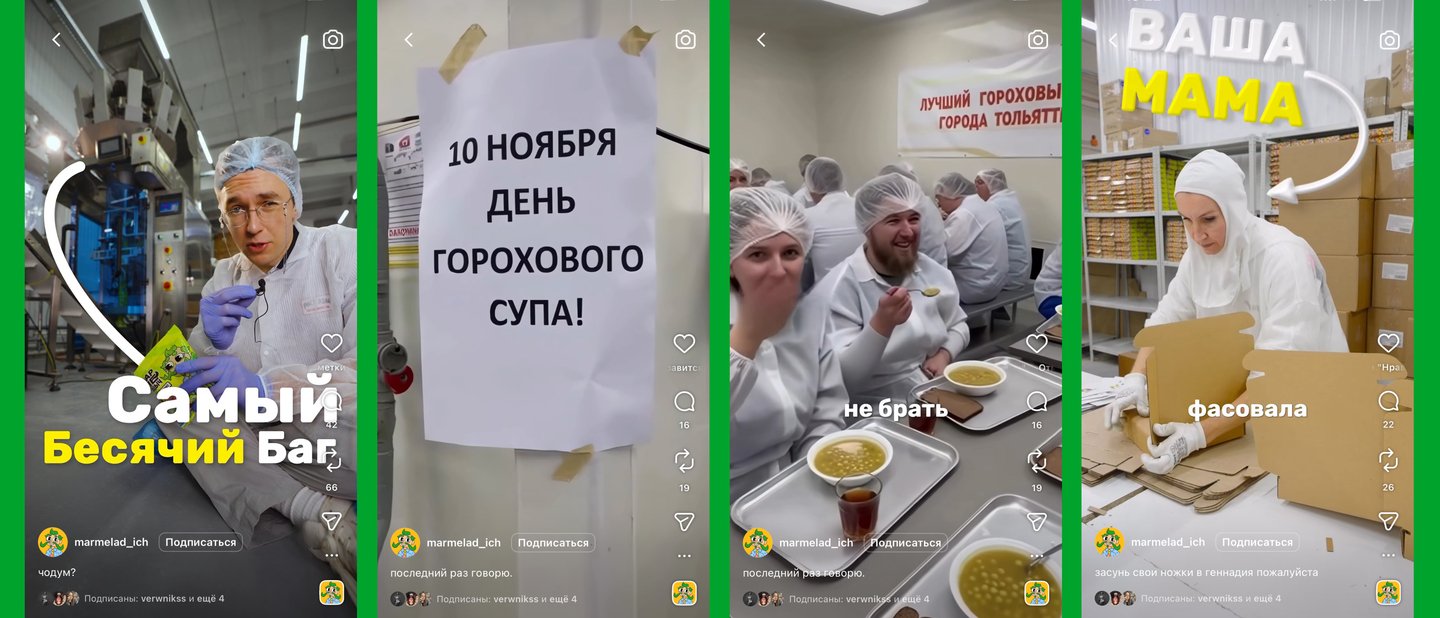
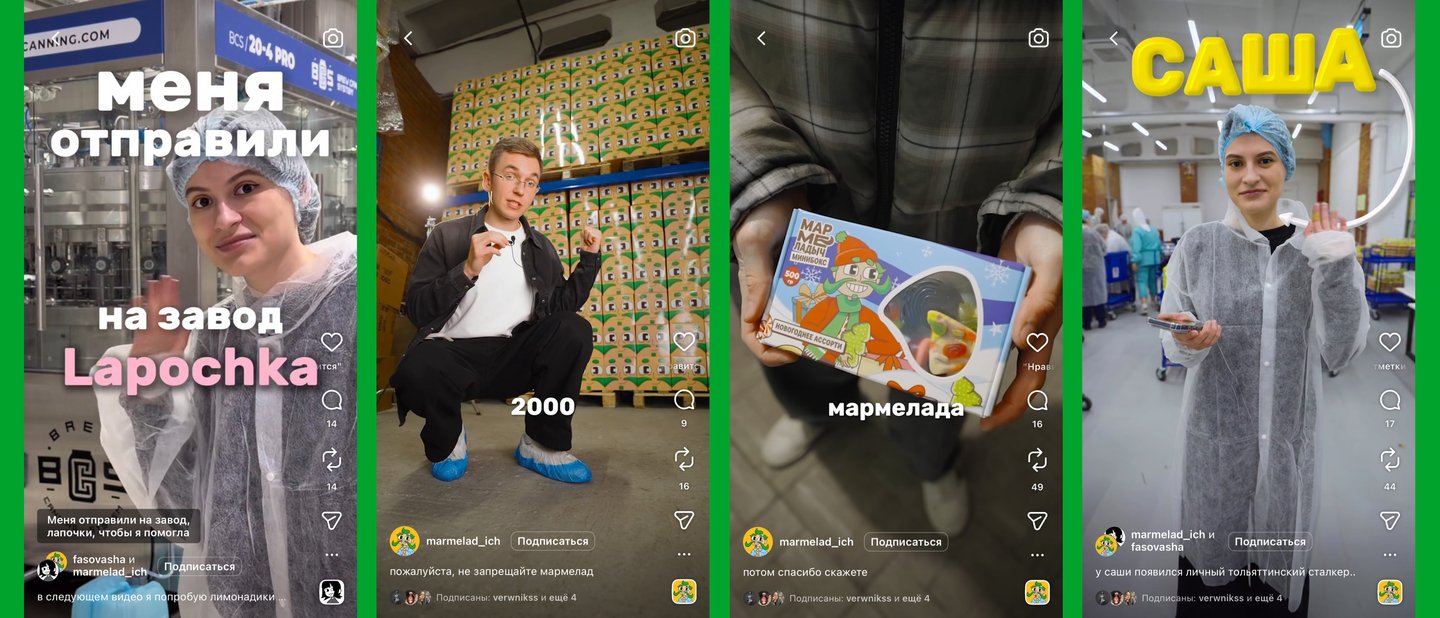
The brand’s website is a place to place orders and browse its product range. But the brand also finds its customers through social media. The strategic focus is on vertical video: Reels, VK Clips, YouTube Shorts, and TikTok.

Исходный размер 2880x1236

Social medias

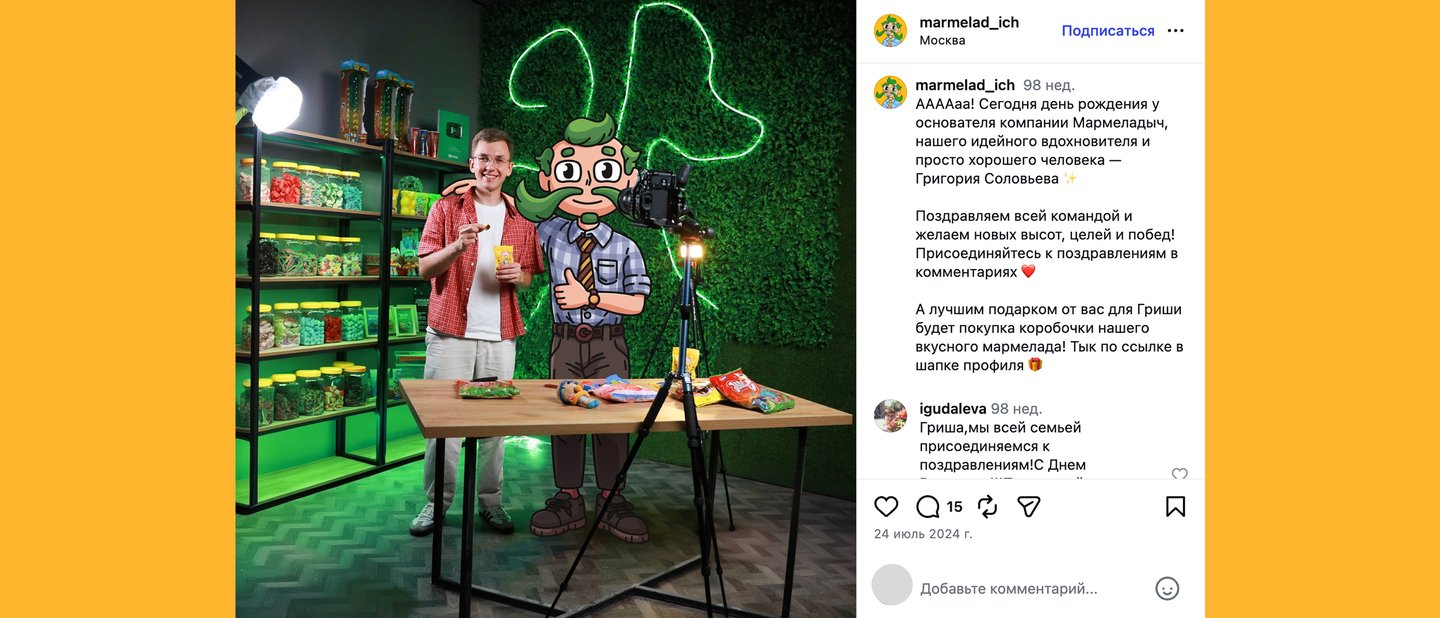
  1. Social media posts: an endless feedback loop. Social media algorithms demand constant engagement, and likes, comments, and reposts provide instant feedback to the brand. Marmeladych sees which videos are popular (for example, unboxing a new sour filling) and immediately adapts the content. What was initially just advertising often transforms into user-generated content when people start making their own reviews.
Исходный размер 3840x1648

Comments on Instagram*

  1. Marketplaces(Wildberries, Ozon) and product cards on the website. Infographics use bright colors, large fonts, and icons like «European marmalade» or «halal» are instantly readable, creating the desired impression even before reading the text.
Исходный размер 3840x1648

Marketplace Ozon

  1. Telegram channel.Here, Marmeladych creates dramatizing messages—life-related memes, and «recognized yourself» situations (for example, «that friend who always steals your marmalade»). The brand ceases to be just «food» and becomes a marker of belonging to a fun, modern community of sweet-toothed people.
Исходный размер 3840x1648

Telegram channel

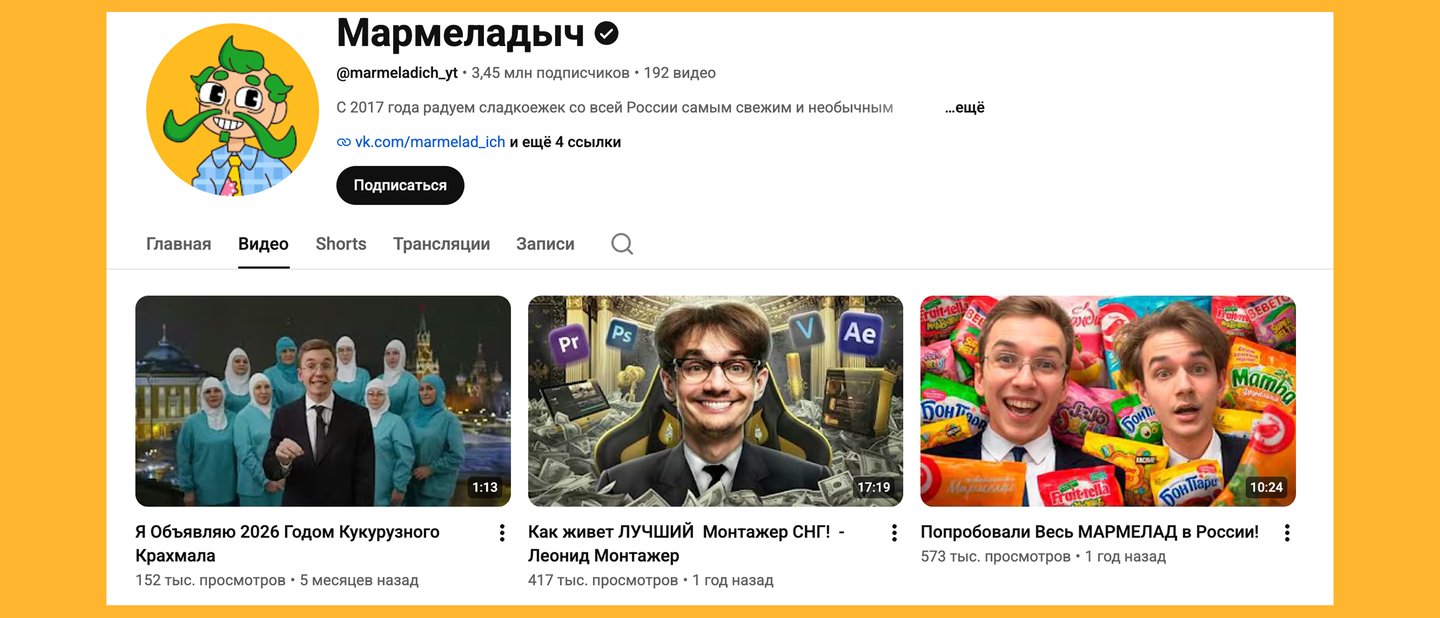
  1. Long-format videos(YouTube videos, founder interviews, podcasts). While short videos convey emotion, long-form videos convey meaning. These reach a more engaged audience, where the brand reveals the «inner workings» of its products, discussing the development of new flavors, the eco-friendliness of its packaging, or the company’s history. This builds expertise and trust, proving that behind the flashy packaging lies a high-quality, well-thought-out product.

0

YouTube videos

0

Reels on Instagram*

Why does the vertical format work? The vertical video format itself is a sign of sincerity, mobility, and an insider’s perspective. Marmeladych exploits this quirk: their videos are often shot in a first-person perspective, as if they were recorded not by a professional cameraman, but by a fellow consumer on a phone. This creates a phenomenological effect: the viewer literally experiences the experience of eating marmalade along with the video’s creator, becoming a participant in the process.

3. Theoretical Framework

To analyse Marmeladich’s communication strategy, this study draws upon two theories from the course: Uses and Gratifications Theory (UGT) and Elaboration Likelihood Model (ELM).

Uses and Gratifications Theory (UGT), developed by Elihu Katz, Jay Blumler, and Michael Gurevitch, assumes that audiences are not passive consumers, but active participants who deliberately choose media to satisfy specific needs. People use media for Diversion (escape from routine), Personal Relationships (social utility), Personal Identity (value reinforcement), and Surveillance (information). In Marmeladich’s communication, this means the brand shifts its focus from merely fulfilling a rational, utilitarian need — buying marmalade, which falls under Surveillance — to satisfying deep emotional needs. The brand’s social media platforms are designed primarily for Diversion and Personal Identity — users intentionally visit their channels for absurdist comedy, emotional release, and to reinforce their self-image as people who value honesty and reject corporate fakery, rather than to make an immediate purchase.

Elaboration Likelihood Model (ELM), developed by Richard Petty and John Cacioppo, explains how people process persuasive messages through two distinct routes. The central route involves careful evaluation of arguments, facts, and evidence — producing attitudes that are stable, resistant, and predictive of behaviour. The peripheral route relies on emotional cues, humour, surprise, and source likeability — capturing attention when motivation or ability to process deeply is low. For Marmeladich, this dual-route strategy unfolds by embedding genuine production expertise — specific temperatures, complaint statistics, error disclosures — within an emotional wrapper of deadpan absurdist narration and a signature trash-montage finale. The brand does not separate information from entertainment. It uses the peripheral route as a delivery vehicle that ensures central arguments are attended to, processed, and remembered. A viewer comes for the worm videos and the glitch effects, but stays for the verifiable data and the transparent production stories. The result is a unique persuasion architecture: durable trust, built through comedy.

Исходный размер 3794x1444

website banner

4.1. UGT Analysis

Uses and Gratifications Theory (UGT), developed by Elihu Katz, Jay Blumler, and Michael Gurevitch, assumes that audiences are active participants who deliberately choose media to satisfy specific needs: Diversion (escape from routine), Personal Relationships (social utility), Personal Identity (value reinforcement), and Surveillance (information). A traditional confectionery brand satisfies only Surveillance — a user checks a price and leaves. Marmeladich has broken this pattern entirely, transforming a utilitarian product into a daily content destination that satisfies all four needs at once.

Исходный размер 1080x608

vertical video

As for Diversion, Marmeladich provides a complete departure from reality. Users subscribe to laugh, not to shop. The video «A short guide to caring for your giant worm» has nothing to do with marmalade. The brand delivers a deadpan tutorial on cleaning a fictional pet worm’s ears with a soldering iron — ear canals grow over quickly, the narrator explains, so do not hesitate to work the tool thoroughly, then add a satisfied well, delicious. The viewer is then instructed to locate skin imperfections and very gently eliminate them — the yellow ones, by the way, are the tastiest — before giving the worm a warm bath and applying facial moisturiser. There is no price, no promotion, no call to purchase. The serious instructional tone applied to utterly absurd content creates a cognitive gap bridged by laughter. The signature trash-montage finale provides the emotional payoff. The brand understands that the current content landscape is saturated with predictable advertising, so it offers a radically different space governed by absurdist logic. Users come for escape and leave having received exactly what they came for.

Исходный размер 1080x608

vertical video

Regarding Personal Relationships, Marmeladich’s content is engineered to be shared and to build genuine community. The video «I hired our subscriber — a schoolboy — to fight hate» illustrates this perfectly. The founder announces that he has given a job to a real subscriber, a schoolboy whose parents forbade showing his face because soon some of you will probably hate him. This is Snack Ronaldo, the ruthless Telegram admin who has spent half a year deleting negativity and who permanently bans Chupa-Chups fans, especially those who support Messi. The brand elevates an actual follower into its narrative, promoting him to head of the newly created department of resistance to nasty things and slander. When a reviewer claims the sour marmalade is not sour enough, Ronaldo will politely explain that sourness perception is subjective and depends on taste bud sensitivity. And then the founder draws a careful line: do not confuse Ronaldo’s personal account with the support team — there, real diplomats work, always ready to peacefully help with any problem, even if you are from the labour inspectorate. This distinction between playful community combat and genuine customer care shows the audience the brand understands the rules of its own game. The Snack Ronaldo mythology becomes social currency: a reference only insiders understand, a character discussed in comments, a story forwarded to friends.

Исходный размер 1080x608

vertical video

As for Personal Identity, Marmeladich creates content that allows viewers to affirm their own values. The video «Do not order lickerish marmalade until you know this» actively discourages uninformed purchases. The founder warns that only five out of a hundred marmalade lovers actually enjoy lickerish — and your mom does not count. He then provides a practical test: go to a pharmacy, buy licorice root cough syrup, and try a spoonful. If after tasting it you smiled and wanted to drink the whole bottle, go ahead and order. But if you ignore this advice and dislike the marmalade anyway, do not leave a one-star review on Wildberries. And then the key line: lickerish is what it is. And that is all that it is. This is not merely a punchline. It is an ethos of acceptance over complaint, of honesty over fake corporate politeness. The viewer who agrees reinforces their identity: I am not the kind of person who leaves unfair reviews. I value directness. I am Marmeladich’s kind of person. Following the brand becomes a marker of cultural belonging defined by shared sensibilities rather than demographics.

Исходный размер 1080x608

vertical video

Concerning Surveillance, Marmeladich embeds genuine business data within its entertainment. The video «Our marmalade is coming to all Magnit stores — or I go bankrupt» delivers unusually transparent disclosure. The founder reveals that for twenty thousand stores they have packed over eighty tons of sour marmalade, into which he has invested roughly all the money of the entire company. He then lays out the existential risk: if customers do not buy at least one packet per day, Magnit will throw them out without the right to return, and the brand will forever remain a pathetic loser without its own production, having failed to compete even with Chupa-Chups, quietly sliding into failure. The viewer learns specific, verifiable figures and the precise consequence of failure. This is not vague marketing language but real business disclosure delivered as a personal confession. The viewer is not a target market segment; the viewer is a trusted confidant. Information creates emotional investment, and emotional investment builds durable loyalty.

4.2. ELM Analysis

The Elaboration Likelihood Model (ELM), developed by Richard Petty and John Cacioppo, distinguishes between two routes to persuasion. The central route involves careful evaluation of arguments, facts, and evidence — producing durable, resistant attitudes. The peripheral route relies on emotional cues, humour, surprise, and source likeability — capturing attention when motivation or ability to process deeply is low. Marmeladich’s video content follows a consistent dual-route formula: every video embeds genuine expertise within an emotional wrapper of absurdist humour and a signature trash-montage finale. The peripheral route does not replace the central route. It functions as the delivery vehicle that ensures central arguments are attended to, processed, and remembered.

Исходный размер 3840x1476

vertical video

The founder opens by calling himself stupid and dismissing the entire category of holiday-themed confectionery as cringy nonsense — heart-shaped candies in festive packaging are, in his view, just deeply embarrassing. The central route then evaluates what he offers instead: a QR code on existing packets leading to five hundred free tulip bouquets, claimable on March 8th at 8 a.m., first come first served. The offer is concrete — seven tulips, specific quantity, clear deadline. The viewer processes this rationally: a real bouquet is arguably more valuable than a heart-shaped marmalade that even the seller admits is a tired formula. The peripheral cue is the self-deprecation itself. A CEO publicly confessing incompetence and using teenage slang signals authenticity, not weakness. The positive affect transfers to the brand, making the tulips feel like a genuine personal gesture rather than a calculated marketing pivot.

Исходный размер 1080x608

vertical video

The brand identifies a specific production problem — sour sugar particles from one variety contaminating sweet marmalades during transport — and walks the viewer through the engineering solution: smaller boxes for tighter packing, plus separate mixing and packing of sugared and non-sugared mixes. Then comes the central route payload: complaints dropped from eighty-two to eleven per week, and as the founder adds, you can verify this yourself by searching the brand on any marketplace. The claim becomes falsifiable. The viewer does not need faith; the viewer can check. At the same time, the peripheral route operates through emotional language. The contamination is not described in neutral terms. It is a disgusting rash, a damned rash, caused by that sour little sugar a diminutive that contrasts absurdly with the damage it does. The emotional wrapper makes the data vivid without changing its factual content. The viewer laughs, cringes, and remembers the numbers.

Исходный размер 1080x608

vertical video

The central route is activated through technical granularity. The viewer learns an exact operational parameter: marmalade bears must be cooled to fifteen degrees Celsius overnight. If not, the bears will stick to the packing machine walls — the turtles, as factory slang has it, will cling to the station — destroying the weighing sensors and leading to mass rejection of packets. Given the insane sales volumes, the founder warns, any downtime will cost the company dearly. These are not generic quality slogans. They are details only someone running a real production line would know. The peripheral cue arrives at the very end, when the founder abruptly pivots: by the way, November 10th is pea soup day at the factory, do not bring lunch, the best pea soup in the city will be served. This has zero rational connection to freezer protocols. It exists purely to generate warmth, surprise, and a sense of insider belonging. Technical competence and human absurdity, side by side.

Исходный размер 1080x608

vertical video

The central route is activated through a detailed, rule-based explanation of operational standards. The viewer learns exactly which marmalade varieties are banned from customer packs and the specific reasons for each prohibition. Finnish strips, though the most sour, turn into damned mush upon contact with sweet varieties. Beans taste fine, but their glaze coating reads as too hard against the softer textures of the rest of the box. Piglets in a bath — well, the founder suggests you can guess why the Spanish once again made marmalade that is technically halal in composition but shaped in a way that is… and then the video cuts. The list is not arbitrary. Each entry carries a precise, production-level justification. For a viewer processing centrally, this is a signal of genuine quality control: the brand has thought through the interactions between different marmalade types and enforces standards that prioritise the customer’s experience.

The peripheral cues operate through the language in which these rules are delivered. The strips do not degrade — they turn into damned mush. The discovery of a banned item at the inspection stage triggers a protocol where the senior shift supervisor pays the entire team out of pocket to hunt down and eliminate the bastards from the whole rejected batch. The word choice — bastards, applied to pieces of marmalade — transforms an internal quality control document into a revenge narrative. The viewer laughs at the absurdity of marmalade piglets being treated as contraband. Resistance drops. The central message — this brand has rigorous, specific, enforced standards — is absorbed without the viewer ever feeling lectured.

5. Evaluation of effectiveness and recommendations

Recommendation 1: Make the Product the Punchline, Not Just the Afterthought

Right now, the brand’s content world and its actual product exist as friendly neighbours rather than housemates. You can watch ten videos and forget that the company sells something you can put in a basket. This is partly by design — the lack of sales pressure is what makes the content feel safe — but it leaves a gap. A viewer can be a fan for months without ever crossing the line into becoming a customer, simply because the content never asks them to.

The fix is not to add calls to action. It is to make the marmalade itself a character in the absurdist universe the brand has already built. If the factory floor, the packers, the founder, the worm, and the schoolboy admin are all part of the show, why is the product always the quiet one in the corner? A limited batch of a flavour that was «a mistake, honestly, we got the acidity wrong, it is weird and probably not for everyone, here is a link» fits the brand voice perfectly and turns the purchase into a continuation of the story rather than a departure from it.

Recommendation 2: Systematise the Truth-Telling

Marmeladich has built significant trust on the back of transparency — real complaint numbers, real production failures, real financial stakes shared publicly. The risk is that this transparency currently lives inside individual videos, scattered across the feed. A viewer who discovers the brand today has no easy way to find the evidence that long-time followers already absorbed.

A dedicated, permanently accessible space — a pinned story, a series of highlights, a «proof page» — that collects the verifiable claims the brand has made over time would do two things. First, it would reward sceptical newcomers who want to check whether the brand is actually honest or just performing honesty for engagement. Second, it would protect the central-route credibility the brand has already earned, ensuring that as the content universe gets weirder and more absurd, the underlying argument — «we are real, we are competent, and here is the data» — remains visible and unmissable.

6. Conclusion

Marmeladich has solved a problem most brands do not even realise they have. A packet of marmalade is, by its nature, a forgettable purchase — something you grab at the checkout or scroll past online without a second thought. The brand’s response to this reality was not to shout louder or discount deeper. It was to build an entirely different relationship, one in which the purchase is almost incidental to the connection.

Through the Uses and Gratifications framework, we can see that the brand keeps its audience close by serving needs that have nothing to do with hunger: the need to laugh at something genuinely unexpected, the need to feel like an insider in a world that feels real, the need to have one’s scepticism toward corporate language reflected back with a wink. Through the Elaboration Likelihood Model, we can see that this closeness is not fragile. It is backed by information that can be checked, numbers that can be verified, and admissions that most companies would bury. The jokes open the door. The evidence locks it in place.

The risk ahead is not that the brand runs out of ideas. It is that the balance between the absurd and the verifiable tilts too far in one direction — all worm, no proof, or all data, no chaos. If Marmeladich can keep those two forces in tension, it will not only keep its audience watching. It will keep them believing. And for a brand that sells something as simple as fruit jelly, that is a genuinely remarkable achievement.

Библиография
1.

Официальный сайт бренда «Мармеладыч». — URL: https://marmeladich.ru/ (дата обращения: 13.06.2026).

2.

Forbes.ru. Как 23-летний парень выручил 500 млн рублей на мармеладе и стал звездой соцсетей [Электронный ресурс]. — URL: https://www.forbes.ru/svoi-biznes/528225-kak-23-letnij-paren-vyrucil-500-mln-rublej-na-marmelade-i-stal-zvezdoj-socsetej (дата обращения: 13.06.2026).

3.

Tochka.com. «Продукт вторичен, он монетизирует сторителлинг». Григорий Соловьёв о том, как продавать дороже рынка за счёт контента [Электронный ресурс]. — URL: https://allo.tochka.com/marmeladych-tok (дата обращения: 14.06.2026).

Источники изображений
1.

Marmeladich [Официальный сайт]. — URL: https://marmeladich.ru/ (дата обращения: 13.06.2026).

2.

Marmeladich [Сообщество в Instagram*]. — URL: https://www.instagram.com/marmelad_ich/ (дата обращения: 13.06.2026).

3.

Marmeladich [Видеоканал на YouTube]. — URL: https://www.youtube.com/channel/UCKJb65T9g6BJwJTeiSAG2kA (дата обращения: 13.06.2026).

4.

Marmeladich [Сообщество в Telegram]. — URL: https://t.me/marmeladich_ru (дата обращения: 13.06.2026).

5.

Marmeladich [Сообщество в VK]. — URL: https://vk.com/marmelad_ich (дата обращения: 13.06.2026).

6.

Marmeladich [Сообщество в TikTok]. — URL: https://www.tiktok.com/@marmelad_ich (дата обращения: 13.06.2026).

7.

Marmeladich [Карточка продавца на Wildberries]. — URL: https://www.wildberries.ru/catalog/0/search.aspx?search=%D0%BC%D0%B0%D1%80%D0%BC%D0%B5%D0%BB%D0%B0%D0%B4%D1%8B%D1%87 (дата обращения: 13.06.2026).

8.9.

Marmeladich [Продавец на Ozon]. — URL: https://www.ozon.ru/seller/marmeladych/ (дата обращения: 13.06.2026).

10.

Marmeladich [Видеозапись на YouTube]. — URL: https://www.youtube.com/watch?v=LUBk1jR5M4E (дата обращения: 13.06.2026).

11.

Marmeladich [Видеоканал на YouTube (плейлисты/видео)]. — URL: https://www.youtube.com/@marmeladich_yt/videos (дата обращения: 13.06.2026).

12.

Marmeladich [Reel в Instagram*]. — URL: https://www.instagram.com/reel/CsbNroELHDR/?igsh=MWpvbTJjbXo1OGNjOQ== (дата обращения: 13.06.2026).

13.

Marmeladich [Reel в Instagram*]. — URL: https://www.instagram.com/reel/DZRrhtGMhY9/?igsh=MTByMzNzNnBpYTYzcw== (дата обращения: 13.06.2026).

14.

Marmeladich [Reel в Instagram*]. — URL: https://www.instagram.com/reel/DVim8vHDPCc/?igsh=bzgwMjg3eTMwNGs1 (дата обращения: 13.06.2026).

15.

Marmeladich [Reel в Instagram*]. — URL: https://www.instagram.com/reel/DOvVBJEDMgS/?igsh=MW83Y2xxOW5qNXczMw== (дата обращения: 13.06.2026).

16.

Marmeladich [Reel в Instagram*]. — URL: https://www.instagram.com/reel/DQ1DUF5jMxm/?igsh=MWVjNHFmMGdpd2R6eA== (дата обращения: 13.06.2026).

17.

Marmeladich [Reel в Instagram*]. — URL: https://www.instagram.com/reel/DNV1SATMb4F/?igsh=MWpybHJobXBzano4Mw== (дата обращения: 13.06.2026).

18.

Marmeladich [Reel в Instagram*]. — URL: https://www.instagram.com/reel/DIoOJoBgfHW/?igsh=NmloNmpyNW5zaThr (дата обращения: 13.06.2026).

19.

Marmeladich [Reel в Instagram*]. — URL: https://www.instagram.com/reel/DOayxmGjBzT/?igsh=dXpzemh5NWp3aGh5 (дата обращения: 13.06.2026).

20.

*Instagram принадлежит компании Meta, которая признана экстремистской и запрещена на территории Российской Федерации.