Concept
At the heart of every issue is a familiar item and a specific situation. How to style a white shirt for class and then meet friends in the evening? What to wear instead of a blazer when it’s not in your closet? How to bring a skirt, usually reserved for special occasions, back into your everyday rotation?
Each breakdown follows a specific logic. First, we present an item, then suggest several combinations and explain how the look changes—whether it’s a new layer, different shoes, altered proportions, or a different way to tuck in a shirt. Finally, we offer an alternative suggestion so the idea can be replicated with your own wardrobe.
Editorial System. In the «One Item» section, we create several outfits built around a single piece. In «Combinations, ” we explain how color, texture, and proportion work together. „Substitutions“ helps adapt an outfit to your existing closet, „Back in Action“ brings seldom-used items back into circulation, and „Detail“ showcases the impact of a single change. The „Your Closet“ section uses the reader’s personal wardrobe as a starting point.
Platforms. On VKontakte, the difference between outfits is shown through cards or short videos. On Pinterest, individual looks are collected into a visual archive based on specific items and situations.
Data Sources
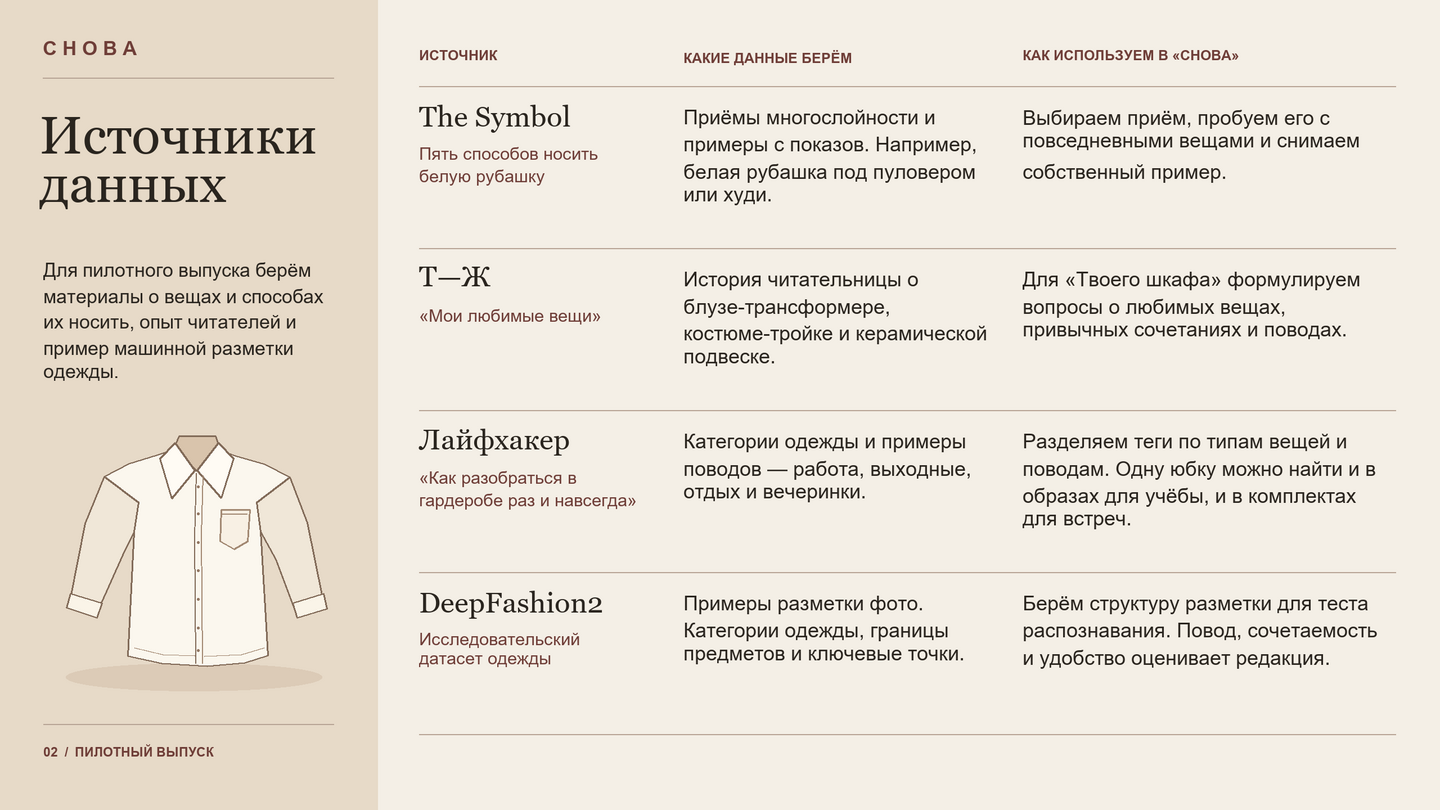
Your personal data will emerge during the media production process. For «Your Wardrobe, ” this includes photos of items, a clothing inventory, occasions, and participants’ preferences. Once the materials are published, they will be supplemented with survey responses, comments, and available publication statistics. External photos will remain as references until the editorial team separately verifies their publication viability.
Data Schema
At the editorial desk entrance, there is a reference point, a question for the issue, and a list of items. The automation system organizes the source data into cards, suggests tags, prepares draft combinations, and adapts the approved material for various platforms. The editor reviews the data and image permissions, evaluates the combinations during proofing, selects viable options, and approves the final versions.
Alumni Showcase
Starting Data. In the analysis for The Symbol edition, the editorial team notes the «shirt under a pullover» styling trick. For the demonstration issue, we establish a list of items—a white shirt, a gray pullover, straight jeans, a dark midi skirt, sneakers, and loafers.Service Draft. For class, the service suggests pairing the shirt with the pullover, jeans, and sneakers. For an evening gathering—tuck in the same shirt with the midi skirt and swap the sneakers for loafers. In the first look, the shirt collar becomes a visible detail of the layered ensemble. In the second, the tucked-in shirt emphasizes the waistline, and changing the footwear makes the outfit feel more put-together.Editor’s Solution. During the fitting, the editor checks whether the collar is visible from under the pullover and if the shirt is comfortable when tucked in. They then select angles for the photoshoot and add an alternative from the same list. For example, in the second look, the skirt could be swapped for straight jeans, keeping the shirt tucked in and retaining the loafers.Final Output. A post featuring both outfits and an explanation is published on Telegram. On VKontakte, there are cards showcasing the change in layer, bottom, and shoes. On Pinterest, there are separate cards captioned «White Shirt for Class» and «White Shirt for an Evening Out.»
Guidelines for Automated Services
Final OutfitThe white shirt you already own. For classes — pair it with a gray pullover, straight-leg jeans, and sneakers. Leave the collar and cuffs visible so the shirt reads as a distinct layer. For meetings — tuck the shirt into a dark midi skirt and wear loafers. If you don’t have a skirt, keep the straight-leg jeans and just change the shoes and how you wear the shirt.