Navigation
(1) Concept (2) Early recordings and rock lineups without a guitarist (3) Keyboards in rock—from organ trios to piano ballads (4) Saxophone in jazz-rock and rock trios (5) Bass as a lead instrument in rock duos (6) Conclusion
Concept
In a rock band, the electric guitar often performs multiple functions. It carries the main melody, sets the rhythm, or supports the tune with chords. When the band doesn’t have a guitarist, other instruments take on these roles. This made me curious about how their combination changes the structure of the song and the band’s overall sound.
In Royal Blood, the bass simultaneously handles the low end and drives the riff. Mike Kerr explains that he boosts a portion of the bass signal an octave, achieving a sound close to that of an electric guitar.¹ In Keane’s «Somewhere Only We Know,» the piano takes on the rhythmic role of the guitar. Tim Rice-Oxley describes how the piano part dictates the song’s movement.²
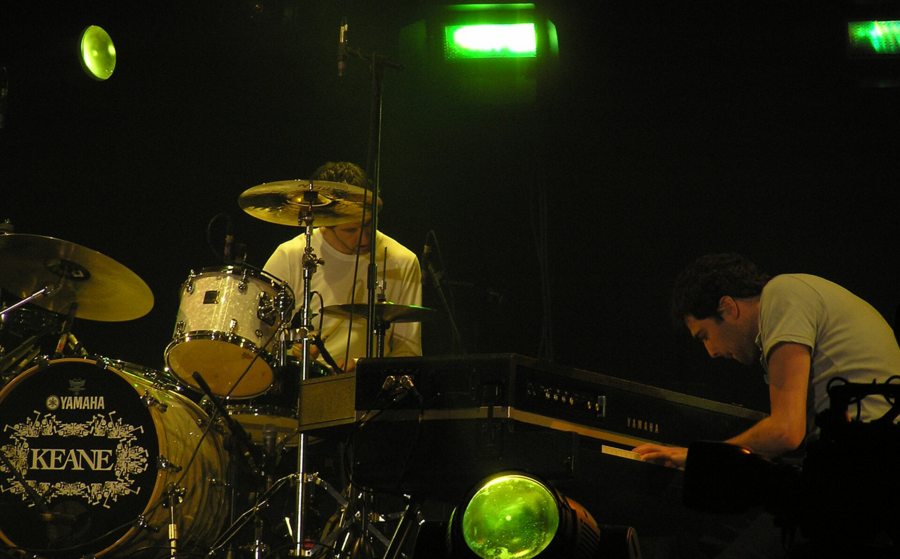
Tim Rice-Oxley on keys and Richard Hughes on drums. Keane at a concert in Cardiff, 2005.
Research Question
How are melody, rhythm, and harmonic accompaniment distributed in rock bands without a guitarist, and how does this distribution change across recordings from different decades?
The Hypothesis is that even with similar instrumentation, various solutions are possible. In some recordings, a single instrument combines multiple functions, while in others, the musicians distribute these roles among different parts. This hypothesis can be tested using specific excerpts to trace how the roles of the instruments evolve throughout the composition.
The main selection includes twelve compositions, two from each group. Three pairs allow for a comparison of similar instrumental arrangements in different musical contexts. Recordings by Ben Folds Five and Keane enable a comparison of two distinct approaches to building a song around the piano. In the compositions Death From Above 1979 and Royal Blood, attention is paid to how the bass drives the riff and the role processing plays in the density of the sound. Comparing Morphine and Trioscapes allows for an examination of the saxophone, bass, and drums working both in songs with vocals and in purely instrumental pieces. Segments that clearly differentiate the lead motif from the accompaniment are suitable for analysis.
The historical section begins with «Crazy Arms» by Jerry Lee Lewis. A 1956 recording featuring piano and drums demonstrates how an arrangement without guitar functions in early rock and roll.³ This example is followed by bands that regularly perform without a guitarist. The order of the three chapters is determined by the dates of their early recordings. The keyboard section starts with the recording by The Nice, the saxophone section with Soft Machine, and the bass section with Lightning Bolt. Each chapter pairs an early recording with compositions from two bands in the main selection. In the saxophone section, two versions of «Celestial Terrestrial Commuters» performed by Mahavishnu Orchestra and Trioscapes are also compared. Comparing two versions of the same composition allows one to trace how the parts are redistributed when the lineup changes.⁴
The foundation of the illustrative material consists of audio excerpts and group charts complete with timestamps. The charts illustrate when the lead instrument enters, where it transitions into accompaniment, and who takes up the motif. Photographs and footage from performances show the group lineups during the study period.Information regarding group compositions, dates, and recording versions can be verified using album booklets, official release pages, and label materials. Interviews help to understand how the musicians themselves explain their choices regarding lineup, playing style, and sound processing. These explanations are cross-referenced with the audio excerpts so that conclusions are based on what can actually be heard in the recordings.