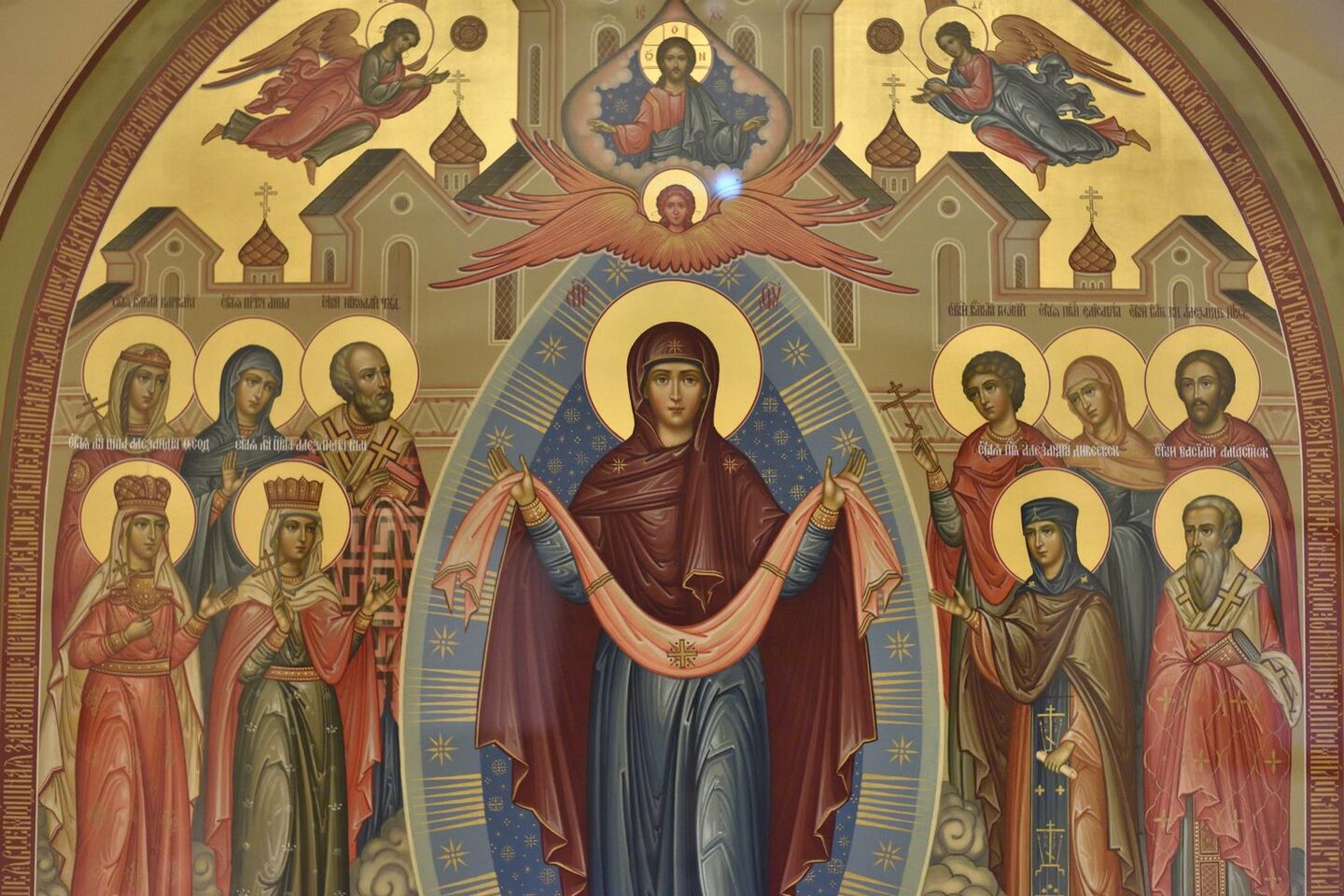
Concept
How to Depict the Invisible?
The image of the Intercession of the Mother of God holds a special place in Old Russian art. At the core of this subject is the concept of celestial intercession, which itself has no visible form. However, iconographers managed to convey it through specific artistic images: the figure of the Mother of God, the spread-out cloth, the gestures of the supplicants, angels, and the space of the sanctuary.In Russian icon painting of the 16th–17th centuries, this subject appears in various compositional variations. Sometimes the Mother of God holds the veil in her own hands; other times, angels support the fabric. In some works, the figures are arranged freely; in others, the artist creates a complex, multi-tiered composition uniting earthly and heavenly realms.These differences allow us to examine the Intercession not only as a religious subject but also as an artistic challenge: how can an image convey the idea of protection that cannot be observed directly?Why was this image chosen?
This study interests me in how the same religious concept is given diverse artistic interpretations. The Icons of the Protection of the Mother of God share a common theme, yet they differ in compositional structure, color, figure scale, and the manner in which the mantle itself is depicted.Particular attention is drawn to the interaction among the characters. The Theotokos can be presented at the center of the composition, looking directly at the viewer, or in a prayerful gesture directed toward Christ. Angels, saints, and witnesses of the miracle form a complex system of interconnected gestures and gazes around her.Choosing this theme allows for an examination of which of these elements remained consistent and which changed across works from different artistic centers. To do this, it is important to consider not only the symbolic meaning of the imagery but also the specific characteristics of the painting: line, color, proportion, rhythm of the figures, and spatial organization.Research Question
What artistic means did Russian iconographers of the 16th–17th centuries use to convey the idea of heavenly intercession in the image of the Protection of the Mother of God?
To answer this, it is necessary to determine how the artists organized the compositional center, how they depicted the covering, and what significance the gestures of the surrounding characters held.
A separate question relates to the artistic space. In icons of the Protection, an architectural depiction of a temple is often present. It not only denotes the location of the event but also helps to connect several levels of the composition.
The goal of this research is to define how the interaction between the figure of the Mother of God, the covering, the architecture, and other characters forms the artistic representation of heavenly protection.
Research Hypothesis
The research hypothesis is that the concept of heavenly intercession in Russian icon painting was conveyed not through a single, immutable image, but through a combination of several artistic techniques. Primarily, this relates to the compositional placement of the Virgin Mary. The central positioning of her figure, her supplicatory gestures, and her interaction with the mantle create the core semantic axis of the work. Simultaneously, the surrounding figures play a vital role, lending the image a narrative quality. It is hypothesized that the relationship between these elements varied across works from different schools. In some icons, the manifestation of the Virgin herself was paramount; in others, it was her prayerful invocation; and in a third set, it was the depiction of a community united by heavenly patronage. To test this supposition, it is necessary to compare several works, paying close attention to their specific artistic organization.
Materials and Research Methods
The study is based on Russian icon paintings from the 16th and 17th centuries, drawn from the collections of the State Russian Museum, the Vologda Museum-Reserve, the Novgorod Museum-Reserve, and the Mikhail Abramov Museum of Russian Icons. Additionally, the monumental fresco by Dionysius from 1502 in the Ferapontovo Monastery is examined.The material is selected based on several principles. First, the works must belong to the chosen historical period. Second, they must represent different variations of the same subject. Third, the ability to closely examine the composition and pictorial features through a high-quality reproduction is crucial.The primary research method is comparative visual analysis. First, the entire work is examined, and then individual elements are isolated: the figure of the Theotokos, the mantle, gestures, architecture, and surrounding figures. Following this, the artistic solutions of the different icons are compared.The research is divided into five parts. The first is dedicated to the iconographic variations of the Veil, the second to the figure of the Theotokos, the third to the depiction and color of the mantle, the fourth to the sacred space of the church, and the fifth to the figures witnessing the miracle.Museum catalogs and scientific studies are used to verify historical data, particularly publications by I. A. Shalina and T. B. Vilinbakhova concerning ancient Russian iconography of the Theotokos.
Chapter I. Two Ways to Represent Wonder
Novgorod and Middle Russian Traditions
The iconography of the Intercession of the Theotokos developed gradually in ancient Russian art. By the end of the 14th century, two main compositional variants had formed, which are traditionally called the Novgorod or the Suzdal, or Middle Russian, types. Their differences are particularly noticeable in the way the Theotokos and the veil itself are depicted. [1]In the Novgorod variant, the Theotokos is typically shown inside the church in a prayerful posture, and angels support the veil above her. The Middle Russian tradition is characterized by the depiction of the Theotokos herself spreading the fabric over those who are praying.The organization of space also differs. Novgorod icons are often structured around a church interior presented in several tiers. In Middle Russian works, the interaction between the Theotokos and the people before her can take greater importance.These two solutions allow us to see how one religious subject receives different artistic forms.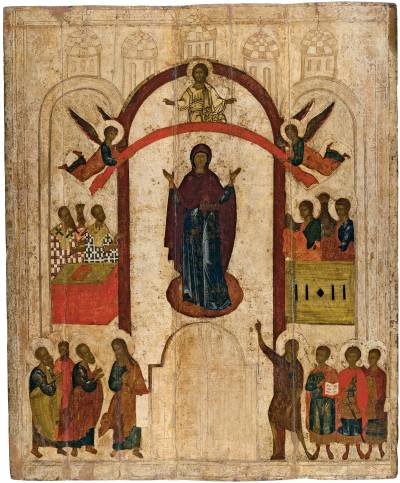
In the icon of the Intercession of the Theotokos, dating to the early 16th century and housed in the Russian Museum, the action unfolds within a five-domed church. The architectural forms occupy a significant portion of the image, creating a distinctive frame for the figures positioned in the center and on the sides.The Theotokos is depicted in the altar space, with angels supporting a brilliant mantle above her. Christ, bestowing a blessing, is positioned higher up. This arrangement establishes a vertical sequence of images, guiding the viewer’s eye from the earthly realm toward the heavenly.A distinctive feature of this icon is the rich green color of the church interior. Against this background, the red and ochre elements of the garments and mantle are particularly striking. This color contrast helps to highlight the central event amid the numerous figures.The Russian Museum’s description associates the green color with the concept of the church as an image of a spiritually transformed space. Furthermore, the expressive power of the work is determined not only by the symbolism of color but also by how it unifies the composition.Artwork—“Intercession of the Theotokos.» Novgorod Province, early 16th century. Wood, gesso, levkas, tempera. State Russian Museum
Another Novgorod image
«The Protection of the Mother of God.» Novgorod Province, early 16th century. Wood, gesso, gesso priming, tempera. State Russian Museum
In this icon from the Novgorod school, the composition is also organized around the figure of the Mother of God, who is presented within a sacred space. Her hands, raised in prayer, form a symmetrical gesture that corresponds to the horizontal depiction of the mantle above her head.
Groups of saints are positioned on the right and left. Their figures form several distinct sections, yet they remain connected by a common focus of attention on the central event.
In the lower section of the icon, Andrew the Holy Fool points out the apparition of the Mother of God to his disciple Epiphanius. His gesture becomes one of the important compositional elements: it not only signifies the event but also directs the viewer’s gaze upward.
As a result, the work is structured upon the convergence of two directions of movement. The vertical axis connects the earthly and celestial levels, while the horizontal arrangement of the mantle unifies the space of the church.
The Development of Novgorod Composition
«The Dormition of the Mother of God.» Novgorod lands, last quarter—late 16th century. Wood, gesso, preparation layer (levkas), tempera, gilding. Mikhail Abramov Museum of Russian Iconography,
Preservation and Evolution of Tradition
The icon from the late sixteenth century, housed in the Russian Icon Museum, retains the fundamental characteristics of the Novgorod composition. The Mother of God is presented in the central part of the shrine, with angels supporting the mantle above her, and surrounding figures arranged in distinct groups.However, the space becomes more fragmented. It is divided by slender columns and recurring arches that create several independent sections of the image.Roman Sladkopevets is placed in the lower center, standing on the ambo. His figure suggests that the Novgorod tradition may have incorporated elements characteristic of other iconographic variations of the Dormition.Nevertheless, the distinctive features of local painting are preserved: small figures, expressive contours, and a complex rhythm of architectural forms.Thus, the iconographic tradition was not completely static. New elements could be incorporated into the established composition without disrupting its core structure.The Veil in the Hands of the Mother of God
«The Protection of the Mother of God.» Early 16th century. Wood, gesso, lead white, tempera. Vologda State Museum-Reserve
In the icon from the Glushitsky Sosnovetsky Monastery, the Theotokos is depicted standing on a red cloud. Her arms are spread wide, holding a white mantle with a red border. Two angels further support the edges of the fabric.Compared to the Novgorod composition, the relationship between the figure of the Theotokos and the mantle changes here. The fabric no longer exists as a separate image above her but is directly connected to the movement of her arms.This technique makes the Theotokos herself the primary participant in the action. She is not only praying for the people but is visibly extending patronage over them.In the lower part of the work, Roman the Sweet Singer is depicted on the ambo. Around him are the praying and singing figures, and to the right is Andrei the Ascetic with his student Epiphanius.Comparing this to the Novgorod icons shows that the difference between the two traditions lies primarily in the way the central action is organized.
Conclusion of Chapter One
Comparing the Novgorod and Middle Russian variants shows that the same image of celestial protection could be constructed around different compositional solutions. In the Novgorod works, the division of space into multiple levels assumes particular significance. The Mother of God is depicted inside a church, and the mantle is supported by angels. The event itself becomes the central focus, unifying the earthly and heavenly spaces. In the Middle Russian variant, the connection between the fabric and the figure of the Mother of God is more pronounced. The movement of her hands forms a horizontal line beneath which the other participants of the event are positioned. Thus, the differences between the icons relate not only to individual details but also to the very manner of portraying intercession. In one case, it is shown as a celestial phenomenon, and in another—as an action by the Mother of God directed toward people. This conclusion forms the basis for further analysis of the central figure.
Chapter II. The Virgin Mary as the Center of Composition
Dionysius and the workshop. «The Protection of the Mother of God.» 1502. Fresco, painting of the eastern lunette of the Cathedral of the Nativity of the Theotokos in the Ferapontov Monastery.
The Iconography of the Theotokos in Monumental Painting
In Dionysius’s fresco, «The Protection of the Theotokos» (1502), the figure of the Theotokos occupies the central position. She is depicted in full length, with her arms spread outward, holding the veil. Figures of saints and angels are positioned on both sides, and participants in the event are shown in the lower part of the composition.Unlike smaller icons, the fresco is designed to be perceived within the architectural space of the church. Therefore, the scale of the figures and the clarity of their silhouettes hold particular significance.
The figure of the Theotokos is defined by a serene verticality, which contrasts with the more complex arrangement of the surrounding figures. Her dark garments relate to the light areas of the veil and the background of the fresco.
Smooth lines, elongated proportions, and restrained color combinations convey the solemn nature of the event without abrupt movement. The image of protection here is created through the balance of the composition and the tranquility of the central figure.
Pokrov in Stroganov painting
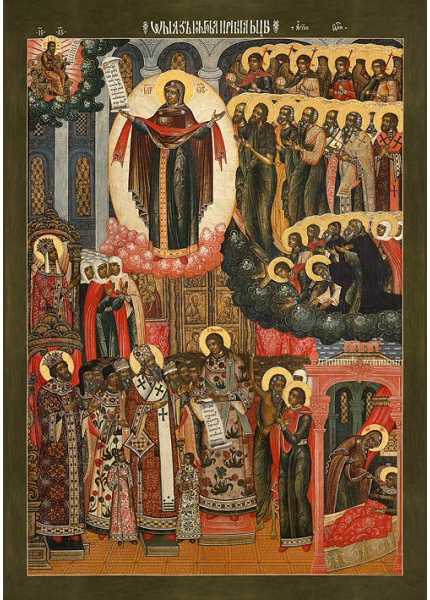
Image Scale Variation
The icon by Master Mikhail, dating to the late 16th—early 17th century, is a relatively small work. Its dimensions are 35,8 × 29.6 centimeters.Unlike the monumental frescos by Dionysius, this icon necessitates close inspection. This allows one to focus on minute details that might play a secondary role in a large-scale fresco.
When analyzing the work, it is important to consider the ratio of the board size to the number of depicted elements. The central figure of the Theotokos exists within an overall composition that includes other characters and architectural forms.
Comparing Master Mikhail’s icon with the frescoes of the Ferapontov Monastery reveals how differently artists approached the same subject matter.
In the first case, the image is intended for a small format; in the second, it is part of a monumental church ensemble. The nature of the viewer’s perception also differs—shifting from detailed examination to perceiving the image within its surrounding architectural space.
Image — The Dormition of the Theotokos. Novgorod lands, last quarter—late 16th century. Mikhail Abramov Museum of Russian Iconography.
«The Protection of the Mother of God.» Novgorod, second half of the 16th century. Wood, gesso, tempera. State Russian Museum,