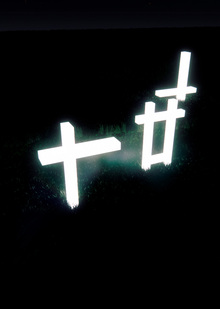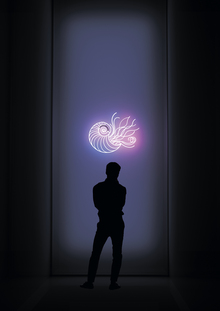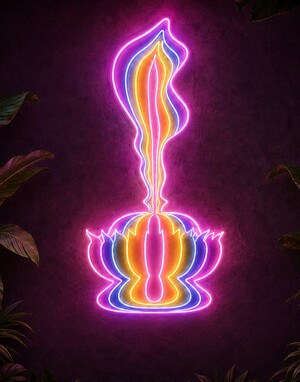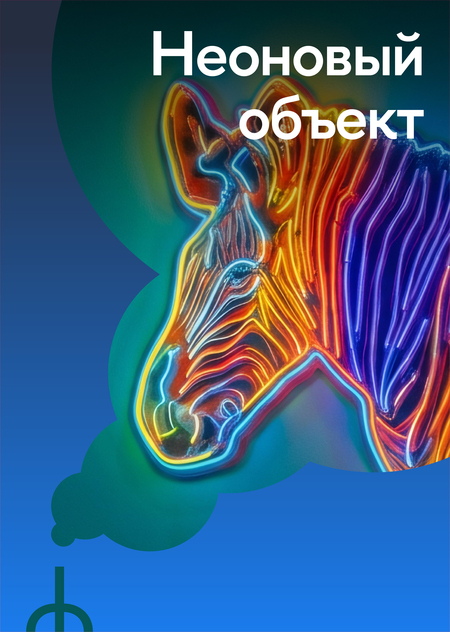
Neon is a light medium in which the image is constructed directly with a light line. This can be a graphic composition, a character, a sign, lettering, an abstract form, or any other original design.
The project is intended for wall mounting. The light composition can be affixed directly to a prepared base or assembled with it into a single wall object.
Three production technologies are available: flexible LED neon, NEON2, and glass tube neon.
Student Task
To design an original wall-mounted object where the image is formed by a neon line.The project must define: • Composition; • The form and trajectory of the light line; • Size; • Color or combination of colors; • Proposed technology; • The shape of the base, if one is necessary; • How the object will be mounted on the wall.
The physical thickness of the neon, minimum bending radii, and the technical feasibility of producing the chosen shape must be considered.
Technical Specifications
Dimensions
The base size for the project is up to 100 cm on the longest side.This restriction applies to the entire finished piece, including any base, if one is used.
Larger objects beyond this size are not permitted for this assignment.
Placement
The finished piece is intended exclusively for wall mounting.During the design phase, you must account for:
- the object’s position on the wall;
- orientation;
- mounting points;
- placement of the power supply and wiring;
- the distance from the wall, if the design requires it.
The final mounting and electrical system will be clarified by production after the project selection.
Three Technologies
Flexible LED Neon
The LED strip is housed within a silicone diffuser casing and secured to a rigid base.
This technology is suitable for:
· Outline graphics;
· Characters;
· Lettering;
· Large signage;
· Relatively large and simple linear compositions.
Lines are typically 6 or 8 mm thick.
Flexible neon is not suitable for very fine graphics, small lettering, or a large number of sharp, short curves. Typically, the overall letter height is about 75 mm, and the neon elements are cut with a specific technological tolerance.
Flexible neon is impact-resistant and well-suited for interior installations, but standard options are virtually unreparable once the LED strip is damaged.
NEON2
NEON2 consists of two separate components: an LED strip and a silicone diffuser.
This design allows for more precise handling of curves and intersections, enables the combination of different hues, and allows for the LED strip to be replaced if necessary. The product offers over 20 lighting options.
NEON2 is best suited for:
· Complex linear graphics;
· Multi-colored compositions;
· Objects on transparent bases;
· Combining neon with imagery;
· Projects requiring a sufficiently precise line trajectory.
Light strips of 6 or 8 mm width are typically used.
Glass Neon
Classic neon is handcrafted from glass tubes that are heated and bent to the form of the project.Tubes are available in diameters of 8, 10, 12, and 15 mm. They illuminate 360 degrees and can be bent not only in a plane; therefore, the technology allows for the creation of spatial light objects.
Glass neon is particularly suitable for: · Spatial lines; · Hanging installations; · Light sculptures; · Works without a solid base; · Objects viewed from multiple perspectives.
This technology is more expensive and more fragile compared to LED solutions. Damaged glass elements can be remade if necessary.
Base and Mounting
Depending on the chosen technology, the neon can be mounted on a base. Possible materials for the base include:
Depending on the project, this could be:
· transparent or colored acrylic;
· polycarbonate;
· PVC;
· composite;
· MDF;
· another suitable sheet material.
The base can be rectangular or follow the outer contour of the light composition. Its purpose is to provide the necessary rigidity, allow for the installation of the neon, and enable the finished piece to be safely secured to a wall.
Color
The number of available shades depends on the chosen technology.
The palette of standard flexible neon is more limited. NEON2 allows for combining the LED color and the silicone diffuser, thus offering a wider selection. Glass neon also has its own palette of light colors.
The exact shade is determined before production begins.
File Preparation
To calculate the project, you must prepare:
· a visualization of the finished object;
· dimensional specifications;
· a vector mock-up of the light line;
· a diagram showing the neon placement relative to the base or another object;
· proposed glow colors;
· a description of the materials for the rest of the project.
The primary formats are AI, EPS, PDF, SVG, or CDR.
The light line must be shown as a vector outline using curves.
You are not required to independently design the connections, breaks, wiring, or mounting. After selection, the production team will adapt the artistic mock-up to the capabilities of the chosen technology and coordinate any changes with the author.
Production
After selection, the project is transferred for technical adaptation.
**Production verifies: **
- bending radii;
- minimum element dimensions;
- object mounting to the wall;
- length of individual sections;
- connection feasibility;
- selected colors;
- base construction;
- power supply.
If the original line cannot be manufactured exactly as intended, it is adjusted to be as close as possible to the artist’s mockup. All notable changes are approved before launch.
Flexible neon is typically mounted on a prepared base. For NEON2, a milled groove can be used to house the LED strip and diffuser.
Glass neon is handmade from individual bent tubes and can be mounted on a base or on another structure.
The minimum production run is one piece. The cost is calculated individually and depends on the object’s size, the length and complexity of the light line, the number of colors, the chosen technology, the base, and the structure.
What to submit
For the final submission, you must prepare:
· Project title;
· Project description, up to 1,000 characters;
· Final visualization;
· Overall dimensions of the completed object;
· Selected technology—flexible LED neon, NEON2, or glass neon;
· Vector layout of the light line in PDF;
· Chosen illumination colors;
· Base layout, if applicable;
· Visualization of the object with light on and light off;
· Visualization of the object on a wall in an interior setting;
· Editable source files.
After the final submission, the materials are transferred to the curator. The curator verifies the package and places it in the corresponding project folder within the private «Personal» section on the School’s network drive. Access to this section is restricted to staff working on the projects.
Production mockups and source files are not placed in public access nor attached to a public longread.
Questions and Answers
Which of the three technologies is best to choose?
The choice depends on the idea and the construction. Flexible LED neon and NEON2 are suitable for flat graphics. NEON2 is convenient for complex lines and multiple colors. If the light needs to exist as a freestanding spatial line, you should consider glass neon.
Can the object be made without a rectangular base?
Yes. The base can follow the contour of the composition or have another suitable shape, provided the construction allows for secure mounting on the wall.
Can multiple colors be used?
Yes. The number and selection of shades depend on the technology. NEON2 and glass neon, in particular, offer a wide selection.
Can I use very fine graphics?
No. Neon has physical thickness and a minimum bending radius. Small letters, short segments, frequent sharp corners, and dense detail may require simplification.
Do I need to calculate the bending radii and connection points myself?
Precise technical calculations are not required. When developing a design, it is important to remember that a neon line has physical thickness and cannot replicate overly sharp bends, very small radii, or excessively complex sections without adaptation.
The form must be initially designed keeping these limitations in mind. Production will refine the final radii, connections, and technical adaptations after the project selection.
Is it possible to make the object larger than 120 cm?
The basic limit is 100 cm on the longest side. If a larger size is a fundamental part of the concept, it must be discussed separately with the curator.
Can the object be used outdoors?
This depends on the technology. Glass neon can be used outdoors, but most manufacturers recommend flexible LED solutions primarily for indoor use.