Navigation
[1] Concept [2] Cinema That Was Never Entirely Silent (1895–1900) [3] Early Forms of Musical Accompaniment (1895–1907) [4] Music Becomes Part of Dramaturgy (1908–1914) [5] Formation of a Musical Cinematic Language (1915–1919) [6] Music as an Independent Artistic Tool (1920–1924) [7] Symphonization and Experiments with Cinematic Language (1925–1927) [8] Transition to Sound Film (1927–1929) [6] Conclusion [7] Bibliography [8] Image Sources
Concept
Relevance of the StudySilent cinema was not a singular art of silence: the image was captured on film, while the sound event occurred in the theater. A pianist, an ensemble, an orchestra, sound effects, or a narrator’s voice could change the perception of the same reel. Moreover, accompaniment was not mandatory for every early screening. Therefore, this research examines music as a historically mutable practice, rather than as an immutable attribute of cinema since 1895.The main question is how music became a means of organizing screen time and audience attention. It could denote a character’s nature, connect episodes, warn of danger, and create emotional continuity during scene transitions. Cinema language here is understood as a system of expressive devices through which editing, movement, composition, and musical rhythm guide the viewer’s perception of the film.The chronological boundaries are 1895–1929: spanning from early public film screenings to the transition to recorded synchronous sound. The material is limited to European and American cinema. Within this period, different models are compared: variable accompaniment for short reels, the selection of pre-existing pieces, original score composition, and music fixed on a sound medium. These forms coexisted; the history is not reducible to a direct replacement of improvisation by a symphony orchestra.
Research ObjectiveTo identify the principles governing the interaction between music and imagery that developed during the silent era: rhythmic alignment, emotional commentary, thematic repetition, and the unification of montage fragments. Specific works—"The Murder of the Duke of Guyse» (1908), «Intolerance» (1916), «Intermission» (1924), «Metropolis» (1927), and «Jazz Singer» (1927)—allow us to examine these principles. Each example is included in the analysis to demonstrate a specific function of music, rather than being presented as an isolated illustration of film history.
Method and SourcesComparison of film footage, posters, musical scores, and records of historical performances. While film footage allows for an analysis of composition and movement, it does not, by itself, prove what music was played in the hall. For that, scores, musical exegeses, and archival descriptions are necessary. Modern audio accompaniment and reconstructions are distinct from the original premiere timing.The historical basis includes research by Rick Altman and Martin Miller Marx, as well as materials from the Library of Congress and film archives. Sound alters the meaning of the visual, and the image provides the music with its subject and temporal anchor. The outcome will be a description of how musical practice shaped the film’s dramaturgy even before the sound was fixed to the film stock.
[1] Cinema That Was Never Entirely Silent (1895–1900)
1895–1900: The Screen and Spectacle SpaceOn December 28, 1895, the Lumière brothers organized a paid public film screening at the Grand Café in Paris. The program featured «Workers Leaving the Lumière Factory» (1895). «Arrival of a Train at La Ciotat Station» (1896) belongs to a subsequent phase of their film presentations and should not be included in the December screening program.In «Workers Leaving the Factory, ” the movement of people is organized by the depth of the frame and passing through the gates. There is no editing yet, which connects different scenes—the viewer observes a short, continuous action. A musical performer could set the pace and mood, but it is inaccurate to attribute a single original score to the film. It is precisely the contrast between the unchanging image and the variable accompaniment that defines the early film screening as a performance event.
The show drew on traditions from theater, music hall, and the magic lantern—a projection device for static images. Music could connect individual acts within the program and organize the audience’s attention. At the same time, early film screenings also allowed for speech, sound effects, and a lack of structured accompaniment.
«The Sprinkler» (1895) is built on visible cause-and-effect: a boy squeezes a hose, a gardener looks into it, and the stream returns. For a musician, this sequence creates points of emphasis. However, this is an opportunity for musical interpretation of the image, not evidence of specific premiere accompaniment. Therefore, the origins of film language are linked not only to the construction of the frame but also to the conditions of its presentation to the viewer.
[2] Early forms of musical accompaniment (1895–1907)
In its early stages, music lacked a unified organizational system. The choice of accompaniment depended on the capabilities of the cinema, the musician’s preferences, and the nature of the film being shown.
Improvisation—the creation or alteration of music during performance—allowed the pianist to follow the pace of the on-screen action. Compilation, conversely, combined pre-existing pieces. These methods could be combined: a familiar melody could transition into an improvised passage, and a scene change might necessitate a new musical character.
Georges Méliès’s «Journey to the Moon» (1902), with its frontal compositions and changing sets, resembles a theatrical picture. The music could tie them together in a unified journey, although the film did not have a single mandatory score. The music by the band Air, which was composed for the 2011 restoration, cannot be mapped onto the premiere.
Edwin S. Porter’s «The Great Train Robbery» (1903) demonstrates a different challenge: the transitions between robbery, escape, and pursuit require shifts in tension. The musician could emphasize movement using a recurring rhythmic figure. This establishes the principle of emotional commentary: the accompaniment offers the viewer a framework for interpreting the event.
Smaller venues used the piano, while more affluent ones featured ensembles; sound effects could be added to the music. The choice depended on the venue and the performers. There was no single standard for all cinemas yet.
Music becomes part of the dramaturgy (1908–1914)
In 1908, Camille Saint-Saëns composed the music for Andre Calmette and Charles Le Barraux’s «Murder of the Duke of Gisé.» The score, Op. 128, is one of the early examples of specifically composed film music. The musical dramaturgy here refers to the development of tension and the characterization of the figures through music: intrigue and violence are given distinct sonic qualities, and the transition between musical episodes corresponds to the action.
The static camera and theatrical mise-en-scène—the arrangement and movement of actors within the frame—make the accompanying score’s work particularly noticeable. While the image maintains a wide shot, the music is capable of shifting the emotional perspective: the viewer not only sees the protagonist moving through the halls but also anticipates the conspiracy’s resolution. The composer’s score thus dictates the interpretation of the sequence of scenes.
By the 1910s, cue sheets began to spread—these are musical explications that indicate which piece to perform and at what moment. They standardized transitions but did not eliminate differences between venues. The musical score allows one to link a specific musical number to a screen event, which a single frame cannot achieve.
Giovanni Pastrone’s «Cabiria» (1914) showcases the scale of the new cinematic spectacle: monumental sets and camera movement demand an extended musical form. The music was compiled and adapted by Manlio Mazzara; Ildebrando Pizzetti created the «Symphony of Fire.» It is important to distinguish these contributions: Pizzetti did not write the entire score. The coexistence of ready-made fragments and new composition demonstrates that compilation remained a creative tool.
[4] The Formation of Musical Film Language
(1915–1919)
A feature-length film complicates the task of scoring: the music must maintain connections between episodes over a long duration. A leitmotif—a recurring theme associated with a character, idea, or situation—allows the meaning to be recognized even when the setting changes. Musical transitions can extend an emotional arc across an edit point.
David Walker Griffith’s «The Birth of a Nation» (1916) connects four historical narratives. Parallel editing—the alternation of different plotlines—gradually accelerates and brings distant eras closer together. Joseph Carl Breil’s score, developed with Griffith’s participation, makes the music an intrinsic part of the organization of this complex structure.
Visually, the monumental wide shots of Babylon contrast with the intimate scenes of modern history. When performing a cohesive musical program, a change in space does not necessarily imply a break in the emotional experience. The repetition and development of themes help to relate the episodes, and the tempo of the score interacts with the increasing frequency of the cuts. This is an analytical observation regarding the function of music; it cannot be derived solely from a promotional image of the film.
The language of cinema is formed through the interaction of several temporal sequences: shot duration, speed of movement, frequency of cuts, and musical pulsation. Music does not create the montage for the director, but it influences whether it is perceived as continuous motion, a sudden rupture, or a climactic acceleration.
[5] Music as an independent artistic medium (1920–1924)
In the 1920s, the interaction between music and image moved beyond mere plot illustration. In avant-garde cinema, rhythm could become the primary structural principle of a work. Repetition, acceleration, and pause link musical and visual events even when there is no traditional causal relationship between frames.
René Clair’s «Intermission» (1924) was created for Francis Picabia and Erik Satie’s ballet, The Performance Is Cancelled. The film was screened in the Ballets Suédois program; Satie’s music was performed by an orchestra. Here, a chess game, a dancer’s figure, a funeral procession, and a frantic chase intersect. Cohesion arises from rhythmic development, not from the psychology of a single character.
Satie synchronized the musical segments with the film’s sequence. Recurring phrases allowed for the sustaining of a scene, while changes in tempo corresponded to shifts in on-screen movement. Ostinato—the persistent repetition of a rhythmic or melodic figure—allowed a series of disparate shots to be perceived as a unified process.
The funeral procession transforms into a chase: the solemn ritual loses its stability, the movement accelerates, and the music participates in the scene’s comic transformation. This exemplifies how accompaniment organizes form and creates distance from what is depicted. For the language of cinema, not only the congruence between the emotion of the music and the frame, but also the interplay between them, proves significant.
[6] Symphonization and Experiments with the Language of Cinema (1925–1927)
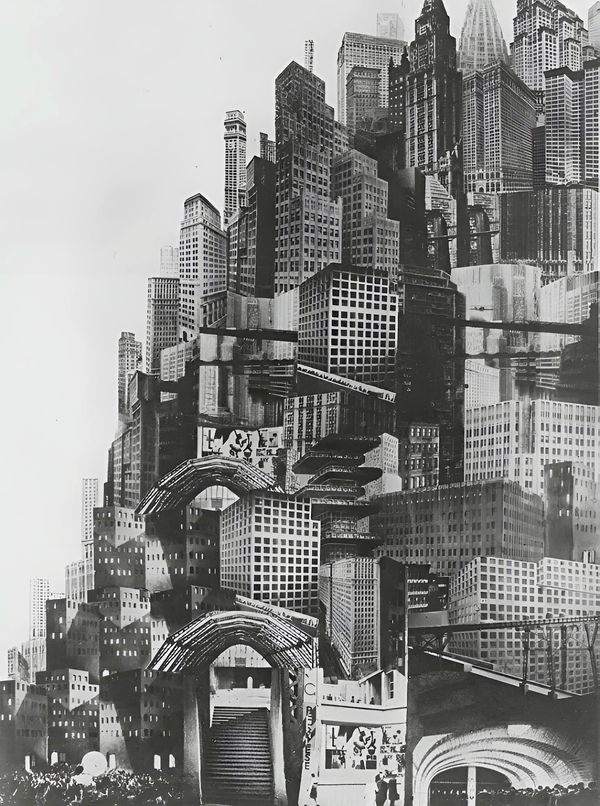
The symphonization of film music—the use of an expanded orchestral form and a system of themes and their transformations—allows for the construction of a film’s entire dramatic arc. In Fritz Lang’s Metropolis (1927), Gottfried Huppertz’s original score binds the technological city, the world of the workers, and Maria’s story into a single musical construct. The music was created in collaboration with the film’s creators, partly even during the filming process.The repetitive movements of the workers and the geometry of the machines form a visual rhythm. The orchestral pulse intensifies the feeling of humanity being subjugated to the mechanism. However, the score is not limited to mimicking the operation of machines; thematic development connects mechanical movement with character conflict and alters the emotional meaning of similar imagery.The leitmotif functions as the film’s memory. Returning in a new context, a theme allows recognition of a character or idea, but its timbre, dynamics, and harmony can change the perception of what is happening. Timbre is the coloring of an instrument’s sound or a combination of sounds; dynamics are the degree of volume and its variation. These elements create distinctions that the image alone does not capture.Huppertz’s score is also important to the history of film preservation: the musical materials were used in restoring the sequence and duration of episodes. Consequently, the music was not merely external ornamentation but a document of the work’s temporal structure. When analyzing the film, it is necessary to specify the version: Huppertz’s 1927 accompaniment differs from later musical interpretations of the film.
[7] Transition to sound cinema
(1927–1929)
The transition to sound film changes the mode of presentation above all else: musical performances can be fixed onto a medium and repeated along with the image. Synchronization—the stable temporal correspondence between sound and on-screen action—existed as a challenge before, but it now becomes technologically reproducible.
The precursor to this shift is Allan Crosland’s «Don Juan» (1926): the Vitaphone system played back recorded orchestral scores and sound effects from a disc. The film did not have recorded spoken dialogue. This shows that recorded sound entered feature films not only through speech but also through the preservation of musical programming.
Crosland’s «Jazz Singer» (1927) combines intertitles—text displayed between frames—with synchronized songs and separate conversational scenes. To call it the first sound film is inaccurate; its significance lies in the commercial success of its mixed format and the acceleration of the industry’s shift to sound.
When a character sings at the piano, the music becomes part of the depicted world. This type of music is called diegetic: the characters are able to hear it. Orchestral commentary, which lacks a visible or implied source within the action, serves a different function—it guides the viewer’s experience. Distinguishing between these levels forms the foundation of sound cinema.
Between 1927 and 1929, live accompaniment, silent versions, and recorded tracks continue to coexist. The musical language of cinema is not newly invented: thematic memory, rhythmic consistency, and emotional commentary transition from the practice of silent screenings to the production of sound films.
Alan Crosland. «The Jazz Singer,» 1927. Warner Bros. American poster; artist unknown. Source: Wikimedia Commons. The singing protagonist at the piano emphasizes music as an action within the frame.
Conclusion
Music influenced the development of cinema language long before the advent of a fixed soundtrack. In early screenings, it dictated the interpretation of short actions; in auteur scores, it linked scenes to a specific emotional trajectory; and in feature films, it helped maintain memory of characters and connect disparate episodes. Comparing these examples reveals four consistent principles: rhythmic alignment of movement and sound; emotional commentary; thematic repetition; and the unification of editing fragments. «Intermission» demonstrates that music can organize form without a linear plot, while «Metropolis» shows that a score can become the structural foundation of an entire work. The shift to recorded sound altered the degree of replicability of this interaction. Performative variability yielded to a fixed version, but the functions of music discovered in the silent era persisted. Therefore, music should be viewed as one of the contributors to cinematic meaning, and the silent film as an image existing under historically mutable conditions of sound.
Altman, Rick. Silent Film Sound. New York: Columbia University Press, 2004.
Marks, Martin Miller. Music and the Silent Film: Contexts and Case Studies, 1895–1924. New York: Oxford University Press, 1997.
Library of Congress. A Warming Flame — The Musical Presentation of Silent Films. https://www.loc.gov/collections/silent-film-scores-and-arrangements/articles-and-essays/a-warming-flame/
Palazzetto Bru Zane. L’Assassinat du duc de Guise, op. 128. https://www.bruzanemediabase.com/en/exploration/works/assassinat-duc-guise-op-128-camille-saint-saens
Museo Nazionale del Cinema / Progetto Cabiria. Cabiria (1914). https://progetto-cabiria.alicubi.it/cabiria/
American Film Institute. Intolerance (1916). https://catalog.afi.com/Film/16253-INTOLERANCE
Museum of Modern Art. René Clair. Entr’acte. 1924. https://www.moma.org/collection/works/305166
Friedrich-Wilhelm-Murnau-Stiftung. Metropolis: Restoration Program, 2010. https://www.murnau-stiftung.de/sites/default/files/pdf/programmmetropolis2710premiereberlin.pdf
British Film Institute. A genre is born: how moviegoers first fell in love with the musical. https://www.bfi.org.uk/features/genre-born-early-musicals
Date accessed: 11.15.2026.
Louis Lumière. «Workers Leaving the Lumière Factory, ” 1895. Frame, digital reproduction: https://commons.wikimedia.org/wiki/File:Sortieusinelumiere.jpg
Georges Méliès. «A Trip to the Moon, ” 1902. Frame showing a projectile striking the Moon: https://commons.wikimedia.org/wiki/File:Le_Voyage_dans_la_lune.jpg
Giovanni Pastrone. «Cabiria, ” 1914. Photograph from the film scene; photographer unknown: https://commons.wikimedia.org/wiki/File:Cabiria_film_still.jpg
W. Griffith. «Intolerance, ” 1916. Frame from the Babylon episode: https://commons.wikimedia.org/wiki/File:Intolerance,_1916,_il_sommo_sacerdote_di_bal_guarda_babilonia_dall%27alto_del_tempio.jpg
René Clair. «Interlude, ” 1924. Frame from the chase scene; MoMA, inv. W1159: https://www.moma.org/collection/works/305166
Fritz Lang. «Metropolis, ” 1927. Collection of Ufa/Eureka Entertainment frames; German History in Documents and Images: https://germanhistorydocs.org/en/weimar-germany-1918-1933/scenes-from-metropolis-by-fritz-lang-1927
Alan Crosland. «The Jazz Singer, ” 1927. Performance frame, excerpt from Emmetkells, CC BY-SA; original card and terms: https://commons.wikimedia.org/wiki/File:The_Jazz_Singer_1927_screencap.jpg
«The Jazz Singer, ” 1927. Warner Bros. poster; artist unknown: https://commons.wikimedia.org/wiki/File:The_Jazz_Singer_1927_Poster.jpg
Research cover — original typographic composition, 2026.
Date of access: 11.15.2026.