Fashion is a rare creative industry where women make up the majority—62% of designers. Yet, in the leadership of the biggest houses, they make up one in five. The gap isn’t in the profession, but in the right to decide.
// INTRODUCTION: THE QUESTION AND THE METHOD
Inequality at the top is often attributed to a lack of women in the profession itself. This is not the case here: there are more women. Therefore, if they are still underrepresented at the top, the reason lies not in entry into the profession, but in appointments.
The method involves measuring two levels using two independent sources and comparing the proportions. The professional level: who works as a fashion designer. The power level: who leads the fashion houses.
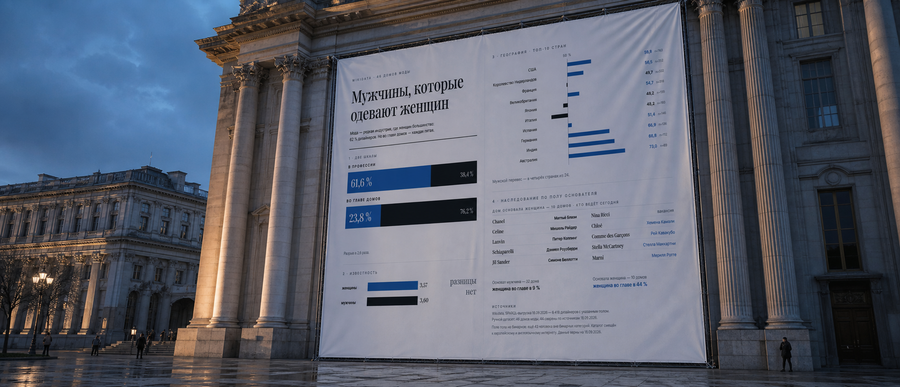
The result: 61,6% in the profession versus 20.0–23.8% leading the houses—a 2.6 times gap. The obvious counterargument, «there are more women, but they are less visible,» is not supported by the data: average recognition is nearly identical—3.57 Wikipedia language sections for women versus 3.60 for men, and the maximum is also female (175 sections versus 110).
Women in fashion are not a minority, nor are they in the shadows. They are simply not appointed.
DATA HANDLING
Source 1 — Profession. Wikidata, SPARQL endpoint query.wikidata.org, export dated September 18, 2026. All persons listed with the occupation «fashion designer”—6,418 individuals with specified gender—were exported. For each person, gender, year of birth, citizenship, and the number of language editions of Wikipedia containing an article about them are known. The latter was used as a rough, yet functional, measure of prominence: it allows verification that women are not disproportionately represented in the catalog by sheer number rather than by impact.Source 2 — Influence. A proprietary dataset of fashion houses, manually compiled. The selection criteria for the houses were established before collecting data on individuals to prevent tailoring the sample to the desired outcome: the house was founded in 2005 or earlier, shows collections in the official calendar of Paris, Milan, or London, and belongs to a luxury group or is independent. Mass market, premium-mass, subsidiary lines, and brands under beauty conglomerates are excluded—the list of excluded entities with reasons is kept in a separate file.Forty-six houses were presented; forty-four were verified. Each row has been cross-referenced with an external source and dated: Wikipedia, Vogue, Harper’s Bazaar, WWD.
What was considered in the calculation:— A position is considered female only if it is exclusively held by women. — Mixed duos are listed in a separate category and are not blended into the general count. There are two such duos—Prada and Giorgio Armani. This accounts for the range: a strict count of 8 out of 40 positions equals 20,0%; a count including the duos, 10 out of 42, equals 23,8%. Both figures are more accurate than a single one. — Vacancies were excluded from the denominator. There are two—Alaïa and Nina Ricci. — The final breakdown across 44 houses is: men—32, women—8, mixed duos—2, vacancies—2. — Percentages by profession are calculated using binary categories, but 43 individuals outside these binary frameworks have been noted rather than discarded.Limitations: — Wikidata is not a census of the industry, but a snapshot of those who have a page; a bias toward the European and English-language internet persists. — Coverage anomaly: The Netherlands ranks second in the number of designers (352 people)—this is almost certainly a result of mass data entry, not the weight of Dutch fashion. — «Creative Director» is not a standardized title: in one case it might be the founder, in another a commissioned artist, and in another, a duo. The counting rule is described above and was applied mechanistically. — The figures are accurate as of September 18, 2026.
Using Claude Code, this infographic was compiled in SVG format based on this data, and then manually refined in Figma.
// VISUAL MEDIA
The project is presented as a unified campaign. The infographics are showcased on media formats used by the industry itself:
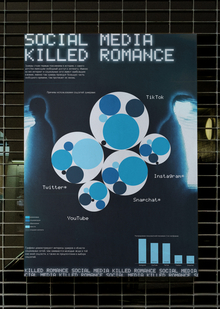
— street posters — boutique posters — magazine spreads — social media cards
Fashion presents itself through window displays, photoshoots, and editorial spreads. Information about who is leading this is placed in the exact same formats—so that the disconnect is read in the same space where the industry showcases itself.
/ JOURNAL SPREAD
/ POSTERS AND BANNERS
SOCIAL MEDIA POSTS