DAVID GALLOWAY
A VENETIAN INTERLUDE: MONA AT REST
In 1998, Mona Lisa became George Pusenkoff’s portable muse and tireless traveling companion along the highways and byways of his native Russia. Seven years later — the magical time-span of fairytales — she ascended into the heavens with the Italian astronaut Roberto Vittori. (Was it sheer coincidence that he possesses the good looks of an Italian film star? Or — more appropriately, perhaps — those of a fairytale prince?)
The astronaut thus became the first man to sleep legally with Mona Lisa since she left Napoleon’s boudoir to assume a place of honor in the Louvre.
Another Italian, the immigrant worker Vincenzo Peruggia, who kidnapped the beauty in 1911 and concealed her in a cupboard beside his bed, can hardly qualify as Vittori’s rival. Nor can those who sleep beneath posters of Leonardo’s masterpiece, snuggled between pillows bearing images of La Gioconda, for Pusenkoff’s ingenious reprises have succeeded in restoring to the image something of its original, ineluctable aura. Here the issue is not one of originality but of authenticity.
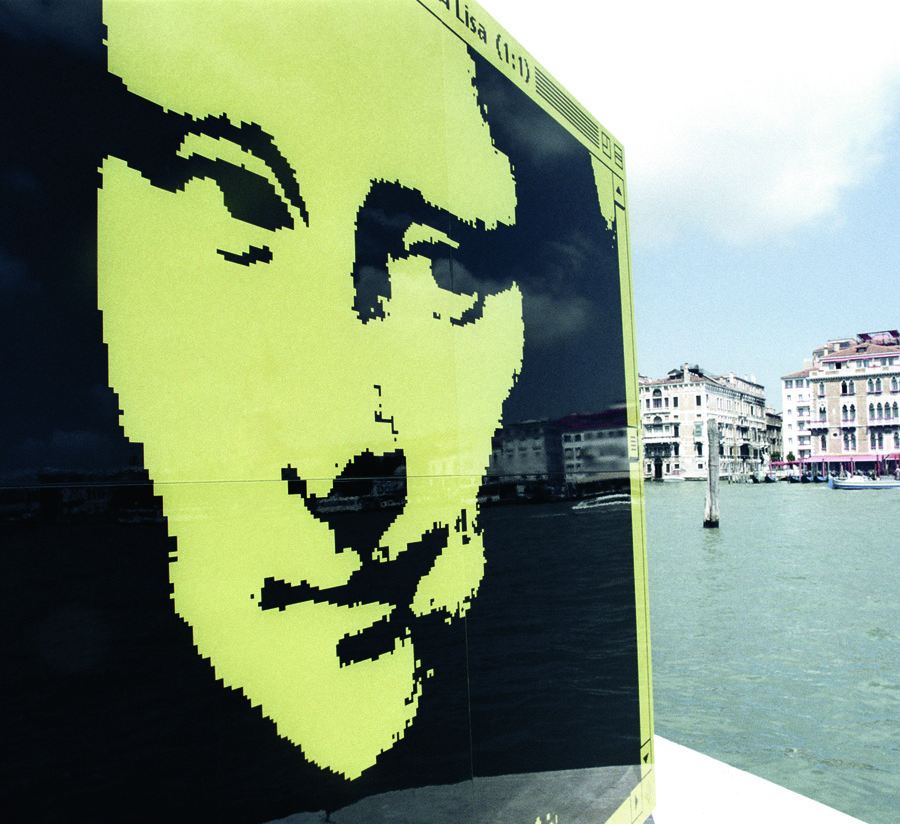
Installation Mona Lisa Goes Venice. Silkscreen on metal, 300×300×5 cm.
51st International Art Exhibition, 2005

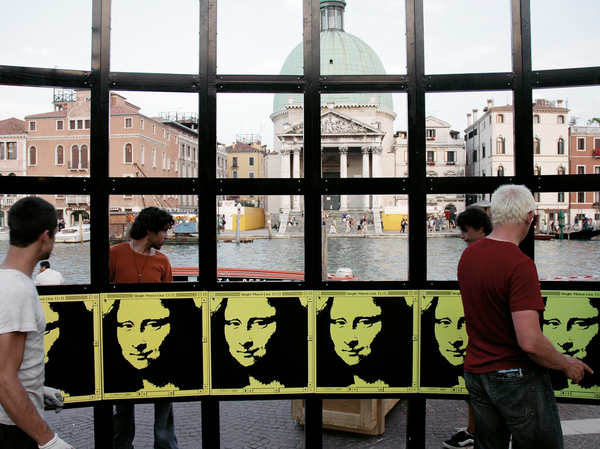
Installation Mona Lisa Time Tower, 51st International Art Exhibition, 2005
Installation of the Mona Lisa Time Tower. Piazza Santa Lucia, Venice.
51st International Art Exhibition, 2005
Following her eventful Wanderjahre, Mona Lisa came to rest for more than five months in Venice, where each and every day tens of thousands of visitors would pay her their homage.
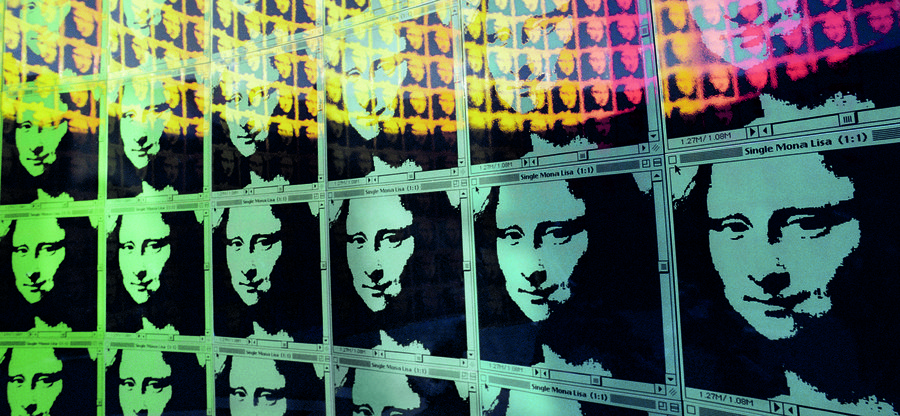
From June 12 to November 6, 2005, Mona Lisa Goes Space constituted one of the principal attractions of the 51st Biennale di Venezia. Light-boxes mounted on the façade of the Santa Lucia train station, since 1846 the principle gateway to the island city, documented the picture’s unprecedented journey to the International Space Station. In front of the Santa Lucia train station and adjacent to the Canale Grande stood Pusenkoff’s imposing Mona Lisa Tower, a roofless structure which visitors could enter to gaze upward past rainbow-colored variations on the Renaissance masterpiece, while a melody based on Leonardo’s own notations played softly in the background.
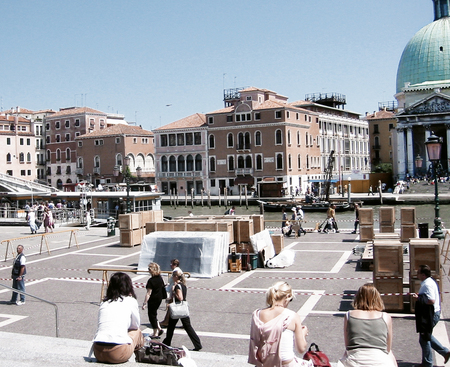
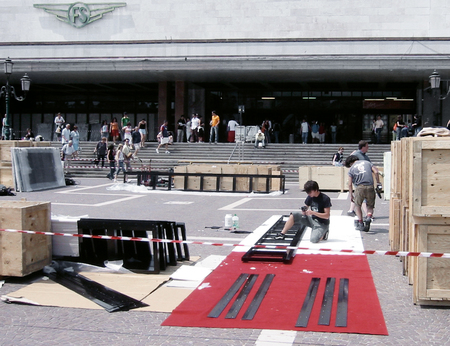
Installation of the Mona Lisa Time Tower. Piazza Santa Lucia, Venice. 51st International Art Exhibition, 2005
Flowing through the city from this location, to the Campo del Ghetto Novo in the north and all the way to the Giardini gardens in the east, seven oversized aluminum panels with a yellow-and-black Single Mona Lisa 1:1 — once more the fairytale number — were dramatically positioned. Measuring 3×3 meters, each was painted in a different yellow tone, thus echoing the chromatic sequences within the tower.
Installation Mona Lisa Time Tower. Aluminum, acrylic lacquer (50 colors), varnish, diameter 10 m, height 6 m. 51st International Art Exhibition, 2005 (courtesy Museum Ritter, Waldenbuch)
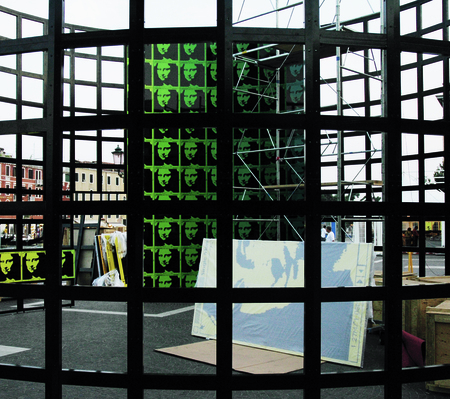
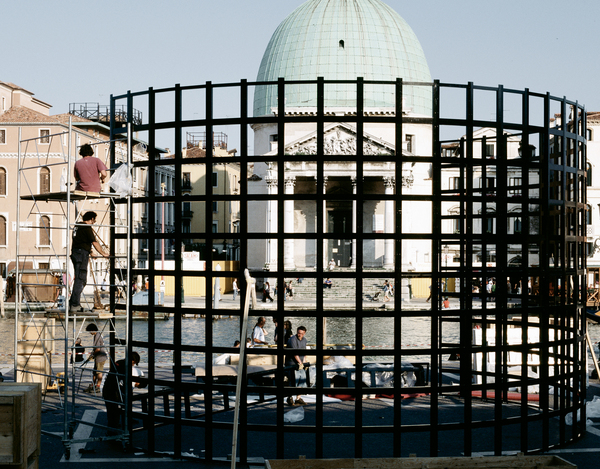
Installation Mona Lisa Time Tower. Piazza Santa Lucia, Venice.
51st International Art Exhibition, 2005
The famous traveler had found repose within the swirl of commuters, travelers and art tourists that lend the city its characteristic flair; she became what T.S. Eliot once termed «the still point of the turning world». (In similar fashion, the great Irish poet William Butler Yeats came to see the tower as a symbol of order and harmony among the turbulence of modern life).
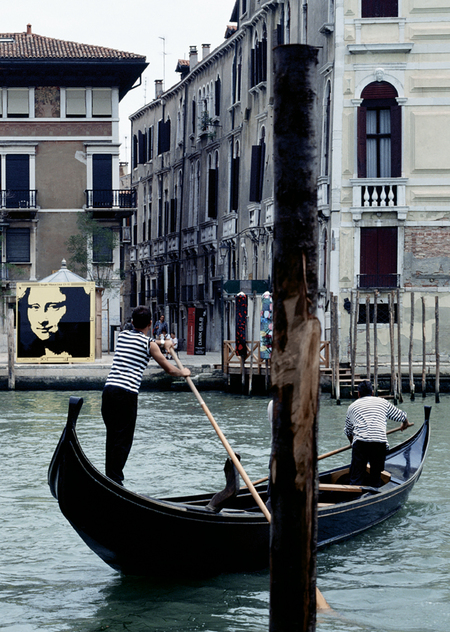
The notion of repose was strengthened by the fact that three of the aluminum panels were visible from the water, so that passengers aboard vaporettos or gondolas moved past the familiar icon, as though passing in ceremonial review before the distinguished guest. On the other hand, the fact that Pusenkoff’s Mona Lisa had come to rest after seven years of earthly and heavenly voyaging did not exclude a degree of dramatic nuance in her reception. Visitors to the tower saw themselves reflected in its curved surface, while every alteration of the sky above found its counterpart within the structure. The kaleidoscopic effects were thus in continuous motion, creating unique tableaus that vanished as soon as they appeared — often so rapidly that they can only in retrospect be fully appreciated through the remarkable photographs they inspired.
Photo installation Mona Lisa Goes Space, 27 light boxes, each 120×150×15 cm. Piazza Santa Lucia, Venice. 51st International Art Exhibition, 2005
Montage of the photo installation Mona Lisa Goes Space
The seven yellow-and-black aluminum panels exhibited within the cityscape also had glossy surfaces that underwent more subtle but nonetheless continuous alterations, shifting according to time of day, weather, and passing traffic.
More importantly, each was differently contextualized by the surrounding historic architecture, acquiring in the process a distinct sculptural presence. Unlike the relatively modest 70×70 cm format of Single Mona Lisa 1:1, which Pusenkoff briefly positioned more or less like a stage prop in 500 different settings throughout Russia, the Venetian panels towered over the viewer. Here they were less like props than elements of a stage set whose effect relied on the total mise-en-scène; what resulted was a kind of continuous street theater or happening.
Installation Mona Lisa Goes Venice. Silkscreen on metal, 300×300×5 cm. Campo San Maurizio
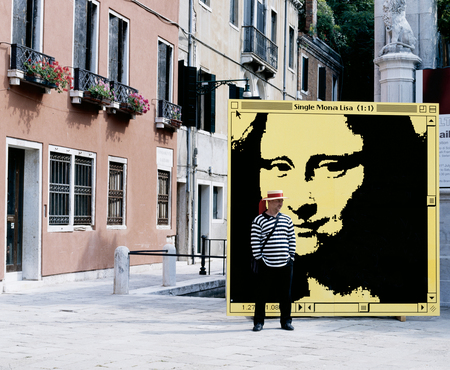
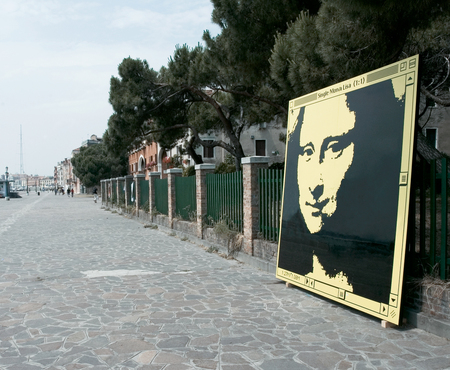
Installation Mona Lisa Goes Venice. Silkscreen on metal, 300×300×5 cm. Left: Campo Santo Stefano. Right: Riva dei Sette Martiri
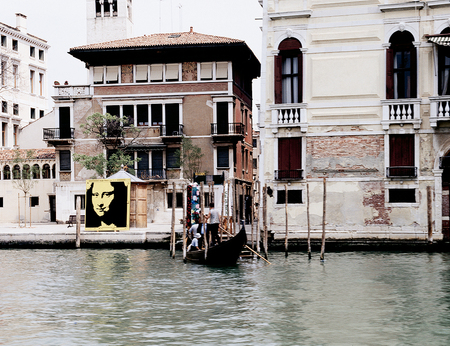
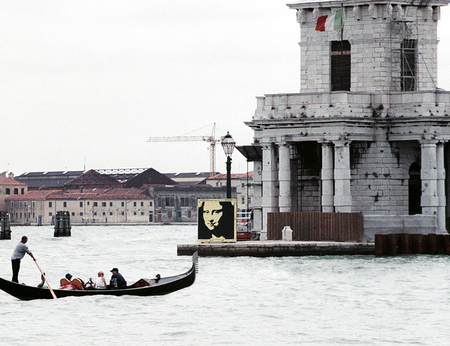
Installation Mona Lisa Goes Venice. Silkscreen on metal, 300×300×5 cm. Left: Campo San Samuele. Right: Punta della Dogana
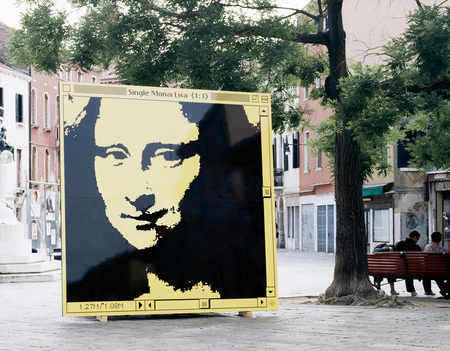
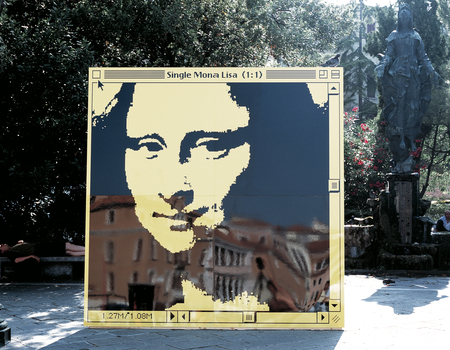
Installation Mona Lisa Goes Venice. Silkscreen on metal, 300×300×5 cm. Left: Campo Santa Margherita. Right: Piazza Santa Lucia
In residential areas, with neighborhood youths playing football under the lady’s benign gaze, the effect was dramatically different than that prompted by the noble Campo Santo Stefano. Viewed from ships entering the Canale Grande, the panel situated at the Punta della Dogana seemed at once like a majestic queen of the sea and a sternly watchful guardian, protecting the city from undesirable intruders. Unfortunately, the undesirable elements already nested within the bosom of the Doges’ ancient capital.
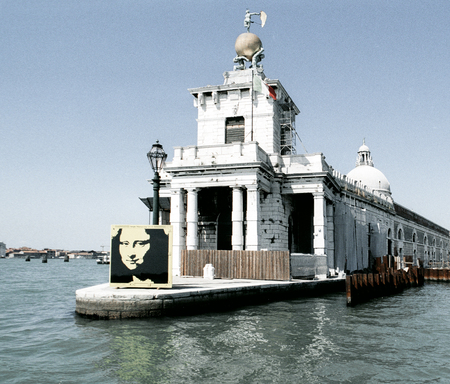
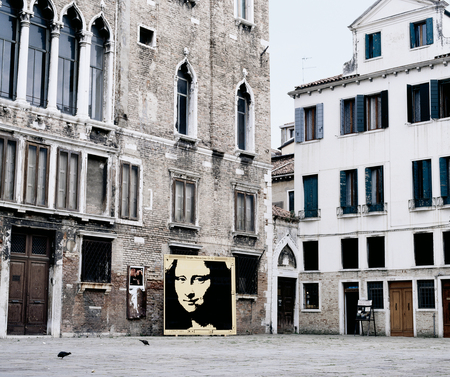
Installation Mona Lisa Goes Venice. 51st International Art Exhibition, Venice, 2005. Left: Punta della Dogana. Right: Campo San Maurizio
From left to right: George Pusenkoff, Roberto Vittori, David Galloway, Gerda Ridler, Marc Scheps, Olga Bisera, Pasquale Di Palermo, Riccardo Panunzi, Nicola Savoretti, Valery Baranov
On the night of June 8th, vandals disfigured the Mona Lisa installed in the picturesque but somewhat decrepit square of Campo Santa Margherita. With ballpoint pens and knives, they subjected the figure to a violent attack, reserving their greatest fury for the figure’s celebrated, enigmatic smile. There was none of the sprayer’s skewed humor or macho bravura here; the aggression with which one knife-wielding vandal stabbed at the image was unmistakable. The perpetrators were never apprehended, though in the course of the following days they would disfigure several other panels, as well.
Mona Lisa had survived a breathtaking journey into outer space, but not a single night on the streets of Venice.