Categories
- Concept
- The Cat as a Natural Subject
- The Cat as a Genre Character: A Human Companion in Edo Period Art
- Anthropomorphism Through Mythology: Cat Demons
- The Cat in Place of Man: Anthropomorphism as a Means of Bypassing Censorship
- The Image of the Cat During Artistic Modernization
- Conclusion
- Bibliography
- Image Sources
Concept
The image of the cat in Japanese art occupies a special place due to its dual nature. On one hand, it was perceived as a domestic animal intimately connected to human daily life. On the other hand, in Japanese culture, it was endowed with mystical qualities and could take human form, occupy human spaces, and interact with people on equal footing.
Throughout the centuries, artists interpreted this image in various ways. In early painting of the 16th–17th centuries, the cat appears as part of the natural world. During the Edo period, it became a companion in everyday scenes and simultaneously a mythological being in the depictions of bakeneko and nekoma. By the mid-19th century, anthropomorphism takes on a social character: in the woodblock prints of Utagawa Kuniyoshi, cats replace people to circumvent censorship. During the period of modernization, interest shifts toward observing the animal’s natural form—the image undergoes a reversal, returning to the natural pole from which its history began.
How has the image of the cat evolved in Japanese fine art from the 16th to the 20th centuries: between a natural subject and an anthropomorphic character?
This visual study aims to examine the transformation of the cat’s image in Japanese fine art from the 16th to the 20th century. The primary focus is on how the visual and semantic role of the animal changed—from a natural object and decorative element to a genre character, a mythological being, and an anthropomorphic figure.
The analysis is built upon comparing paintings and woodblock prints from various periods, allowing us to trace shifts in composition, plasticity, and the character of the cat’s interaction with humans. Of particular significance is the question of how the cat’s image related to the social context and artistic traditions of each era, and how the artistic language dictated the methods of depicting the animal.
Cat as a Natural Object
Initially, the cat appeared in Japanese visual arts as a natural motif incorporated into broader compositions, lacking an independent narrative function. Imported from China around the 6th century, it held a utilitarian purpose as an animal protecting temple scrolls from rodents [1].
Owning a cat signified belonging to the elite, so artists included it in compositions as a sign of sophistication—alongside fine fabrics or exquisite furnishings. One example is the Uta Gyoshi scroll, «Musky Cat, ” where the animal is depicted next to a blooming camellia and a bird.
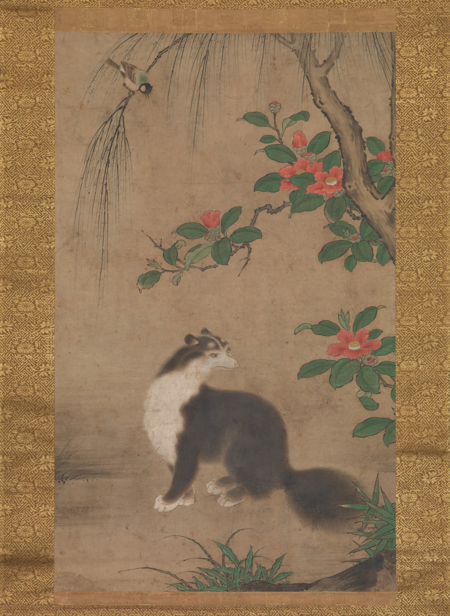
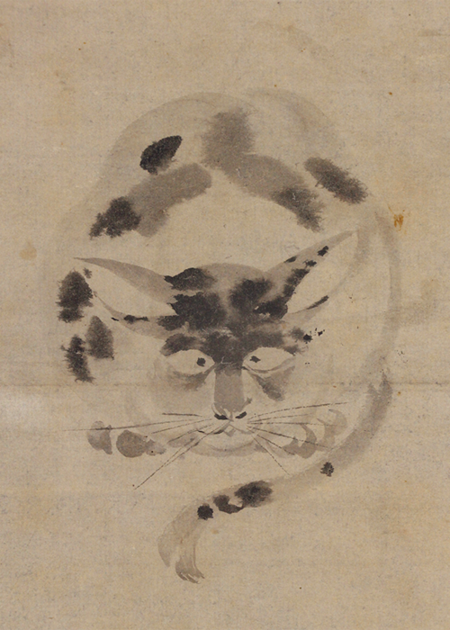
Uto Gyoshi, «Musk Cat, ” 16th century // Kano Yasunobu, „Two Scrolls with a Cat and a Rabbit, ” 17th century — fragment
When comparing these two works, a common element is noticeable: the cat is depicted as a self-sufficient natural form, without interaction with humans or narrative function.
Thus, at this stage, the cat functions in art as a natural object—a background symbol of aristocratic status, not yet imbued with emotion or narrative. It is part of the world, but not yet its storyteller.
The Cat as a Genre Character: Man’s Companion in Edo Art
During the Edo period (17th–19th centuries), the image of the cat increasingly appears in Ukiyo-e genre scenes related to private life and domestic settings. In these depictions, the cat ceases to be a background element and begins to integrate into the composition on par with human figures and the surrounding environment [2].
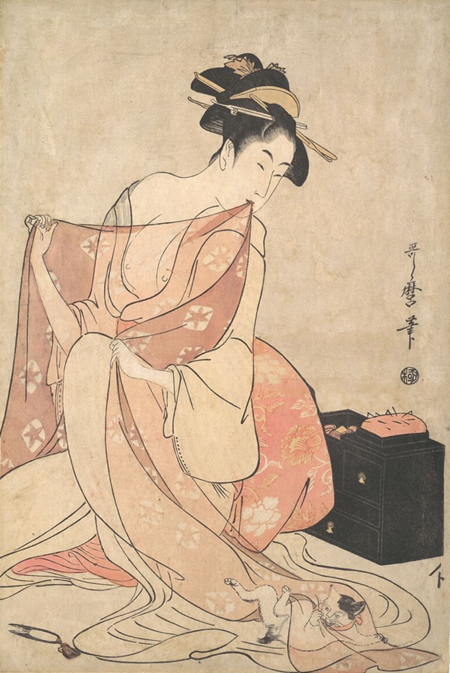
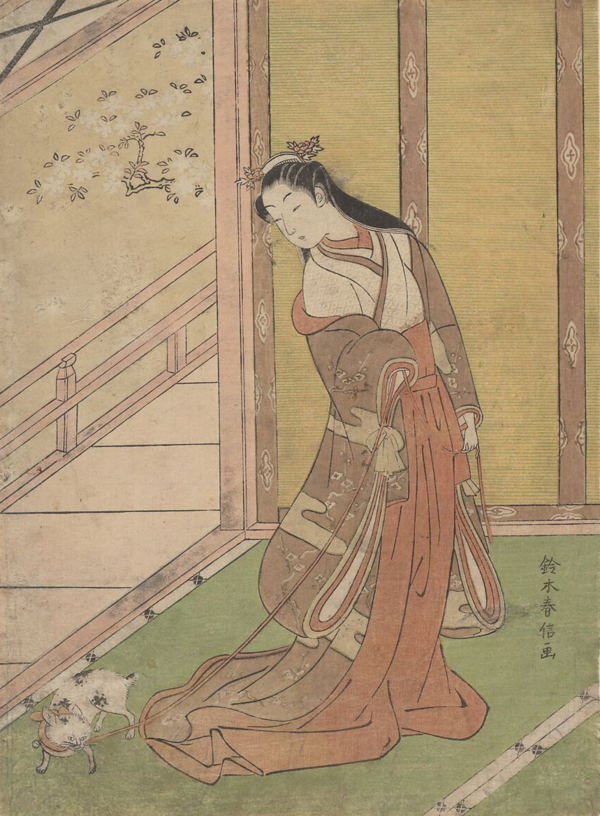
Kitagawa Utamaro, «Woman and Cat,» 1793–1794 // Suzuki Harunobu, «Onna San no Miya (Third Princess),» 1768–1770
In these works by Suzuki Harunobu and Kitagawa Utamaro, a shift is demonstrated: the animal is placed in close proximity to the heroines and becomes part of the overall scene. Simultaneously, it retains its own plasticity—an altered pose, movement, or head turn—which makes it stand out within the composition.
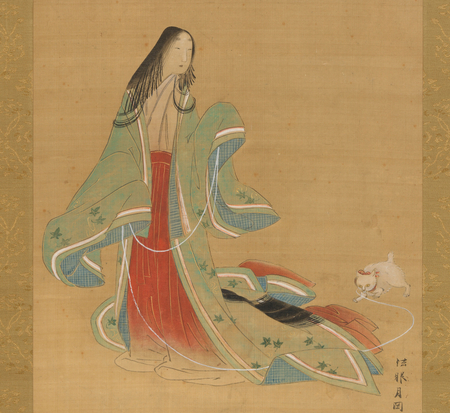
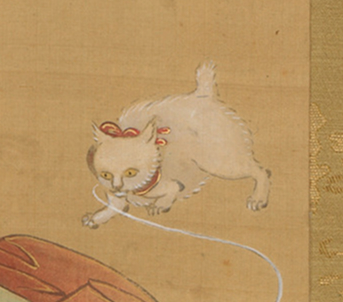
Tsukiyoka Sattei, «The Third Princess with Her Cat, from Chapter 'New Herbs I' (Volume I) of The Tale of Genji, ” 18th Century — Fragment
In Settei Tsukioka’s work, the interaction between human and animal figures is intensified through compositional connections—primarily leading lines, including the leash as a visual axis. It not only connects the characters but also organizes the scene’s structure, directing the viewer’s gaze.
In this context, the cat becomes integrated into the system of visual movement: its posture and displacement trajectory form the dynamic center of the composition, shifting the emphasis from the human figure to the interaction between elements. This allows the animal to be perceived not as a decorative addition, but as an active component of the image’s construction, participating in the distribution of visual balance and tension within the scene.
Yoshitoshi Tsukiyoka, «Cat Play,» 1888.
In many engravings, cats are depicted wearing red collars and bells, which indicates their status as domestic pets and emphasizes their emotional bond with their owners. The red collar serves as visual proof that the cat is cherished by its owners [3].
Kiyohiro Torii, «Woman Sitting Holding a Cat,» 1755 — fragment
Overall, in Edo art, a persistent motif of the cat emerges as part of everyday life. Here, the cat is not merely a decorative detail but a regular element in genre scenes, connected to humans through shared presence within a single visual field.
Anthropomorphism through Mythology: Demon Cats in Ukiyo-e Art
Parallel to the formation of the cat as a real companion to humans, another line of its visual interpretation—a mythological one—developed during the Edo period. In this context, anthropomorphism manifests through the image of the shapeshifting cat (yōkai), in which the animal is endowed with human characteristics: it may be depicted in a standing posture, wearing clothes, holding musical instruments, or in other attributes of human activity.
Two closely related images of such creatures are distinguished in the Japanese mythological tradition: the bakeneko and the nekomata. The bakeneko is often mischievous, while the nekomata represents its older, stronger, and more malevolent form [4].
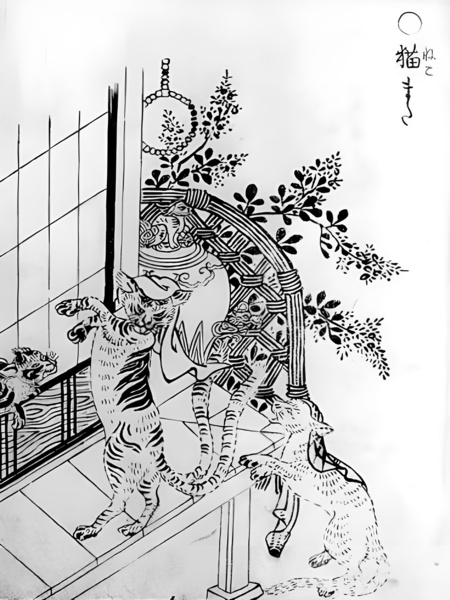
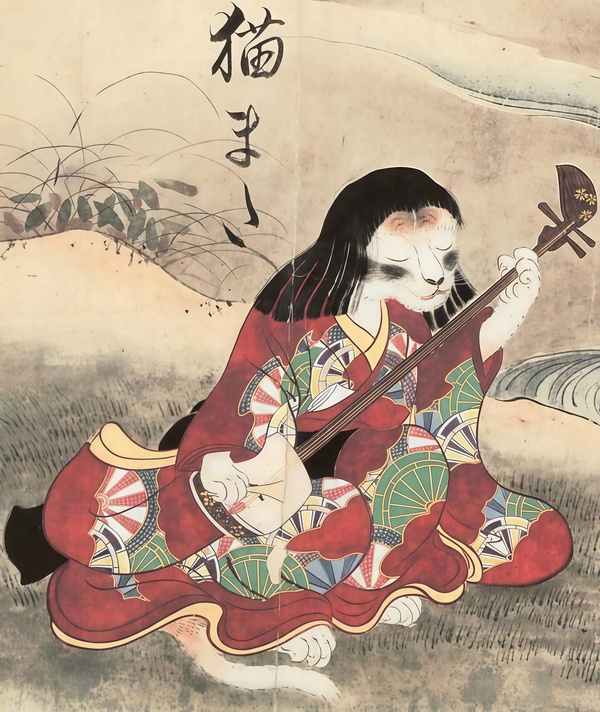
Toriyama Sekien, «Night Parade of a Hundred Demons, ” Nekomata, 1776 // Savaki Sushi, Illustrated Book of a Hundred Demons, 1737
In Sakiena’s work, there is a cat wearing a headscarf, standing on two hind legs with a split tail—the primary sign of a transformation into a nekomata. In Sawaki Susi’s work, the transformation is already complete: the nekomata sits in the form of a girl wearing a red kimono and playing the shamisen.
A comparison of the works shows that in 18th-century Japanese art, there were already two ways to depict anthropomorphism: as a process of transformation and as its result.
Utagawa Kuniyoshi, «The Witch Cat, the Ghost Cat, and Dancing Cats, ” 1847–1850.
As Ukiyo-e woodblock printing matured, the mythological figure became a mainstream subject. In Kuniyoshi’s work, the cat-demon is not chosen randomly to possess an elderly woman. Most often, the bakeneko possessed childless aristocrats, particularly widows—in a patriarchal society, they were considered closest to the «other world» because they existed on the social periphery and failed to fulfill the primary function, by contemporary standards, of bearing an heir [5]. Anthropomorphism here is not simply transforming an animal into a human; it is a means of visualizing previously invisible experiences: the rage and power of a woman whose subjectivity society denied her.
Utagawa Kuniyoshi, «Scene from a Ghost Story: The Demon Cat from Okazaki, ” 1850.
Here, the artist employs a kabuki technique: an obsessed woman is depicted as ordinary, but the presence of the demon is revealed by a huge cat’s face in the background. The scene shows the moment when the bakaneko steals the life force of Prince Hizen: on the right is the demon’s host, and beside her is the spirit of the dying prince. The cat, the human, and the demon exist within one body [5].
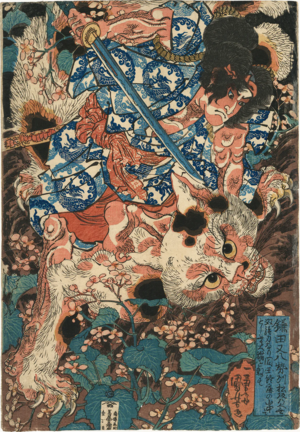
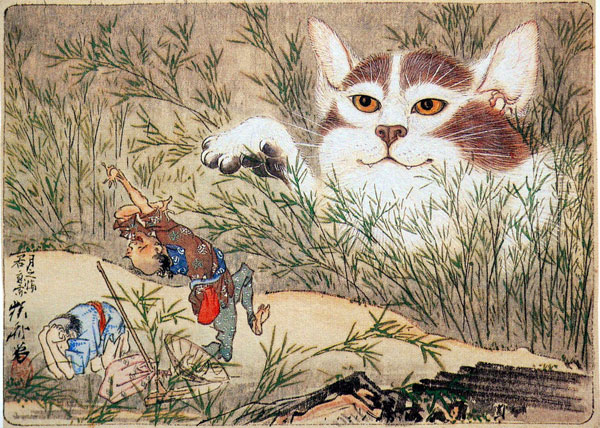
Utagawa Kuniyoshi «Kamada Matahachi Slaying a Monstrous Cat in the Ise Province Mountains, ” 1840 // Kawanabe Kyosai, „Giant Cat“ (Bakeneko), 1860–1870
In such compositions, the cat retains stable visual signs of anthropomorphism—altered proportions, a vertical posture, or involvement in human action or space. Its image is always defined through interaction with humans, which underscores the dependence of the mythological form on a human context.
Thus, within the mythological tradition, the cat gains expanded visual possibilities for depiction: from an animal form to a hybrid state where human and animal traits coexist within a single image.