Description
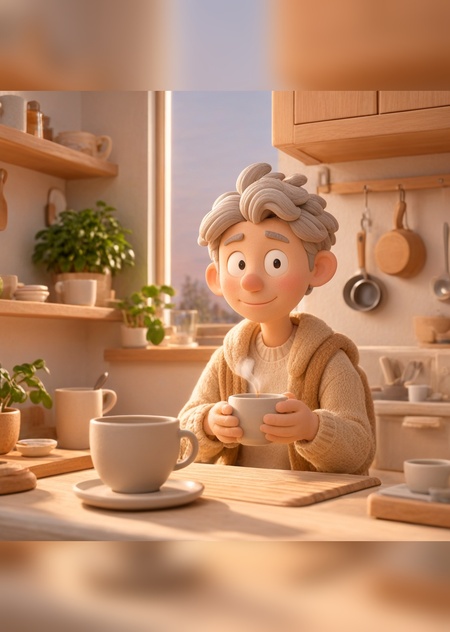
This is a series of images featuring a small character who lives in a warm and quiet world of everyday rituals. He drinks coffee, works, draws, sits in cafes, relaxes in an armchair, and returns home at sunset. The project explores solitude not as a state of anxiety, but as a space of serenity, self-reliance, and gentle self-care.
Project Concept
The core of the project is the image of a small 3D character designed in the aesthetic of a soft toy and a plasticine miniature. It was important to me to create not just a character, but an entire visual world: warm, intimate, tactile, and slightly playful.
The main theme of the series is quiet solitude. The character is almost always alone, but this solitude does not feel empty or dramatic. On the contrary, it becomes a form of personal space—a place where one can work, relax, read, draw, and be with oneself.
Visual Style
The project style can be described as a soft, toy-like 3D aesthetic with elements of clay miniature. The images feature rounded shapes, a warm color palette, soft materials, woolly and earthy textures, wooden surfaces, houseplants, and bright, sunlit interiors.
Dataset
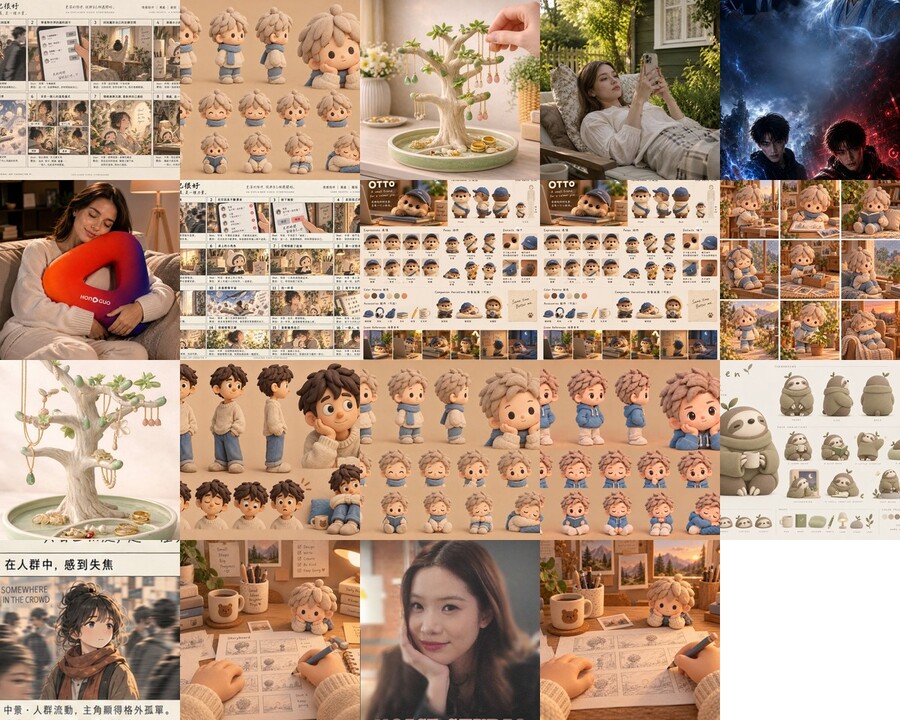
A dataset of 19 images was prepared for training. It included character references, expressions, hairstyles, clothing, poses, as well as images with a cozy atmosphere and soft lighting. All images were resized to a 1:1 square format and prepared at a resolution of 1024×1024 pixels.
The Learning Process
A dataset of 19 images was prepared for the training. This set included character references, variations of facial expressions, hairstyles, clothing, poses, as well as images conveying a cozy atmosphere and soft lighting. All images were standardized to a 1:1 square format and prepared at a resolution of 1024×1024 pixels.
Final Series
Results Analysis
The model effectively captured the core features of the visual world: soft 3D sculpting, the character’s rounded form, warm interior lighting, a tranquil composition, and the feeling of a small, handcrafted miniature. In its best shots, the protagonist appears as an independent character organically existing within a cozy setting.The scenes featuring coffee, a laptop, drawing, and cafes were particularly successful. They retain the project’s central image: a small protagonist is alone, but their solitude feels calm and fulfilling. It is connected to personal rituals rather than isolation.However, the final result is not entirely consistent. In some scenes, the model alters the character’s appearance or shifts the focus away from the protagonist and onto the surroundings. This is evident in the scenes of reading, walking through the city, and returning home. These errors highlight the limitations of the small dataset and the difficulty of maintaining a single character across diverse situations.Despite this, the final series conveys the core concept: a world of soft clay where everyday activities transform into quiet visual narratives about self-care.
Generative Model Application Overview
During the project development, generative artificial intelligence tools were utilized. Stable Diffusion XL Base 1.0 (Stability AI) served as the primary generative model. The model was locally fine-tuned using the DreamBooth LoRA method on a custom-prepared author dataset. The training dataset comprised the author’s proprietary visual materials; automated image scraping from open internet sources was not used for the final training. A specific token, tnsolo, was employed to identify the author’s character during the training process. The resulting LoRA model was used to generate the final series of images, wherein the character was situated in various everyday scenarios: working on a laptop, reading, drawing, visiting a café, strolling, and relaxing. The core images of the final series were generated locally using the fine-tuned Stable Diffusion XL model.
As an additional technical component, SDXL VAE FP16 Fix was utilized, which is necessary for the model to operate more stably in FP16 mode. The foundational structure for organizing the learning process and the code architecture was derived from the course notebook on training Stable Diffusion XL using the DreamBooth LoRA method; the code was subsequently adapted for local execution and integration with a proprietary dataset.
Furthermore, ChatGPT (OpenAI) was employed during the workflow. It served as a supplementary tool for structuring the local training process, debugging and correcting technical errors, organizing the project structure, developing and refining text prompts, and preparing and editing the project’s written documentation. ChatGPT was not used to create the training dataset nor did it function as a tool for the direct generation of the final visual series.
The training dataset includes the author’s original visual materials.