Concept
In medieval European art, religious themes related to Christian history and the figures of saints held a prominent place. One of the most common images in Italian painting was the Virgin Mary with the infant Christ. Mary was depicted both as a mother and as a sacred figure possessing special religious significance. Her sanctity was emphasized using traditional artistic techniques and symbols that helped the viewer perceive the image as a religious object. [1]In the 13th century, Italian painting was influenced by Byzantine artistic tradition. Works from this period were characterized by gold backgrounds, solemn compositions, and static figures, while Mary often occupied a central position. Such works were primarily intended to convey religious meaning. [1]The late 13th to early 19th centuries marked an important phase in the development of Italian painting. Artists began to focus more on the volume of the human body, the depiction of space, the naturalness of gestures, and the emotional interaction between characters. These changes are particularly noticeable in the work of Giotto and Duccio di Buoninsegna. [1]Of particular interest is how these artistic characteristics manifested in depictions of the Virgin Mary with the infant Christ. In some works, Mary is presented on a throne surrounded by angels and saints. Her central position, symmetry, gold background, and halos underscore her sacred status. In other compositions, artists focus attention equally on Mary and the child. Here, their gazes, touches, and the positioning of their bodies play a crucial role. However, the absence of angels or a throne does not signify the disappearance of religious content, as the sacred nature of the image can be conveyed through other means.
How is the holiness of the Virgin Mary and her maternal role combined in Italian painting?
For my research, I have chosen images of the Virgin Mary with the Child created by Italian artists of the late 13th–14th centuries. The works will be compared based on visual characteristics: first, I will examine the ways the sacred status of Mary is conveyed, and then the depictions of maternal intimacy and their combination. For historical context and analysis, I will utilize art historical articles and cross-reference their information with my own observations of the works.
In my visual investigation, I aim to determine the artistic means by which Italian painters merged the sacred status of the Virgin Mary with her maternal role. To achieve this, I will compare the works of different masters, focusing on composition, setting, gestures, gazes, and religious symbols. Comparing these elements will allow me to examine how artists portrayed the image of Mary differently and how maternal intimacy intertwined with its religious significance.
How does the composition emphasize the sacred status of the Mother of God?
One common way to depict the Virgin Mary in Italian painting was through the image of Mary seated on a throne with the infant Christ. However, even when employing similar compositional schemes, artists could convey space and figure placement in vastly different ways.This can be seen by examining Duccio di Buoninsegna’s «Madonna of Rucellai» and Giotto di Bondone’s «Madonna of Ognissanti,» which were created about 25 years apart.
Duccio di Buoninsegna, «Madonna col Rucellai,» c. 1285
Giotto di Bondone, «Madonna of the Annunciation, ” circa 1310.
In Duccio di Buoninsegna’s «Maestà» and Giotto di Bondone’s «Madonna of Ognissanti,» the Virgin Mary is depicted on a throne with the infant Christ. Both compositions are structured around the central figure of Mary, yet the organization of the surrounding space differs.Duccio features six angels positioned around the throne, seemingly supporting it and creating the impression of a sacred icon. [2] Giotto, conversely, places angels and saints around an architectural throne, partially obscured by its elements and by one another. [3]
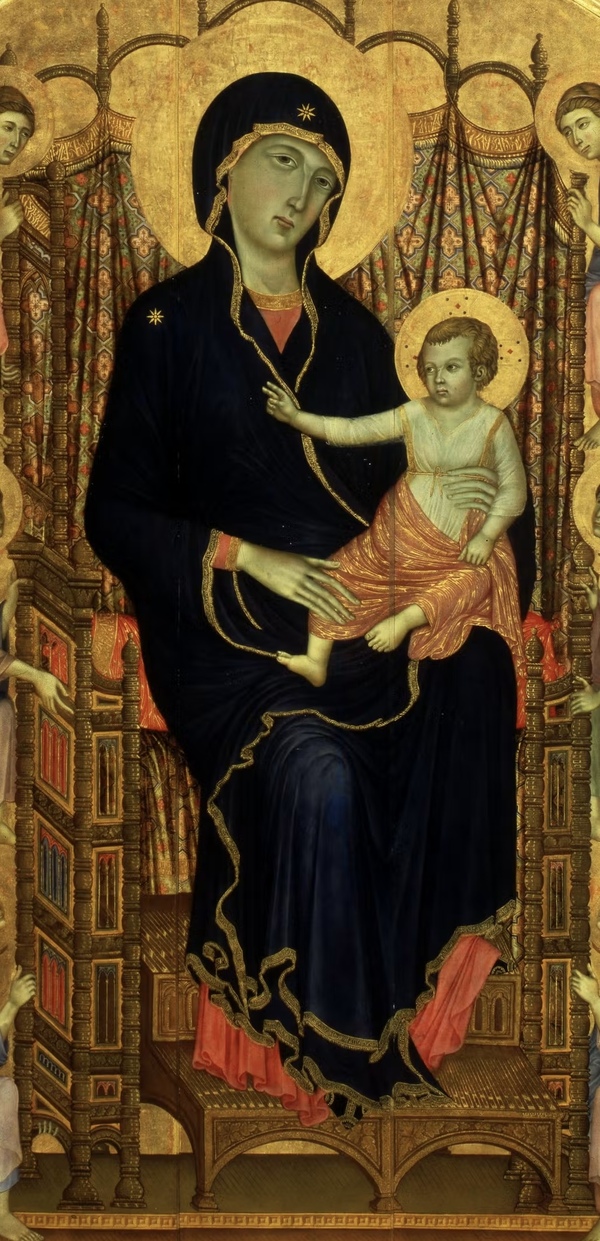
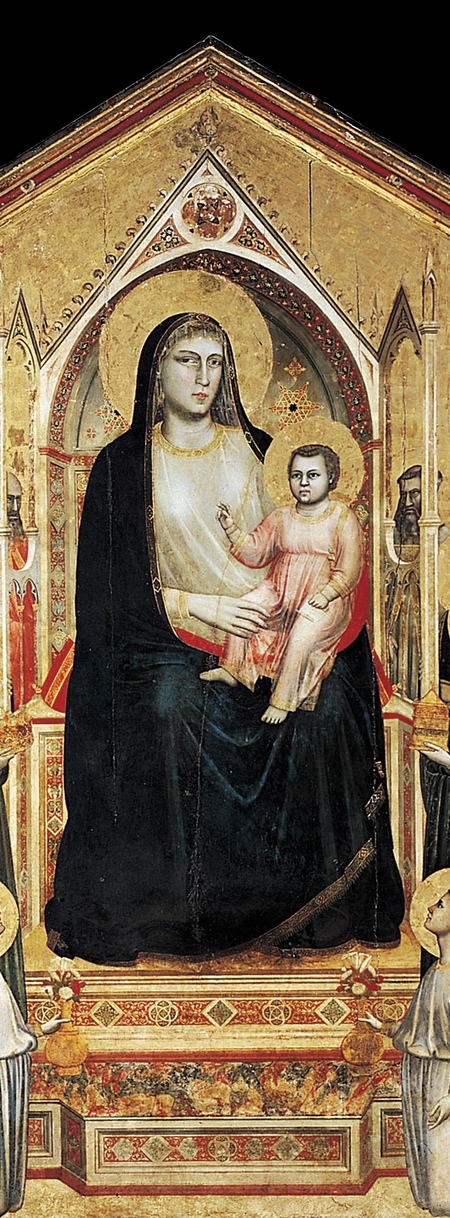
Duccio di Buoninsegna, «Madonna of Rucellai, ” circa 1285, fragment Giotto di Bondone, „Madonna of Ognissanti, ” circa 1310, fragment
In Duccio’s «Madonna of Rucellai,» the throne is depicted at an angle, allowing his sides and base to be visible. However, the golden background prevents any sense of depth in the surrounding space. The throne stands out due to its decorative elements and smooth lines, maintaining the image’s solemn character.In Giotto’s «Madonna of Ognissanti,» the throne resembles an architectural structure with arches and columns. Its elements overlap one another, creating a sense of depth. The Virgin Mary is positioned within this structure, so her figure is perceived as part of a more voluminous space.
Duccio portrays the figure of Mary slightly turned in profile. Her silhouette is emphasized by smooth lines, and the folds of her dark drapery form soft curves. The artist uses chiaroscuro to define the volume of the fabric while retaining its decorative quality. [2]In Giotto’s work, Mary’s figure appears more substantial and corporeal. The folds of her clothing do not so much embellish the silhouette as they help convey the shape of the body beneath the fabric. The artist reduces the number of decorative elements, using light and shadow to emphasize the figure’s volume. [3]
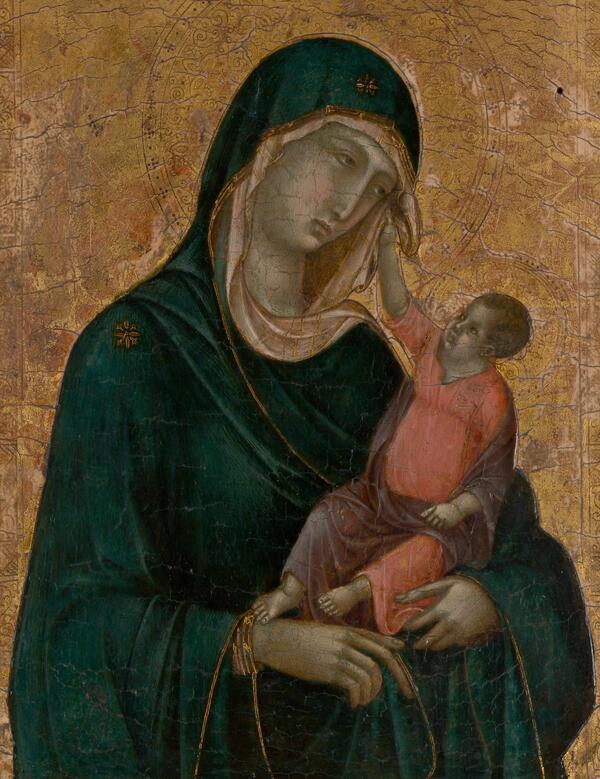
Chimamanda, «Madonna and Child with Two Angels, ” c. 1280.
In Chimamanda Ngozi Adichie’s work, the Virgin Mary is depicted seated on a throne with the infant Christ on her lap. Two angels stand on either side of her, and the golden background and halos underscore the sacred nature of the image. Unlike the works of Duccio and Giotto previously examined, Mary’s surroundings here are more restrained—the artist limits the scene to two angels. This allows the viewer’s attention to remain focused on the central figures of the Virgin and the infant.
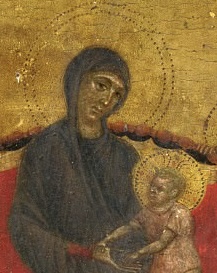
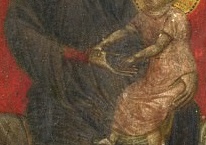
Chimaobu, «Mother of God with Child and Two Angels,» c. 1280, fragments
Halos surround the heads of the Virgin Mary, the Christ Child, and the angels, emphasizing the sacred nature of the entire composition. Christ’s halo is distinguished by an image of a cross decorated with small red and white dots. Today, these details are difficult to discern due to the condition of the painted surface. [4]
Thus, Chimubae employs traditional religious symbols to present Mary and the infant not merely as mother and child, but as sacred figures.
Despite the ceremonial nature of the composition, Chimaibu introduces a natural gesture: the infant Christ holds Mary’s hand, as if trying to maintain balance. In the National Gallery’s scholarly description, this gesture is viewed as an expression of a more intimate connection between mother and child. [5]Unlike the halos, which denote the characters' religiosity, the touch reveals the human dimension of their relationship. Both elements are present in the same image, demonstrating that maternal closeness does not contradict the sanctity of the Virgin Mary.
Bernardo Daddi, «Madonna with Child, Saints, and Angels, ” circa 1345.
In «Madonna with Infant, Saints, and Angels» by Bernardo Daddi, the Mother of God occupies the central position, towering above the surrounding figures. Her figure is significantly larger than the saints and angels positioned on either side of the throne. [6]
The composition unites several groups of characters: saints with characteristic attributes, musical angels, as well as red seraphim and blue cherubim in the upper portion of the image. [6]
Bernardo Daddi, «Madonna and Child with Saints and Angels, ” c. 1345, fragment
In the upper portion of the composition, Bernardo Daddi depicts two pairs of winged beings: red seraphim and blue cherubim. According to the description from the National Gallery of Art in Washington, they belong to the highest angelic orders. [6] Unlike the other angels, these figures are almost entirely composed of wings and stand out with saturated red and blue colors. Their placement on either side of the throne emphasizes that the Virgin and Child are surrounded by celestial powers.
Bernardo Daddi, «Madonna with Child, Saints, and Angels,» c. 1345, fragment
At the bottom of the composition, the saints can be distinguished by the objects they hold. For example, John the Baptist is depicted in camel hair, Saint Peter holds a key, and Saint Agnes holds a lamb. These attributes allow for the identification of the figures and link them to Christian tradition. [6]At the foot of the throne are two musical angels. Unlike the static figures of the saints, their actions create a sense of an unfolding event. The celestial surroundings of the Theotokos (Mother of God) are also conveyed through the interactions between the characters.
Giovanni da Milano, «Madonna and Child with Donors,» circa 1365.
In Giovanni da Milano’s «Madonna with Child and Donors,» the sacred figures are depicted alongside the patrons who commissioned the work. According to the Metropolitan Museum of Art, the painting was originally placed above the tomb of a married couple, symbolizing their meeting with the Christ Child in heaven. [7]The Virgin Mary and Christ significantly dwarf the donors in size. However, the characters do not exist in isolation; their joined hands create a connection between them. Thus, the artist simultaneously illustrates the distinction between the earthly and sacred realms and the possibility of their convergence.
Giovanni da Milano, «Madonna with Child and Donors, ” circa 1365, fragment
In the center of the fragment, Christ extends his arms toward the prostrate donors. The touch connects characters belonging to different worlds: Christ is presented as a sacred figure, while the donors are ordinary people turning to him in prayer. [7] It is particularly important that the contact occurs directly between Christ and the donors. The Mother of God supports the infant, making her a participant in this encounter. Her maternal role here is tied to the religious meaning of the image: Mary holds Christ, through whom believers gain the opportunity to approach the sacred realm.
Conclusion of Chapter One
Analysis of works from the late 13th–14th centuries reveals that Italian artists employed diverse methods to convey the sacred status of the Virgin Mary. Duccio and Giotto emphasized her grandeur through her central placement on the throne and the organization of space. Cimabue referred to traditional religious symbols, while Bernardo Daddi constructed a complex hierarchy of saints and angels around Mary. In Giovanni da Milano’s work, the Virgin Mary’s sacred status is revealed through her interaction with the donors: Mary becomes a participant in the encounter between humanity and Christ. Furthermore, the reviewed paintings already feature natural gestures and touch, which allow us to see in her not only a sacred figure but also a mother.Thus, solemnity and religious symbolism do not preclude expressions of human intimacy. This allows us to move on to examining how artists conveyed the Virgin Mary’s maternal role through gestures, gazes, and interaction with the infant.
Maternal Intimacy: Gestures, Gazes, and Touches