Media Objective
To help people perceive the connection between spatial design and their own feelings—allowing them to choose work and rest spaces more consciously and to improve the environment around them.
Media addresses everyday questions: Why is it comfortable to work at one table but difficult to concentrate at another? Why do you want to linger in a certain café? What prevents you from relaxing, even in a beautiful room?
Topic: Segment and Niche Topic
Segment: Interior and urban environment design. Narrow topic: Human comfort in everyday spaces—through light, sound, materials, furniture arrangement, and the possibility of privacy.
At the heart of each material is a specific situation and its spatial causes.
For example, we explore the topic of lighting through the question: «Why is it difficult to create a cozy atmosphere at home in the evening?»
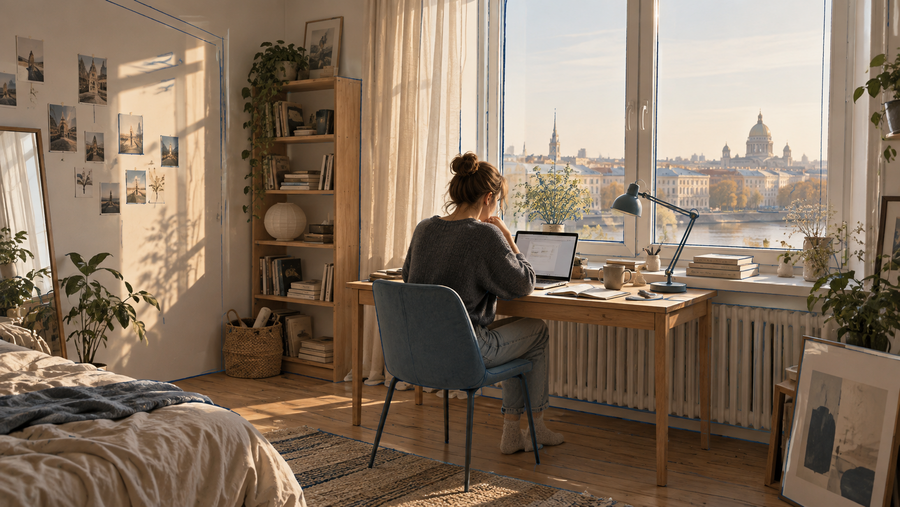
Main Sections: - «Why It’s Great Here?» — An analysis of cafes, libraries, courtyards, and other spaces based on photography and observation. - «What’s In the Way?» — Detailing elements that cause discomfort: screen glare, passersby from behind, lack of storage space. - «One Change» — Small spatial transformations that the reader can try themselves. - «Tested Itself» — Experiments by the author and readers: rearranging a desk, changing the lighting, or choosing a different workspace.
Competitors and Their Analysis
INMYROOM:
Interiors, renovation, décor, real projects, and practical materials for home design. A large selection of visual examples.
We examine both residential and public spaces. Each analysis begins with a specific feeling or everyday challenge experienced by a person.
Design Mate: Design, architecture, professional community, and projects. Strong visual components and a broad perspective on design.
We choose a narrow focus: everyday comfort. We explain the decisions using simple language and suggest a small action that the reader can take.
Distribution Channel
Main channel — Telegram. The channel will feature: short texts, captioned photos, cards, and polls. Readers will be able to submit photos of their spaces for analysis.
The proposed cadence is three posts per week: — analysis of one space; — a practical tip or a small experiment; — a poll or a subscriber photo critique.
To attract an audience, we will collaborate on posts with student communities, design channels, and local city projects.
Target Audience by JTBD
Reader Scenario:
1. «I rent an apartment, and it feels uncomfortable, but I can’t do renovations.» 2. «I study or work from home, but I’m constantly distracted.»
3. «I’m looking for a café where I can quietly read or work.»
4. «I’m studying to be a designer, and I want to understand how people use space.»
His objectives are: 1. Make living spaces more comfortable with minor changes 2. Identify and reduce spatial obstructions 3. Determine if a space is suitable for my project needs 4. Learn to justify design decisions
What media provides:
1. Ideas regarding lighting, furniture arrangement, and organization
2. Analysis of the workspace and available experiments
3. Selection criteria: noise, lighting, seating, privacy
4. Visual breakdowns explaining the relationship between the solution and human experience
Unique Selling Proposition
«Place Matters» helps you understand exactly what in a space creates comfort or causes discomfort, offering small adjustments you can test out yourself.
1. Analyzing Your Space Based on Photos
Readers send in photos of their rooms or workspaces, and in our articles, we point out the sources of discomfort and suggest three specific changes.
2. Comfort Without Renovations or New Purchases
Each practical breakdown offers suggestions for improving a space using what you already have—such as rearranging furniture, changing the direction of light, or organizing items.
3. We changed the space—we checked the results. We will return to the reviews in a week to show what the reader changed and whether it became easier for them to work or relax. We will also publish solutions that didn’t help.