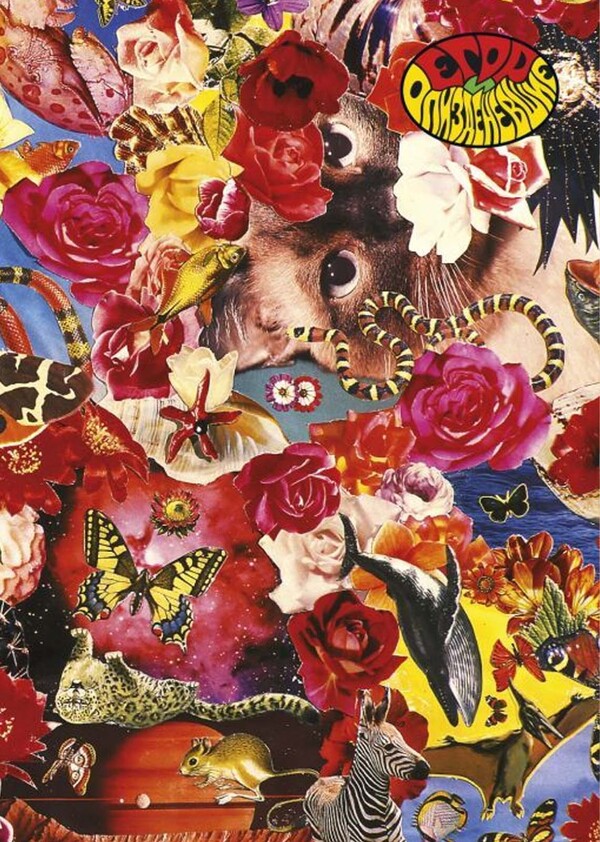
Egora Letov is generally perceived through his music—the voice, the lyrics, the legacy of «Grazhdanskaya Oborona,» the Siberian underground, and the musical aura built around it. Therefore, many of the author’s other manifestations seem to be additions to his musical career. However, his creative trajectory also includes a visual art legacy, the study of which formed the basis of the exhibition «Grass to the Waist» at the Voznesensky Center.
As a self-taught artist, Egor Letov followed a fascinating creative path, refusing to separate art into «high» and «applied.» Letov was an astonishing underground artist who invented and developed his own visual language, assembling details of everyday life into collages. These collages function much like his songs: they juxtapose often incompatible concepts. Perhaps for this reason, many of his works later became album covers for Grazhdanskaya Oborona.
At the core of Letov’s creative work lies an interest in the natural sciences. This fascination formed during his early youth: captivated by the surrounding world, he collected herbarium specimens and kept observation journals. For Egor, nature is a territory where one can step outside the established order of things. It is here that Letov’s visual art comes close to the psychedelic culture that interested and which he reinterpreted.
«Waist-High Grass» offers the opportunity to see Letov outside of his familiar legend and to view one of the main voices of the Soviet underground in a new light. The exhibition is not so much about the punk icon as it is about the person who consistently assembled his own universe from whatever he had at hand.