Concept
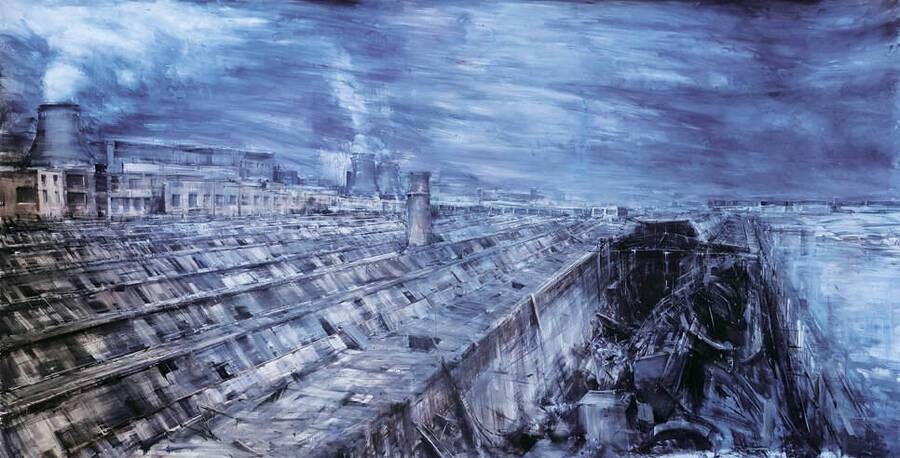
Exterior of the AZLK, 2011
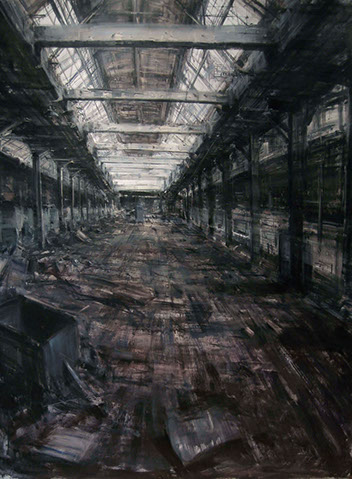
In Papetti’s paintings, I can gaze at the factory floor for a long time, even without understanding the function of the machinery. Previously, it was difficult for me to articulate what I was feeling. I experienced something similar while looking at mountains or stormy seas, or contemplating the scale of space. After studying Kant’s «Critique of Judgment,» I was able to connect these sensations to the experience of the sublime.
But how can an image of an abandoned factory, a shipyard, or an old machine evoke such a feeling? By what means do ordinary, human-made mechanisms acquire such power?
In this study, I will attempt to determine which artistic techniques help us experience the sublime when viewing industrial objects. I hypothesize that this is related to how the image disrupts conventional perception and forces me to feel the limitations of my own viewpoint.
To begin, I will return to Kant’s definition of the sublime. Then, I will examine Papetti’s works—what I feel, which details I notice, and how they affect my impression. For comparison, I will refer to the industrial imagery of Charles Schiller, Bernd and Hilla Becher, Eduard Burtynsky, as well as the films of Denis Villeneuve and Andrei Tarkovsky. The idea of including cinema arose unexpectedly during the research and helped me see the effect of certain techniques more clearly.
For me, the perception of art begins with personal experience. This is especially true when discussing the beautiful and the sublime: it is difficult to discuss these experiences without referring to one’s own feelings.
Therefore, I suggest that you first view each image on your own. Note the overall impression, and then examine the details: what you see, where your gaze lingers, and how your feelings change as you look closer. Only then should you read my commentary.
Route
— What Kant called the Sublime — Who is Alessandro Pagetti — Alessandro Pagetti’s Industrial Archaeology — Industrial Imagery in Other Authors' Work — Cinematographic Analogies — Conclusion — Sources
What Kant Calls the Sublime
We call the sublime that which is absolutely grand.
Industrial Landscape — First GPZ
For this study, it is important to me that Kant links the sublime to the limits of sensory perception and the capabilities of reason. He distinguishes between the mathematical sublime, which relates to magnitude, and the dynamical sublime—which relates to power. This discussion pertains to the human condition.
Great size, fear, or a misunderstanding of a complex machine’s workings do not, in themselves, signify such an experience. What matters is the transition from the feeling of one’s own limitations to the awareness of reason’s potential.
Kant primarily examines the sublime through examples from nature. In this research, however, I will try to understand how his thought helps explain my own sensations and what exactly in an image amplifies such experiences.
Shipyard, 2013
However, the scarier their appearance, the more it draws us in—provided we feel safe…
Who is Alessandro Papetti?
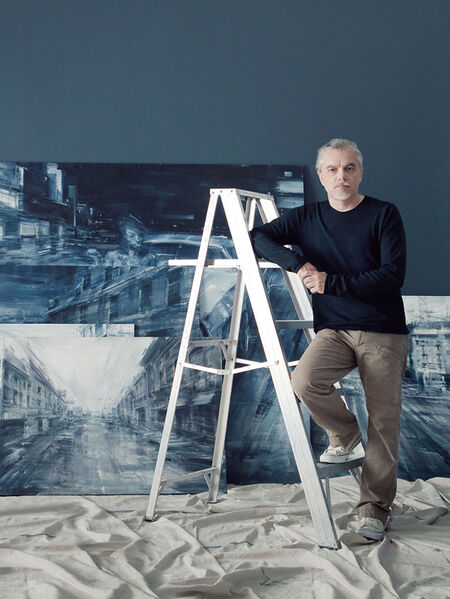
Alessandro Papetti (born 1958, Milan)—an Italian painter. His primary themes include humanity, interiors, the city, water, and the industrial environment. He achieves his recognizable style through swift brushstrokes, a restrained palette, blurred contours, and tense perspective.For this study, several stages of his artistic journey are particularly relevant:— Late 1980s — 1992. Moving from «Portraits Seen from Above, ” Papetti transitions to the Reperti cycle, which focuses on objects, details, and traces of time within workshops and factory interiors.— From 1992 on— „Industrial Archeology.“ At the suggestion of the Bellinzona Gallery, the artist began exploring local enterprises in the Lecco district. Workshops and machinery became independent subjects in his painting. The outcome of this early period was the exhibition Interni di fabbrica (Factory Interiors) 1993–1996 at Villa Manzoni in 1996.— The 2000s. The industrial theme developed into depictions of shipyards and the former Renault factory on Segno Island. The Renault cycle was shown in 2007 at the 1930s Museum in Bolon-Biancure. Concurrently, Papetti explored water, the city, and the scenic spaces surrounding the viewer.— 2012 — „Moscow. Factories of Utopia.“ The A. V. Shchusev Museum of Architecture features nearly 30 large canvases dedicated to ZIL, AZLK, and the First GPZ. The project curator was Umberto Giannetti. The artist was particularly impressed by the preserved equipment—the spaces look as if the workers have stepped away only momentarily.
Industrial Archaeology by Alessandro Papetti
«Industrial Archaeology» is one of the central themes in Papetti’s work. He depicts abandoned industrial spaces: railways, derelict factories (such as the former Renault plant in France), and shipyards. A defining characteristic of these pieces is the absence of people while their traces remain. This creates a feeling of frozen time.
Intermediate ConclusionsIn Papetti’s works, I recognize workshops, machinery, and metal structures, but I can’t always organize them into a coherent space. When I try to examine a single object in greater detail, its outlines begin to dissolve into brushstrokes. The image seems to slip away precisely when I try to grasp it. There is something dreamlike about this—the place feels familiar, yet it resists clear definition. This generates a subtle sense of unease.Color supports this instability. In many works, muted gray, blue-green, and earthy tones anchor the objects to their surroundings. Dark details merge, and bright areas blur the contours. It becomes difficult for me to determine where the machine ends and the surrounding space begins.At the same time, I find myself mentally situated inside the painting. Empty passages evoke a sense of human absence, while the imposing details prompt me to imagine their weight overhead. The signs of wear encourage reflection on the time this place has already endured.My hypothesis is this: Papetti brings me closer to an experience of the sublime through a recognizable space that resists complete visual mastery. Perspective and the repetition of structures suggest its vastness; the heavy forms convey power—but the brushwork and color leave the perceived reality tenuous. I continue to look, experiencing a simultaneous pull and anxiety.