Review of the Exhibition «The Art of the Book: From Sign to Media».HSE Art Gallery at Vinzavod / HSE Art Gallery July 7, 2026 — August 25, 2026Book Designer Authors: Tatyana Andreeva, Ivan Arbuzov, Naël Benk, Daria Brazhnikova, Liya Brusser, Tatyana Bulanova, Anastasia Vakharomova, Valeria Vershinina, Ekaterina Voloshina, Olesya Gavrilina, Aysylu Galieva, Anastasia Garmash, Snezhana Gireva, Anna Goroshko, Anastasia Grigoryeva, Anna Derizyukova, Sofia Yeristavi, Margarita Esenkova, Polina Zherebtsova, Chulpan Zaydulina, Sergey Ivanov, Anna Ivanova, Sofia Ivanova, Alexandra Kashentseva, Yulia Kisileva, Stasya Kislitsa, Anastasia Klyueva, Evgeny Korneev, Ekaterina Krivosheina, Elizaveta Kutepova, Polina Livaich, Elizaveta Lotnikova, Maria Lysova, Maria Lycheva, Saida Magadova, Elizaveta Makedonskaya, Arina Maksimova, Ekaterina Milega, Valeria Morozova, Adelina Nabeeva, Georgiy Novikov, Elizaveta Ovchinnikova, Anastasia Pavlova, Anastasia Pankko, Elizaveta-Eva Pelevina, Daria Pyadushkina, Varvara Savelyeva, Anna Savonyaka, Polina Tataeva, Anastasia Silantieva, Alexander Smirnov, Anna Sobkina, Ulyana Sorokina, Yulia Subbotina, Amalia Ustinovich, Isaak Utegenov, Elizaveta Kharitonyuk, Svetlana Hegay, Daria Tsekhmisterova, Natalya Chekalina, Ksenia Chepanova, Tatyana Chestnova, Vasily Chukovsky, Renata Sharipova, Diana-Rada Shuvalova, Elizaveta Shcheblyakova, Yana YurasovaArtists' Works: Konstantin Adjer, Vladislav Efimov, Evgeny Korneev, Alexandra Kuznetsova, Vladimir Potapov, Igor Samolyot, Alexander SmirnovCurator: Mila Ershova, Margarita Esenkova, Evgeny Korneev


Exhibition Types
Images: Roman Konovalov / HSE Art and Design School Gallery
The exhibition «The Art of the Book: From Sign to Media, ” held at the HSE Art and Design School Gallery, functions as a comprehensive guide to the grammar of the book. For centuries, the book—as a unit of knowledge and a treasure trove of culture—has captured the transformations of time, serving as a unique nexus where physical form and meaning intertwined.
Despite the exponential growth of digital technologies, the physical book—a testament to the traditions of analog printing and binding—still plays a significant role in people’s daily lives. We choose a printed book for various reasons. We love touching the pages, feeling the texture, appreciating the weight and volume of a book in our hands, we adore the distinct, ineffable aroma of the paper, we find value in leaving pencil annotations in the margins, we slip in favorite bookmarks, and much more. The book, in its complete form, is shaped by human needs and the trends of the era. As the curators put it, the union between the book and its owner is a finely tuned ecosystem.


Exhibition Vernissage
Images: Lena Lapina / HSE Art and Design School Gallery
«Engaging with a book today is a way to slow down, reflect, give yourself to your interests, and ultimately—a way for a person to return to themselves and love themselves, ” the exhibition curators believe.


Exhibition Visitors
Images: Lena Lapina / HSE Art and Design School Gallery
The current project is part of the HSE Art and Design School’s annual exhibition series dedicated to the art of the book—from the genesis of an idea to the distribution of finished copies and their life within the media landscape.
This time, the focus is on the fundamental structural components upon which printed publications are created. The exhibition itself resembles a laboratory where various formulas and stages in the genesis of a book are subjected to careful analysis and demonstrated to the viewer. The tools and methods used to assemble a book are presented in typological sections, ordered by increasing scale: «Sign,» «Strip,» «Spread,» «Block,» «Object,» and «Media.»
Each section of the exhibition consists of several levels. The first level is didactic text information, designed to provide a smooth entry point into the structural component being studied. These texts are pedagogical and encyclopedic, helping visitors quickly grasp the terminology. The second level comprises books created by the Design School students, displayed on tables and shelves—these are visual examples of book design adhering to the structural elements of the sections. Each section is complemented by works from contemporary artists, creating associative and conceptual links to enrich the viewer’s perception. The artists interpret the structure and standards of books in their own distinct ways.
Exhibition Texts
Image: Roman Konovalov / HSE Art and Design School Gallery
In the first section, «Sign, ” curators, student designers, and an artist explore the sign as a semiotic image or a minimal unit of information. It carries a specific meaning. Signs transition into letters, letters into words, words into sentences, and sentences into text. Each sign possesses its own character, which manifests depending on its integration into the text composition. On the large table, you can view printed publications where authors experiment with glyphs and letters, create typefaces, and demonstrate methods of using signs across various genres (Lia Brusser, Aysylu Galieva, Chulpan Zaydulina, Yulia Kisileva, Saida Magadova, Alexandra Smirnov, Diana-Rada Shuvalova, and others).
Section View: «Sign»
Image: Roman Konovalov / HSE Art and Design School Gallery
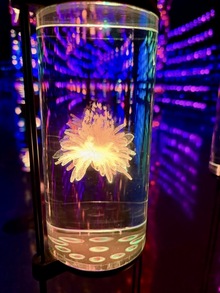
Along the perimeter of the section, you can see the installation «Elements» (1994/2006) by Vladislav Efimov. The artist directs the viewer toward the prime elements—water, earth, fire, and air. These elements served as the first symbols by which humanity described the world. Optical devices are mounted on stands; by looking into them, one can view images of the elements in stages of their destructive power. The underlying concept is that if the balance of these four elements is disturbed, chaos will ensue in the world. The same applies to the symbols used in book design—the image of the book, its language, and its philosophy depend on how and in what manner the symbols are integrated into its material.


Vladislav Efimov. «Elements, ” 1994/2026. Mixed media, print on paper
Images: Roman Konovalov / HSE Art and Design School
The signs are arranged into compositional systems. By increasing the scope of the view, we reach the «Column» section, which discusses the book page as a vital element of internal structure. Within the focus of this section is the text block—the specific area of the page that contains the information. Designers consider all nuances of the text block: column numbers, headers, margins, and other elements that comprise the composition of the text block, which solve the problems of microtypography.Compositions are born within a single text block; rhythm is established, and the font, its size, and its typeface are chosen. On display are exemplary author-biographies, visual studies in art, cultural studies, linguistics, typography research, musical phenomena, and more (Tatyana Andreeva, Anastasia Vakhramova, Ekaterina Voloshina, Olesya Gavrilina, Aysylu Galieva, Anastasia Grigoryeva, Stasya Kislitsa, Elizaveta Lotnikova, Georgy Novikov, Anna Savonyaka, Isaak Utegenov, Yana Yurasova, et al.).


Types of the «Timeline» Section
Images: Roman Konovalov / HSE Art and Design School Gallery
At the table on the wall, Konstantin Adjer displayed «Unfree Fall» (2026)—an object resembling an inverted bookshelf into which books cannot be placed. It has lost all functionality and cannot hold its contents. Similarly, the book spine—its purpose is to keep text from disintegrating, from falling needlessly. The spine, in its purest form, resembles this shelf—straight lines forming spaces for the potential placement of text.


Konstantin Ager. «Unfree Fall, ” 2026. Object, tree
Images: Roman Konovalov / HSE Art and Design School Gallery
The «Spread» section engages with the surface and the magic of an opened book, complete with its binding. A spread allows viewers to peer inside, observe symmetries or asymmetries, compare the book’s spatial composition with that of a graphic sheet, sense proportions, composition, scale, and dynamism, and furthermore, to distinctly feel the left and right sides of the spread—almost as if falling into another dimension as one nears the spine. Within this section, we showcase works by student designers where the spreads construct meaning and drive perception based on various compositional models. The collection includes books on the Chernobyl Nuclear Power Plant, hurricanes, artists, rules of library cataloging, design tool journals, expedition logs, and hockey, the collapse of the Ottoman Empire, architecture, and alternative Polish music from the late 1970s through the 2010s (including Ivan Arbuzov, Sofia Eristavi, Polina Zherebtsova, Sergei Ivanov, Maria Lysova, Elizaveta Makedonskaya, Elizaveta Ovchinnikova, Varvara Savelyeva, Daria Tsekhmisterova, Yana Yurasova, and others).


Types of the «Spread» Section
Images: Roman Konovalov / HSE Art and Design School Gallery
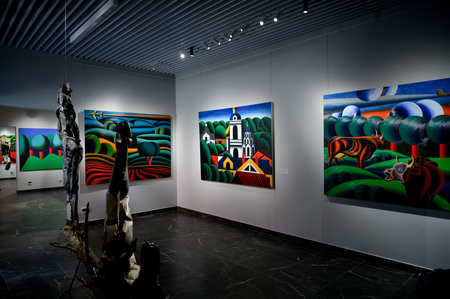
This section features Vladimir Potapov’s picturesque diptych from the «Flash from Above» series (2026). The left and right portions of the work function as two «pages» of a book. The artist discovers tension between them and amplifies it through pictorial means. The kitchen space transitions from a state of anxiety to a state of calm, and the juncture—that is, the figurative «spine» of the book—acts as a portal into new spatial and temporal forms and states.


Vladimir Potapov. From the series «Flash from Above, ” 2026. Diptych, canvas, oil
Images: Roman Konovalov / HSE Art and Design School Gallery
The «Block» section discusses how the boundaries of a book are established and how it achieves a technically complete form—a «capsule of meaning that exists in the world,» according to the curators. The book block combines all the components previously discussed: typography, strip composition, the rhythm of spreads, font dynamics, and much more.Here, we present books by authors that allow viewers to see the block as a whole and trace its existence in space. These include biographies, publications on Japanese photography and postal systems, laughter and tears, gardens, magnifying glasses, radio stations, and musical groups; exhibitions that stunned the USSR; philosophical critiques of technological progress; the Belyaev encyclopedia; archive books on «Theater on the Go, ” and many others (Anna Ivanova, Anastasia Klyueva, Polina Livaich, Maria Lychyova, Georgy Novikov, Daria Polushkina, Anna Sobkina, Yulia Subbotina, Svetlana Khegay, and others).


Types of the «Block» Section
Images: Roman Konovalov / HSE Art and Design School Gallery
At the center of the section stands Alexandra Kuznetsova’s installation, «Babylonian Library» (2026) — a bold meditation on the danger of the total collapse of knowledge and culture. The installation’s structure resembles a pile of balancing book blocks. Emptiness and the «secondary» remain. Humanity’s task is to maintain balance and fight the encroaching entropy that seeks to erase the knowledge of humankind.


Alexandra Kuznetsova. «Babylonian Library, ” 2026. Installation, wood, drywall, plywood, metal, textile
Images: Roman Konovalov / HSE Art and Design School Gallery
The second-to-last section, «The Object,» outlines the moment when a book—even one with a rather limited arsenal of expressive means—comes into a person’s hands. This is precisely when communication occurs: the book speaks to the person silently, through all the signs previously discussed.
Here, on the tables, you’ll find books on 19th-century French newspaper typography, the guitar in the USSR, Takashi Kitano, Japanese homes, landscapes and memory, proto-curing, biographies of prominent figures, and much more (Darya Brazhnikova, Snezhana Gireva, Anna Derizyukova, Aleksandra Kashentseva, Arina Maksimova, Valeria Morozova, Ekaterina Milega, Georgiy Novikov, Daria Pyadushkina, Ulyana Sorokina, Natalya Chekalina, Renata Sharipova, Elizaveta Shcheblyakova, and others).


Types of the «Object» Section
Images: Roman Konovalov / HSE Art and Design School Gallery
This section features an intriguing showcase curated by Evgeny Korneev and students from the Book Art specialization: selected prototypes from the «Prototheca» project (2020–2024). Here, participants examine the book not merely as a vessel for text, but as an architectural model—a form-making construct. Experimental book models created in paper craft are displayed on the shelves, revealing aspects that are often unseen. The collection of prototypes is constantly being replenished, updated, and reinterpreted.


Evgeny Korneev and students from the «Art of the Book» program. Selected prototypes from the «Prototeca» project, 2020–2024. Papercraft
Images: Denis Lapshin / HSE Art and Design School Gallery