Sections
- Concept
- A Woman’s Happiness (1930)
- Athena (1934)
- Abduction (1934)
- The Great Illusion (1937)
- The Case of the Lion Courier (1937)
- Conclusion
Concept
Today, I would like to examine the cinematic techniques in films featuring Vita Palò. Many directors utilize similar techniques and methods to highlight Palò's expansive acting, yet each film also contains unused—or perhaps unique—approaches. We will be looking at Julien Duvivier’s film «Lady Luck, ” Jean Vigo’s „Zora, ” Dmitry Kirsanov’s „The Kidnapping, ” Jean Renoir’s „The Great Illusion, ” and Claude Autant-Lara and Maurice Lemans' „The Case of the Lyon Courier.“
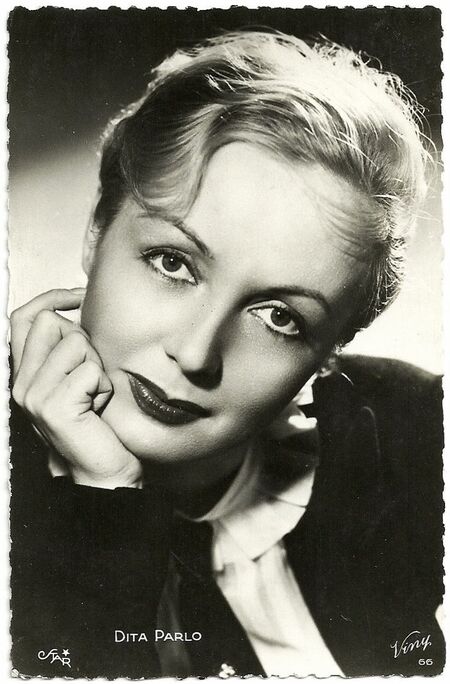
I do not wish to elaborate extensively on the actress herself or her career, nor why she became a topic of discussion. Her real name is Greta Gerda Kornstedt; she adopted her stage name in 1928. The future actress studied acting at the Drama School affiliated with the UFA film studio. She debuted in the German film «Return to the Homeland, ” and was also featured in the film „Hungarian Rhapsody.“ Throughout the 1930s, she enjoyed considerable success in German and French cinema (Dimitri Kirsanov’s film „The Kidnapping, ” Julien Duvivier’s „Ladies’ Happiness, ” and films by Viktor Turzhansky, Pabst, Vine, among others).
Dita attempted to build a career in Hollywood, but despite appearing in several American films, she failed to find success and returned to France. She had planned to take part in Orson Welles' film adaptation of Joseph Conrad’s novel, «Heart of Darkness,» but that project never materialized. The actress has a sufficiently interesting life story, and she embodies this history in her roles. Cinema strives to reveal the actress’s character fully through all its techniques.
Let’s now discuss cinematic techniques. These play a crucial role in shaping the visual language of film, allowing directors to convey emotions, ideas, and plot twists. These techniques can range from shot composition to the use of light and sound, and each contributes to the film’s overall perception.
One fundamental technique is framing. The composition of the frame dictates how the viewer interprets a scene. The rule of thirds, for instance, helps create balanced and harmonious shots. Close-ups of characters' faces can convey their emotions, generating intimacy and audience engagement. This technique is frequently used in dramatic scenes where every detail of expression is important.
Light—another powerful tool—influences the film’s atmosphere and mood. Soft lighting can establish a romantic or nostalgic ambiance, whereas harsh, high-contrast lighting can evoke tension and fear. Backlighting, where the light source is behind the subject, adds depth and mystery, emphasizing the characters’ silhouettes.
Camera movement also plays a vital role in building narrative dynamics. A smooth camera movement that follows a character can create a sense of presence and immersion in the action. In contrast, abrupt movements can induce feelings of anxiety or chaos. Zooming in on key moments heightens emotional tension.
Editing is another crucial aspect of cinema. Lyrical editing, which juxtaposes a character’s experiences with their surrounding environment, helps deepen our understanding of their inner world. Parallel editing, in turn, shows the simultaneous actions of different characters, creating tension and momentum in the narrative.
Costumes and set design also play a significant role in establishing a character’s image and status. They can convey the time and place of the action, as well as the character’s internal state.
A Woman’s Happiness (1930).
The film «Woman’s Happiness» (1930) is an adaptation of Émile Zola’s novel. Julien Duvivier directed the film. It tells the story of Denise, an orphaned girl who comes to work at her uncle’s shop. The main character is portrayed by the wonderful Dita Parlo. The actress successfully conveyed Denise’s fragility and shyness.
I believe Parlo’s leading acting technique is conveying the heroine’s mood and feelings not only through facial expressions but also through her tautly rising chest, her intense and heavy gaze, and much more. The primary cinematic techniques used were—the close-up.
In this film, the close-up on the main character accentuates Denise’s bewildered and conflicted emotion. The girl is anxious, breathes heavily, slowly shifts her vacant gaze, trying to comprehend and resolve the pressing issues.
Denisa is always surrounded by people who build a world around her. Through editing and shot layering, a «dizzying» anxiety is felt—as if we are constantly at the epicenter of the protagonist’s internal conflict.
«Lady’s Happiness» (directed by Julien Duvivier, 1930)
Atlanta (1934).
The film «Atlantis» was shot in France in 1934 and stands as one of the early examples of cinema that explores human life through the lens of confined and limited space aboard a ship. The film was directed by Jean Vigo. «Atlantis» is notable for its visual effects, employing special techniques to convey the romantic-comedy lifestyle of the main characters. The film includes numerous scenes shot in cramped conditions, which generates tension and intensifies the emotional impact. Attach Card
Foreground: Shooting the foreground is an indispensable part of cinematic technique. Introducing this device throughout the entire film helps to draw attention to the facial expressions of Dita Parlo.
«Atlanta» (directed by Jean Vigo, 1934)
«Atlanta» (directed by Jean Vigo, 1934)
«Atlanta» (directed by Jean Vigo, 1934)
Shifting Perspective: Throughout the film, the camera angle changes when filming the actress. To convey a mood of misunderstanding and melancholy, Dita is shot from the side or from above, without focusing on her entire face. Most often, when the heroine is cheerful, the shot is captured in daylight or in a bright room, whereas when the heroine is saddened, the surrounding environment darkens.