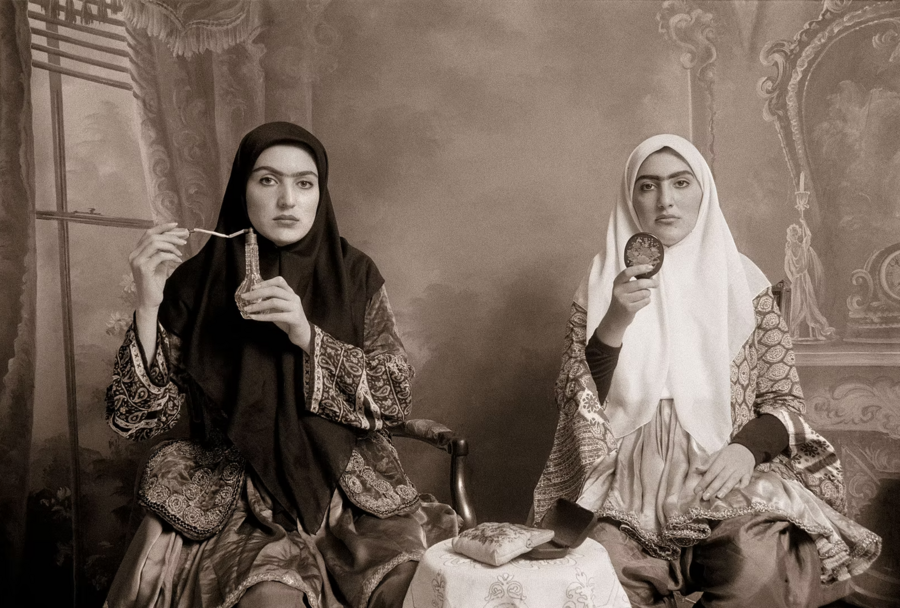
Shadi Ghadirian, «Untitled,» Qajar Series, 1998
CONCEPT
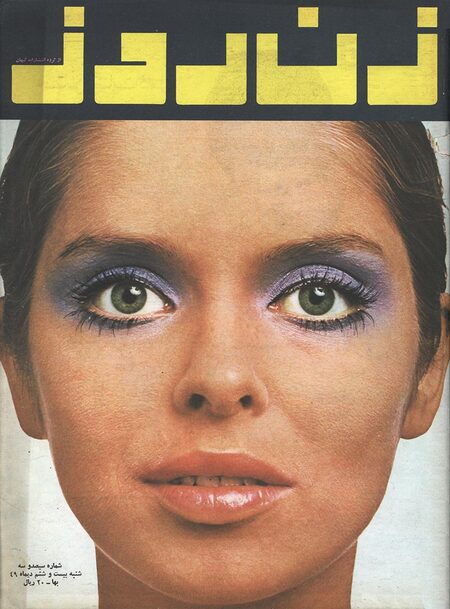
When discussing fashion photography in Iran before and after 1979, the narrative is often reduced to a simplistic dichotomy: before the revolution, women in revealing clothing; after, women in headscarves. This framework is convenient for comparing two covers, but it fails to adequately explain the photographs themselves. Modest attire existed in Iran even before the revolution; after the revolution, neither the interest in fashion, the focus on appearance, nor the desire to be photographed disappeared. What changed were the conditions under which the female body could appear before the camera, and the meaning clothing conveyed within the image.
In this work, I use the concept of the «politics of visibility» as a working framework. By this, I mean the entire set of decisions that determine how the viewer perceives the female body: which parts of the figure are exposed or covered, how the silhouette is structured, what the model is doing with her hands, where the gaze is directed, where the shoot takes place, and who ultimately has the right to publish the photograph. Therefore, the scarf is only one element. Pose, background, photograph type, and its dissemination are of no less importance.
Until 1979, the image of the modern Iranian woman was constructed across several visual spaces. The women’s magazine Zan-e Rooz combined fashion, beauty, advertising, and conversations about daily life. Its pages present not an abstract «Western woman, ” but a localized version of modernity tailored to the Iranian reader. Liora Hendelman-Baavur’s research shows that women’s magazines during the late Pahlavi era were not merely conduits for state ideology or consumer culture, but also became venues where the definition of a modern woman was debated [1]. Morad Moazami’s dissertation helps examine how beauty standards, style, and mass culture evolved between 1965 and 1979 [2].
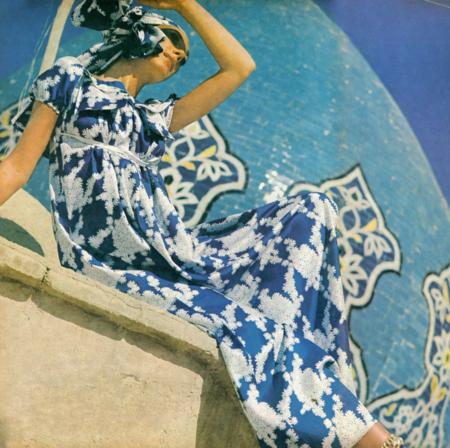
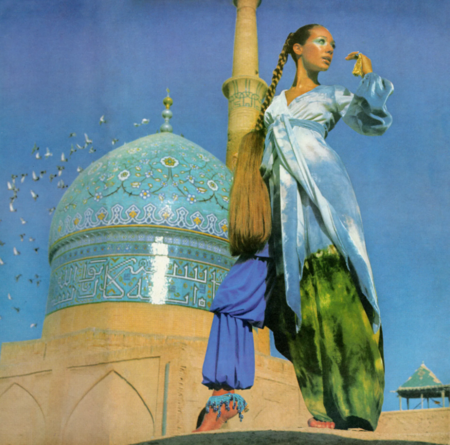
Henry Clark. Fashion editorial shoot «Fashion in the Persian-Blue Gardens of the Sun.» Isfahan. December 1969.
International glossy magazines present an alternative image. In December 1969, Henry Clark photographed for Vogue in Tehran, Isfahan, Shiraz, and Persepolis. In these photographs, high fashion is juxtaposed against palaces and historical monuments. Iran becomes not only a shooting location but also a set—a lens through which the foreign magazine constructs an image of the country. Comparing these shots with local pages in «Zan-e Rooz» reveals the difference between an internal perspective and an external portrayal.
Following the revolution, the conventional magazine model of depicting the female body faces new legal and social constraints. However, photography does not disappear. It changes genres and venues for existence: a documentary report captures the protests of 1979.
Hangame Golestan. Untitled. Women’s protest on International Women’s Day. Tehran. March 8, 1979.
Shadi Ghadirian reconfigures the historical studio portrait in her «Qajar» series, juxtaposing antique garments with contemporary objects; Shirin Neshat utilizes veiled bodies, text, and direct gaze in her artistic photography; and Afra Pourdad and Olghac Bozalp create editorial shoots inside Iran during the 2010s. In these examples, the key is not to merge genres: photojournalism and fine art photography do not automatically become fashion photography simply because they feature clothing. They serve as context, illustrating how the female image evolves outside of glossy portrayals.
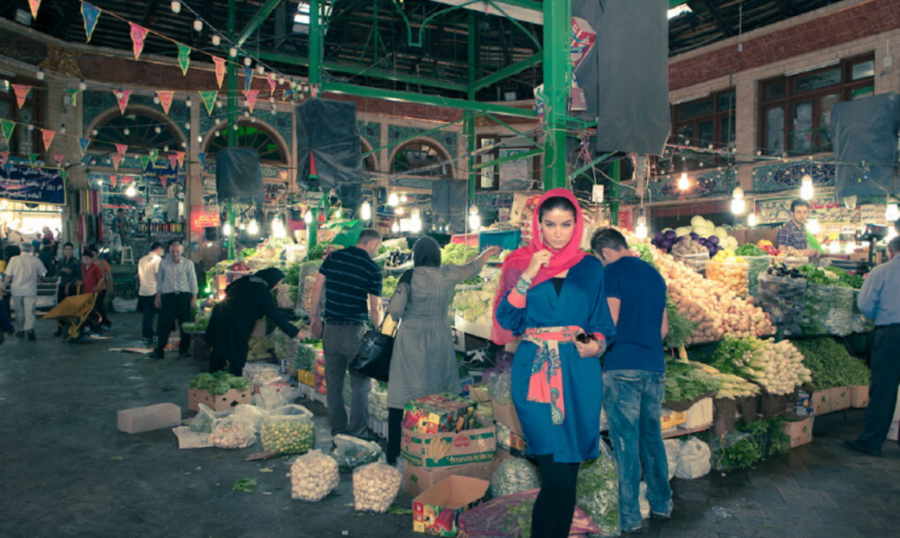
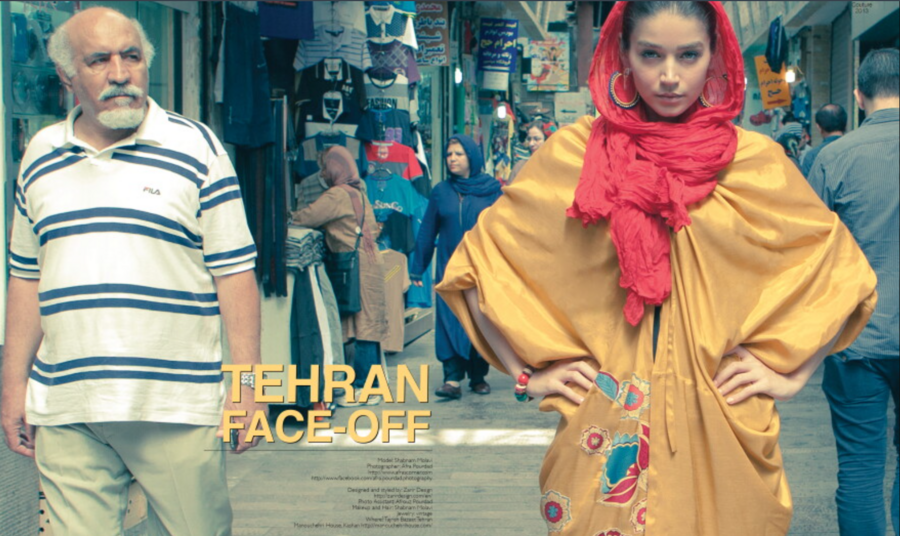
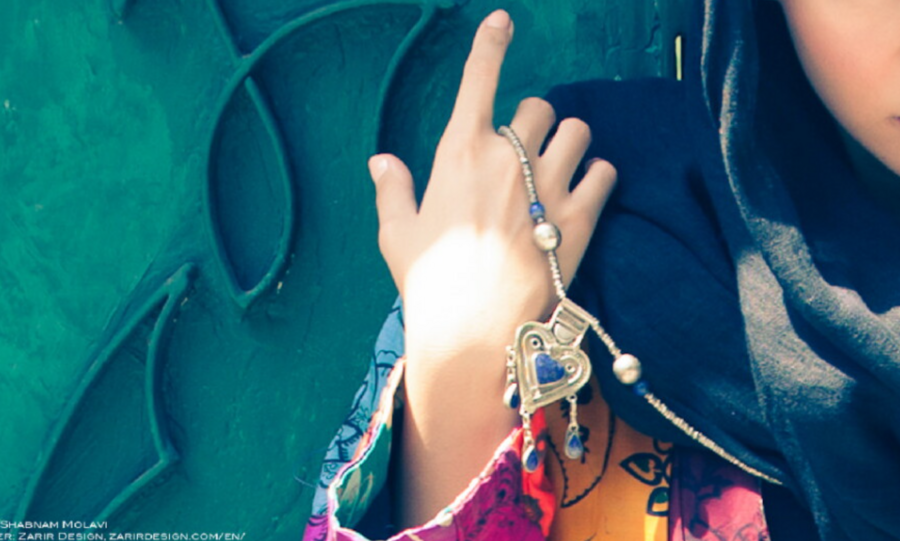
Afra Purdad. Shabnam Molavi at Tajrish Bazaar. Editorial shoot for FSHN. Tehran. 2013