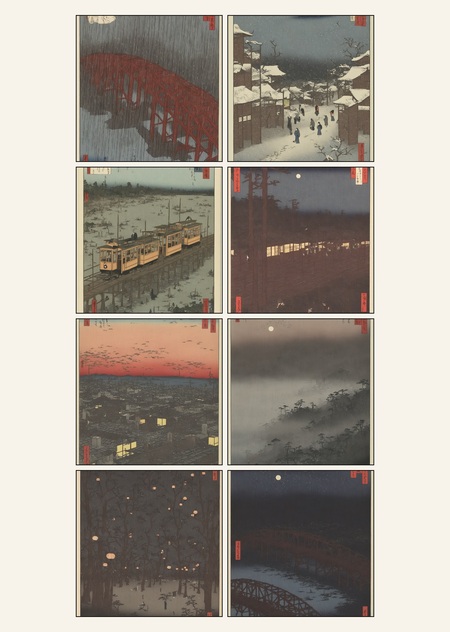
This project explores how a generative model can transpose historical visual styles onto contemporary scenes. For training, I compiled a dataset of 21 public domain images from 19th-century Japanese woodblock prints, selected from the Public Domain Image Archive, and fine-tuned Stable Diffusion XL using LoRA. In the final series, I examine how convincingly the model transfers the characteristics of ukiyo-e into modern urban imagery.
Project Idea
It was important to me to investigate not a single character, but a visual language. I chose Japanese woodblock prints as a highly recognizable system for representing space: flat composition, large blocks of color, the rhythm of lines, and attention to weather, architecture, and natural forms. After training the model on this material, I attempted to generate not historical reproductions, but new scenes related to cities, roads, bridges, water, weather, and time of day. The goal was to try and create my own small, unknown Japanese town.
The project is built on the intersection of two different eras. The original visual language belongs to the 19th century, while the final generations reference the contemporary perception of the urban environment. Because of this, the series functions as a transfer of one imaginative structure into another context.
Source Dataset
For training, I compiled a dataset of 21 public domain images of Utagawa Hiroshige’s Japanese woodblock prints from the Public Domain Image Archive. During selection, I focused on works from a narrow stylistic circle—those related to Japanese landscapes and urban environments—so that the model could better grasp the general characteristics of the imagery. Additionally, I verified the legal notices on the image pages and documented the sources.
The following attributes were key criteria in selecting the dataset:
— flat composition; — expressive outlines; — large color zones; — attention to weather and atmosphere; — the integration of architecture, nature, and movement.
Below are several examples of the original images:


The Learning Process
For the training, I utilized a course-based Colab notebook adapted to my dataset. The methodology employed was LoRA fine-tuning of Stable Diffusion XL. This approach enabled me to work effectively even with a small image set, subsequently generating new scenes based on text prompts.
First, I curated and cleaned the dataset, then standardized the images to a single square format, and uploaded them to the training environment. Subsequently, a metadata.jsonl file was generated, complete with automatic captions and the appended style prefix «in the style of hirostyle.» Following this, the model was launched, and after training, several test generations were executed using various prompt formulations. From these results, I selected the outputs in which the characteristics of the historical style were rendered most convincingly.
Final Series
Rainy Bridge


2. Winter Street 3. Tram by the Water
4. Rooftops at Sunset


5. Evening Station. 6. Misty Embankment


7. Night Lantern Park. 8. River and Bridge at Night.
Comments on the Results
In the final series, the model successfully incorporated the core characteristics of the chosen visual language. The planar quality of the space, the rhythm of the lines, the large color masses, and the specific attention paid to weather, sky, water, and the urban silhouette were preserved most effectively. As a result, the images do not appear as neutral digital illustrations, but rather as scenes constructed along the logic of Japanese woodblock prints.
However, the final frames are not a direct reproduction of historical works. I intentionally utilized contemporary or generalized motifs—the urban bridge, the evening street, the embankment, the station, the winter landscape, fog, and electric light. This demonstrates how the model translates not a specific image, but a system of visual relationships.
The most compelling result for me was discovering that historical styles can effectively engage with contemporary urban narratives. The series doesn’t merely reproduce past aesthetics; it demonstrates how an older visual language can be continued and adapted within new settings.
The images vary in terms of time of day, weather, scale, and the density of the urban environment. In some frames, the focus is on bridges and water, while in others, it is on rooftops, streets, stations, or park settings. Because of this, the series appears cohesive yet not monotonous—each image develops the overall style in its own way.
Not all generations were equally accurate. In some test images, the style was transmitted less strongly, and occasionally random digital artifacts appeared, deviating from the general logic. This is due to the characteristics of the generative model and the limited size of the dataset. Nevertheless, the final selected series demonstrates that the project’s objective was achieved: the model learned to transfer the characteristics of the historical style into new images.
Generative Model Application Overview
The project utilized the generative model Stable Diffusion XL, which was fine-tuned on a public domain dataset of Japanese woodblock prints. A course Colab notebook was adapted to the selected image set for the training process. Additionally, generative AI (ChatGPT.com) was used as an auxiliary tool for structuring the project description, code cleanup and debugging, drafting some prompt formulations, and performing a rough text edit.
Technical Specifications
— Base Model: Stable Diffusion XL Base 1.0 — Method: LoRA — Dataset Size: 21 images — Image Aspect Ratio: 1:1 — Dataset Source: Public Domain Image Archive — Execution Environment: Google Colab