Structure
— Visual Research Concept
— Sound and Acoustic Premises
— From Visible Trace to Reproduction: Phonautograph
— Edison Phonograph: The Cylindrical Mechanism
— Recording and Reverse Playback
— Public Demonstration, Limitations, and Subsequent Development
— Conclusion
— Bibliography
— Image Sources
Concept
This research examines Thomas Edison’s phonograph and poses the question: what theoretical understandings of sound vibrations, preceding acoustic instruments, and engineering solutions made mechanical recording and reproduction of speech on a cylindrical medium possible? My thesis is that the phonograph’s fundamental innovation lay not merely in fixing sound onto a material, but in a closed mechanical circuit: air vibrations drove a diaphragm, the diaphragm transferred motion to a stylus, the stylus created a relief on the foil, and the reverse passage over the relief caused the diaphragm to vibrate again. The cylinder with a screw feed organized the trace into a continuous spiral.
The narrative begins with the nature of sound and the difference between visible recording and audible reproduction. Édouard-Léon Scott de Martinville’s phonautograph could draw vibrations, but it was not designed for playback [2]. I then examine the context of telegraphic and telephone experiments, Edison’s sketches and patents, the construction of the apparatus by mechanic John Kruse, and the design of the early cylindrical mechanism [1; 3; 5]. Special attention is given to the roles of the diaphragm, the stylus, the horn, the foil, and the screw feed.
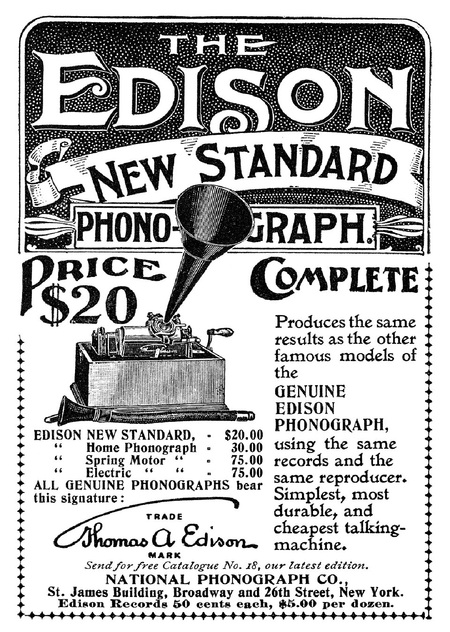
It is crucial to precisely define the medium: the early 1877 phonograph wrapped a thin sheet of metallic foil around a cylindrical drum; the recording was made by impressing the sound. This is not the same as the later wax cylinders that emerged during the subsequent development of sound recording [3; 7]. Comparing these generations reveals the distinction between proving a principle and establishing a reliable practical system.
In this work, historical facts are separated from the author’s visual interpretation. The diagrams of motion, the cylinder’s unrolling, and the schematic of reverse playback are illustrative author diagrams, not archival documents. Illustrations of patents, museum artifacts, and phonautograms are accompanied by sources and precise captions. In the end, the entire mechanism boils down to a single path: sound becomes motion, motion becomes relief, and relief becomes heard sound again. Thus, the phonograph presents itself simultaneously as a technical device and a new means of preserving the voice in time.
The research methodology employs comparative visual analysis of technical illustrations, museum artifacts, and the creator’s schematics. A patent is interpreted as a document detailing the claimed apparatus and its principle, not as the sole proof of the invention’s history. Museum descriptions are utilized for the attribution of objects and materials; library chronologies help correlate the phonograph with earlier phonautographs and later wax formats. The schematics simplify the mechanics for the reader—they illustrate directional movement and operational sequence but do not claim the precision of an engineering drawing. Therefore, every image in the project is assigned a clear status: historical photograph, patent drawing, museum object, or original visualization. This approach allows tracing not only the machine’s design but also how technical knowledge is transformed into a narrative comprehensible to the viewer.
Phonograph, 1887