«The Phenomenon of Russian Melancholy: Visual Language of Solitude and Tremulous Expectation in the Paintings of Viktor Vasnetsov»
Relevance of the Topic
Melancholy occupies a notable space in Russian literature, music, and particularly in the visual arts. This feeling is difficult to reduce to mere sadness; it encompasses a sufficient gradation of human emotions: loneliness, uncertainty, anticipation, a sense of being lost, and the inability to change current circumstances.
Visual art allows for the exploration of how such states are expressed without direct depiction of emotions, through visual imagery and generalized characteristics. The work of Viktor Vasnetsov is of particular interest—he drew upon Russian fairy tales, epics, and historical subjects, revealing the emotional state of the characters and their surroundings through fantastical imagery.
Research Problem Through what means of visual language and imagery does Victor Vasnetsov convey states that a modern viewer might interpret as the melancholy inherent to the Russian people?Hypothesis It is hypothesized that the feeling of melancholy in Vasnetsov’s works arises not only from the narrative but also from the visual solutions the artist employs: the isolation of the character, the expanse of the space, the muted color palette, the static composition, and the ambiguity of the events. Furthermore, the fairy tale and epic motifs allow the individual experience of the hero to be perceived as part of a cultural code.
Research Object The painting of Viktor Mikhailovich Vasnetsov, connected to Russian fairy tales, epics, and historical themes.Research Subject The visual means through which the artist creates emotional states such as loneliness, anxious anticipation, sadness, and yearning in his works.
Research Methodology
The work employs visual-compositional analysis, comparative analysis of artworks, and the interpretation of cultural symbols. The analysis considers the placement of figures, spatial organization, color, lighting, gaze direction, and the relationship between the character and the surrounding environment.
Research Material The paintings «Alyonushka» (1881), «The Knight at the Crossroads» (1882), and «Ivan Tsarevich on the Grey Wolf» (1889). These works were selected to compare different emotional states: vulnerability and loneliness, the uncertainty of choice, and tense movement through dangerous space.
Loneliness and Despair
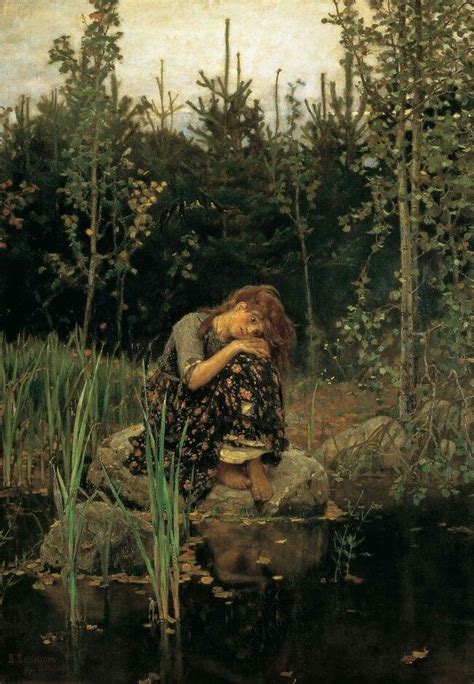
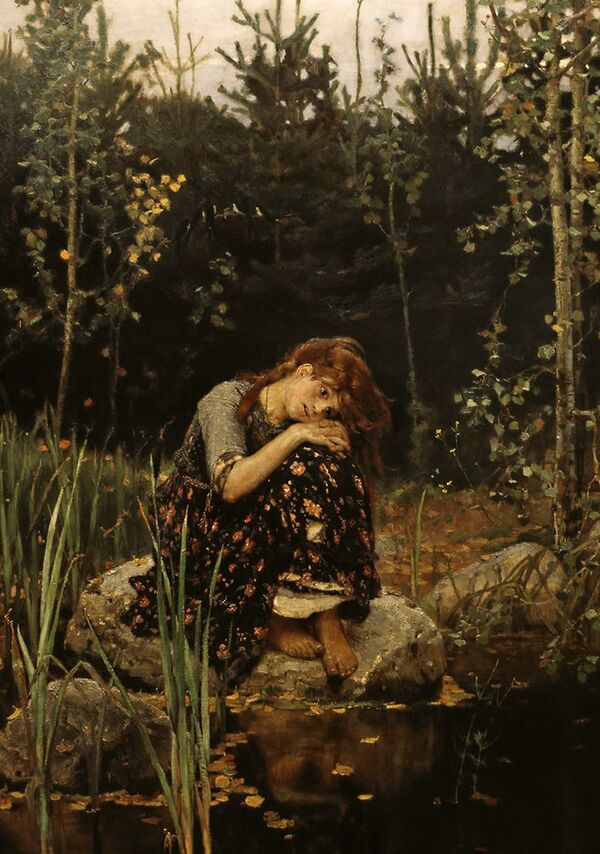
«Alyonushka, ” 1881
Vasnetsov depicts a young woman sitting by the water, surrounded by somber nature. The bent posture, lowered head, and stillness of the figure create an impression of introspection and immersion in her own experiences. The dark water, cool tones, and autumnal foliage reinforce the heroine’s emotional state. The experience is not expressed directly, but rather conveyed through the person’s pose and the resonance of her condition with the surrounding world—a world equally hauntingly serene and silent.
Uncertainty and Anxious Anticipation
«The Knight at the Crossroads, ” 1882
The lone rider paused before a stone warning of mortal danger. The figure of the knight almost merges with the vastness of the steppe. Skulls, crows, the twilight landscape, and the absence of other people amplify the sense of isolation. Longing is interpreted less as sadness and more as internal tension before an unknown future. The hero is in a situation where action is necessary, yet the consequences of choice are frightening.
Anxiety, Vulnerability, and Movement Through the Unknown
«Ivan Tsarevich on the Gray Wolf, ” 1889
Unlike the first two works, the characters here are in motion. However, the dark forest, the intertwined branches, and the unusual atmosphere of the space create a sense of peril. Ivan Tsarevich firmly holds Elena Prekrasnaya, and her static figure and downcast gaze can be interpreted as signs of anxiety and fatigue. The painting illustrates that emotional weight can coexist with movement and hope. It is not a direct depiction of melancholy, but rather an additional example of how an anxious state can be interpreted through space, color, and character poses.
In the selected works, the emotional state of the characters is intimately connected to their surrounding environment. In «Alyonushka, ” nature seems to mirror the girl’s emotions. In „The Knight at the Crossroads, ” the vast expanse emphasizes the human isolation facing a fateful decision. In „Ivan Tsarevich on the Gray Wolf, ” the dark forest creates a sense of danger from which the heroes attempt to escape.
Thus, one of the primary techniques for creating an image of melancholy is the juxtaposition of the individual against the surrounding world. The protagonist might be at the center of the composition, yet appear detached from everything happening around them.
The second crucial technique is stillness. In «Alyonushka,» the heroine’s motionless pose conveys deep immersion in emotion, while in «The Knight at the Crossroads,» the pause before the stone transforms waiting into an independent emotional state.
The third technique involves color and lighting. Muted tones, twilight illumination, and dark areas of the space can amplify feelings of anxiety and sadness. However, dark colors alone do not equate to melancholy; their significance is revealed through their combination with the narrative, composition, and the characters' positions.