Navigator
1) Concept 2) The Notion of Loneliness in Cinema 3) The Visual Language of Solitude in Film 4) Loneliness in the Cinema of Leon Kassak 1. «The Guy Meets the Girl» 2. «Bad Blood» 5) Loneliness in the Cinema of Luc Besson 1. «Underground» 2. «Blue Abyss» 6) Loneliness in the Cinema of Jean-Jacques Beineix 1. «Diva» 2. «37.2°C in the Morning» 7) Comparison of Directorial Approaches
Concept
This research examines the visual representation of loneliness in 1980s French cinema, focusing on films by Luc Cassel, Luc Besson, and Jean-Jacques Beineix. The objective is to study how these directors convey the state of isolation through color, light, frame composition, urban space, and solitude within crowds. Particular attention is paid to how visual aesthetics become a reflection of a person’s internal state.
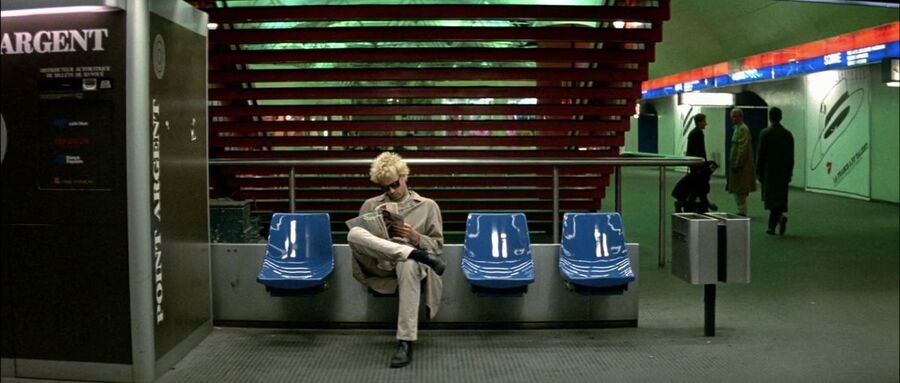
«Metropolis» — Luc Besson, 1985
The Concept of Loneliness in Cinema
Loneliness in cinema is not merely an internal state of a character but a specific method of visual storytelling. Through shot composition, color, light, architecture, and spatial organization, directors can convey feelings of alienation, emotional void, and the inability to connect with the surrounding world. In contrast to literature, where loneliness is often revealed through internal monologue, film allows it to become visible: through the distance between characters, the emptiness of a setting, the stillness of the camera, or the contrast between the human figure and its environment.
The theme of solitude occupies a special place in French cinema, where it is closely linked to the philosophy of existentialism, the search for individual identity, and the human experience in the modern city. French directors often portray loneliness not as the physical absence of other people, but as a state of internal isolation that persists even in a crowd, in relationships, or within a constantly shifting urban landscape.
In French cinema, loneliness is often linked to the problem of human identity and the search for self. Characters confront the contradiction between the desire for independence and the need for emotional closeness. The yearning to be understood and accepted conflicts with the inability to build stable relationships. In this sense, loneliness becomes not merely a temporary emotional state, but a part of a person’s lived experience.
«The Samurai» (Le Samouraï), Jean-Pierre Melville, 1967.
Solitude occupies a significant place in contemporary society. The development of urban culture, the transformation of social relationships, and the accelerating pace of life create conditions where an individual can feel isolated, despite the constant presence of others. In cinema, the archetype of a person existing within society yet feeling alienated from its values, rules, and expectations emerges. This type of solitude is less about a lack of communication and more about a deficit of genuine mutual understanding.
A separate theme is solitude in love and intimate relationships. French cinema frequently explores the impossibility of complete emotional unity between people. Even mutual attachment does not guarantee the overcoming of inner isolation. Characters can experience loneliness within relationships, confronting differences in feelings, desires, and perceptions of intimacy. Love, in this context, functions simultaneously as an attempt to overcome solitude and as a source of new experiences tied to the fear of loss and misunderstanding.
Another crucial aspect is volitional solitude, which is not always perceived as a negative state. Solitude can become a means of preserving personal freedom, independence, and inner integrity. In such cases, solitude is linked not to the absence of opportunities for connection, but to a conscious desire to distance oneself from society, its demands, and its expectations.
Solitude here does not necessarily mean the absence of other people; primarily, it expresses the internal distance between the individual, society, and their own perceptions of self.
The Visual Language of Solitude
In French cinema, solitude functions not merely as a character’s psychological state but as a crucial element of the film’s artistic structure. The feeling of alienation, inner emptiness, and disconnection is conveyed through shot composition, space, color, lighting, camera movement, and shot duration. Through these elements, solitude transcends being just a narrative theme—it becomes a state the viewer can experience through the image itself.French cinema has developed diverse methods for visually expressing solitude. In the aesthetics of the French New Wave, everyday environments, urban spaces, and the subjective perception of reality take on particular significance. In more minimalistic authorial cinema, solitude is linked to restrained composition, emptiness, and silence. Conversely, in the Cinéma du look movement, which emerged in the 1980s, it can be expressed through saturated colors, artificial lighting, and pronounced stylization.As researcher Phil Pouri notes in a British Film Institute (BFI) article, the aesthetic of Cinéma du look marked a significant shift in French cinema, tied to an increase in spectacle and the influence of visual culture from advertising and music videos. This allows solitude to be viewed not only through absence or emptiness but also through the contrast between the external expressiveness of the surrounding world and the individual’s internal isolation.
Space as a Reflection of Inner State
Space is one of the central elements of the visual language of solitude. In cinema, it is not limited to serving as a setting; rather, it can acquire independent emotional and symbolic meaning. The surrounding environment becomes an extension of the character’s inner world, reflecting their anxiety, alienation, introversion, or yearning for freedom.
In French cinema, space is often organized to emphasize the mismatch between the scale of the surrounding world and the position of the individual within it. A character might be in the center of a large room, on an empty street, or among monumental architecture, yet still be perceived as a minor, isolated figure. This creates a peculiar visual contradiction: the space is physically open and accessible, but emotionally, it feels alien and unattainable.
Negative space—the areas of an image not occupied by the main subject—plays a significant role. A large amount of unfilled area around a character can heighten the impression of a lack of connection with their surroundings. However, emptiness does not necessarily signify a real absence of people. It can be perceived as a metaphor for emotional deficiency, a loss of connection, or the inability to be understood.The placement of the figure within the frame is also important. A figure shifted toward the edge of the image can create a sense of instability and detachment. If walls, floors, ceilings, or other architectural surfaces occupy a significant portion of the composition, the impression arises that the space is overpowering the human. The character seems to lose the ability to control the environment in which they exist.
Confined interiors also become a vital tool for depicting loneliness. Small apartments, empty rooms, hotel rooms, and hallways can express not only physical restriction but also psychological isolation. This effect is especially pronounced when a minimalist setting is combined with a static character. The absence of domestic details reduces the amount of visual information about the person’s life, creating a sense of emotional emptiness and alienation.However, it is important to consider that empty space by itself does not necessarily denote loneliness. Its meaning is formed within the context of the entire film—the character’s nature, preceding events, the shot’s duration, and the interplay between the image and sound. Emptiness can symbolize freedom, tranquility, expectation, or threat. It is precisely the juxtaposition of these elements that allows it to be interpreted as an expression of solitude.
«Le Samouraï, ” Jean-Pierre Melville, 1967.
«The Samurai» (Le Samouraï), Jean-Pierre Melville, 1967.
The Urban Environment and the Phenomenon of Solitude in a Crowd
The city holds a special place in French cinema as a space for modern human existence. Parisian streets, cafes, shops, metro stations, train stations, and public spaces become the environment where the contradiction between a person’s social inclusion and their internal isolation is most vividly expressed.
A city inherently requires the constant presence of other people. However, a high volume of social contact does not equate to emotional closeness. On the contrary, the intensity of urban life can amplify feelings of isolation. An individual finds themselves surrounded by countless strangers, fleeting glances, and brief interactions that never develop into lasting relationships. Visually, this contradiction can be expressed through the juxtaposition of a solitary character against the movement of the surrounding crowd. If other people move rapidly across the frame while the central figure remains still, a sense of mismatched internal rhythms emerges. The protagonist seems to exist in their own time, detached from the pace of the surrounding reality.
«Cléo de 5 à 7» by Agnès Varda, 1962.
Another technique is the use of multi-layered composition. A character might be separated from their surroundings by the depth of space, placed behind glass, observing passersby from a window, or positioned apart from the main group of people. Despite the visual richness of the frame, the viewer perceives them as an isolated figure.
Urban architecture amplifies this effect. Long streets, repetitive facades, subway stations, and transit crossings create a system of spaces primarily designed for movement. In such places, a person often becomes a temporary presence, lacking a stable connection to their environment.
A distinctive feature of French cinema is the subjective perception of the urban environment. The same city can appear vibrant, free, and inviting, or conversely, anxious, cold, and alienating. Its emotional significance depends on how the character perceives what is happening. Thus, the city in cinema becomes not just a setting, but a spatial model of modern solitude. Its visual density allows us to emphasize that a person’s isolation is not necessarily linked to the physical absence of others.
Compositional Division and Visual Boundaries
One of the most subtle ways to depict loneliness is by creating visual boundaries within the frame. Unlike empty space, which emphasizes a lack of contact, compositional division illustrates the existence of an obstacle between a person and the surrounding world.
These boundaries can be formed using architectural elements: walls, doorways, windows, partitions, columns, stairs, and other objects. Their placement within the image creates independent spatial zones in which characters exist separately from one another.
The technique of «frame within a frame» takes on particular significance when a human figure is enclosed in an additional border, such as a window or a doorway. This composition restricts the character’s space, creating a sense of confinement. The person seems separated from reality by an invisible barrier.
Even if the door is open or the glass is transparent, the visual separation remains. Thus, the architectural impediment can be perceived not as a physical barrier, but as an expression of psychological distance.
Mirrors and reflective surfaces create a more complex form of visual solitude. They allow for the simultaneous presentation of a person and their reflection, thus forming a duality of perception. The reflection can be perceived as the character’s attempt to see themselves from an outside perspective, to contemplate their own identity, or to discover a contradiction between their outward appearance and their inner state.
Particular attention to mirrors is characteristic of French cinema, which explores issues of self-perception and the social gaze. In such compositions, the person is simultaneously the subject of observation and its object. They look at themselves, yet simultaneously occupy the position of an external observer.
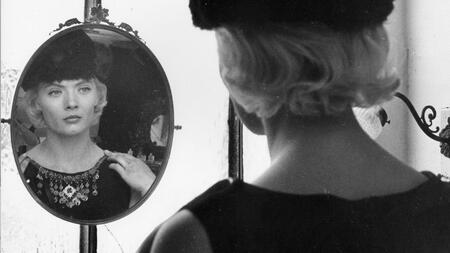
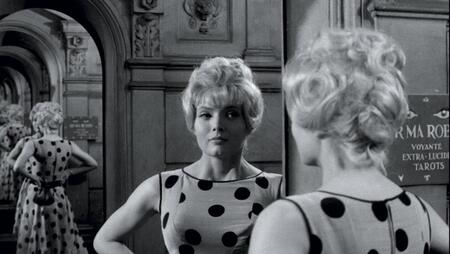
«Cléo de 5 à 7,» Agnès Varda, 1962.