
1. Introduction — the brand, its positioning, visual identity and audience 2. Communication Channels — social media, PR and paid strategies 3. Theoretical Framework — Dialogic Theory and Social Media / Affordances 4. Analysis — theory applied to real communication, with visual evidence 5. Conclusion and Recommendations

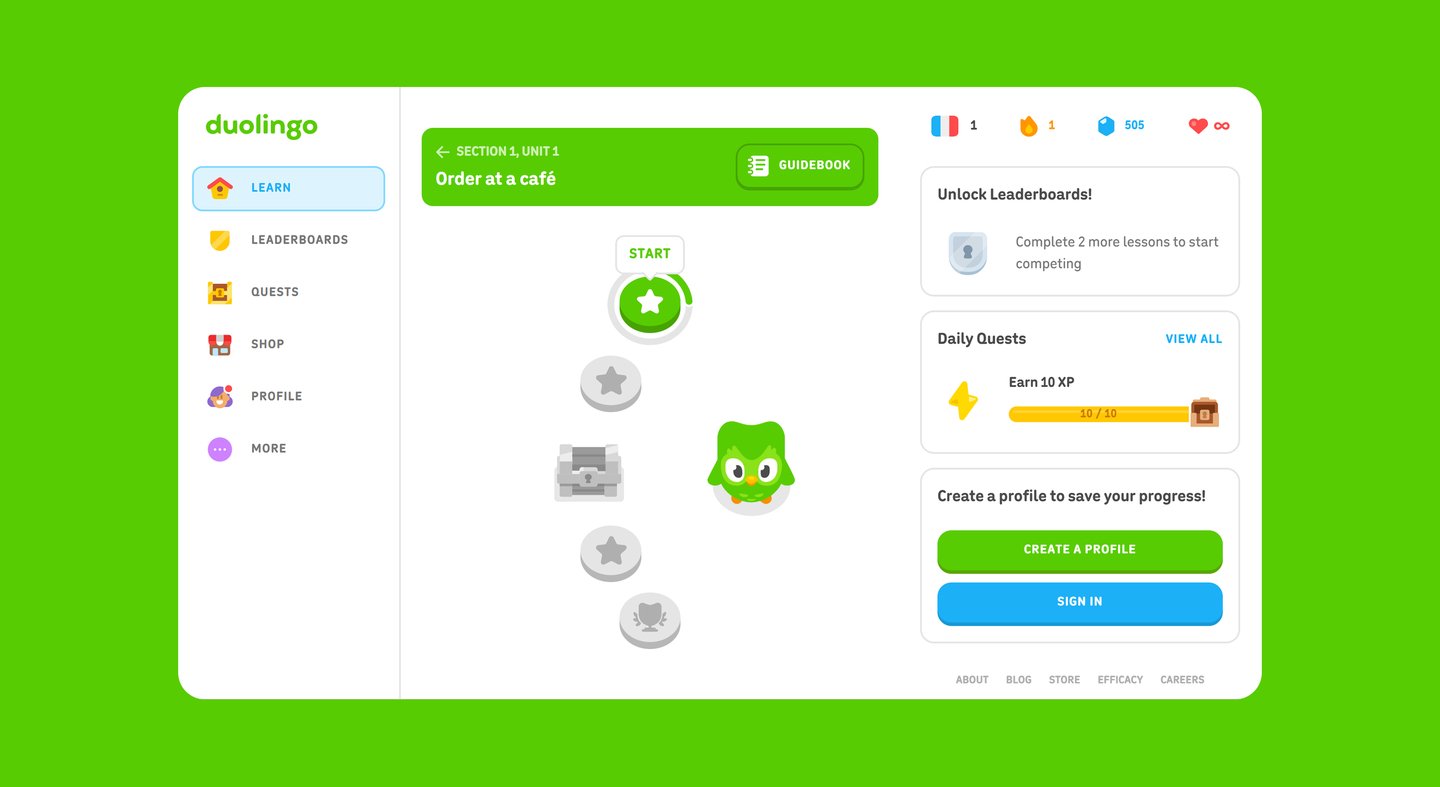
Duolingo is the world’s most downloaded education app. It was founded in 2011 by Luis von Ahn and Severin Hacker with one goal: to make language learning free for everyone. Today the platform offers more than 280 courses — over 40 languages plus math, music and chess — all free. Its method is simple but powerful: it turns studying into a short, game-like daily habit. In the first quarter of 2026 Duolingo reached 56.5 million daily active users and around 137.8 million monthly active users, with 12.5 million paying subscribers. Listed on NASDAQ as DUOL, it has grown from a small free app into a global learning platform.
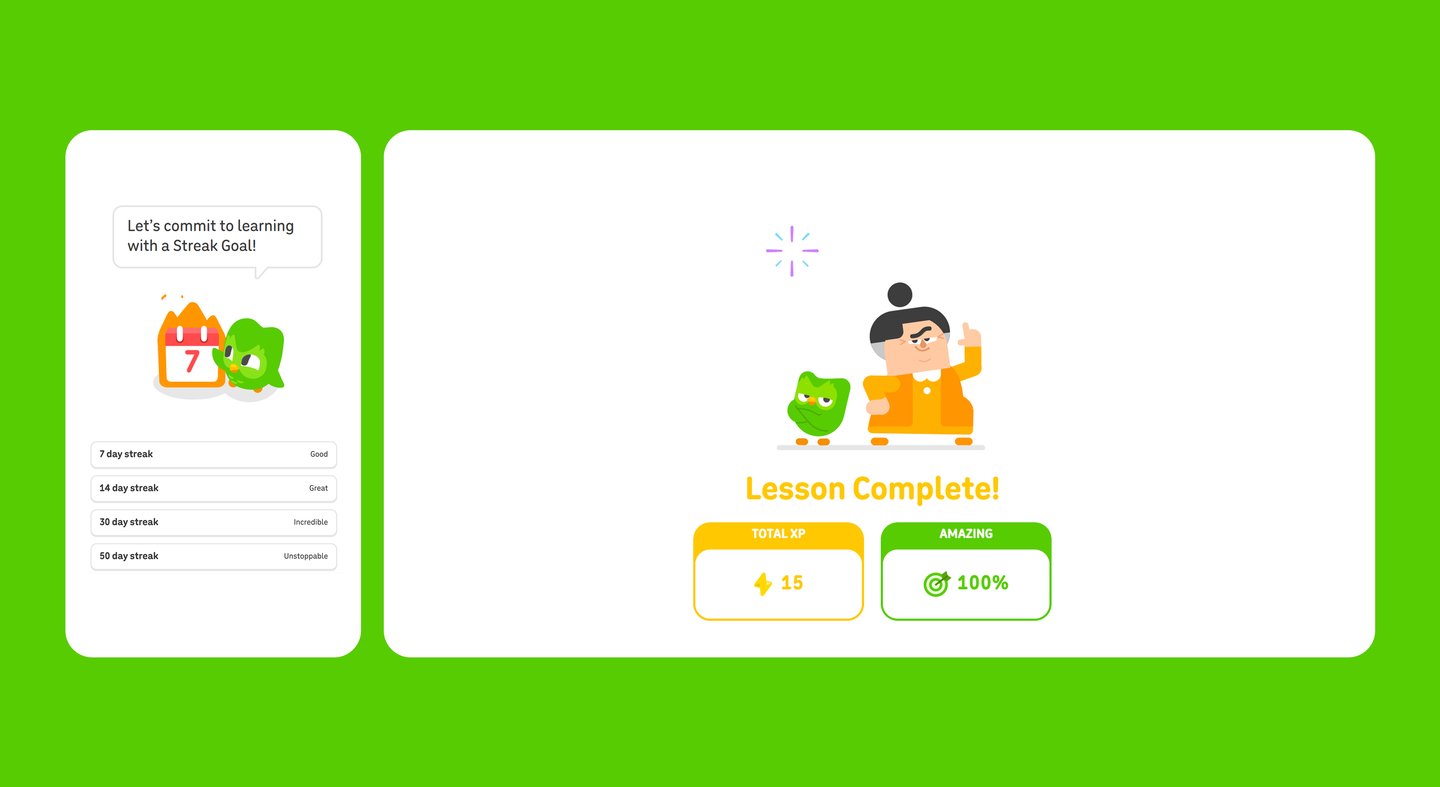
Screenshot of the Duolingo app made by the author in 2026.
Duolingo’s positioning rests on three promises: free, fun and effective. Its mission is to develop the best education in the world and make it universally available. Gamification — streaks, experience points, leaderboards and a relentless daily reminder — makes practice feel addictive rather than dutiful. The core product is free; revenue comes from advertising and the Super Duolingo and Duolingo Max subscriptions. This «free and fun» promise is the foundation on which every communication decision is built.
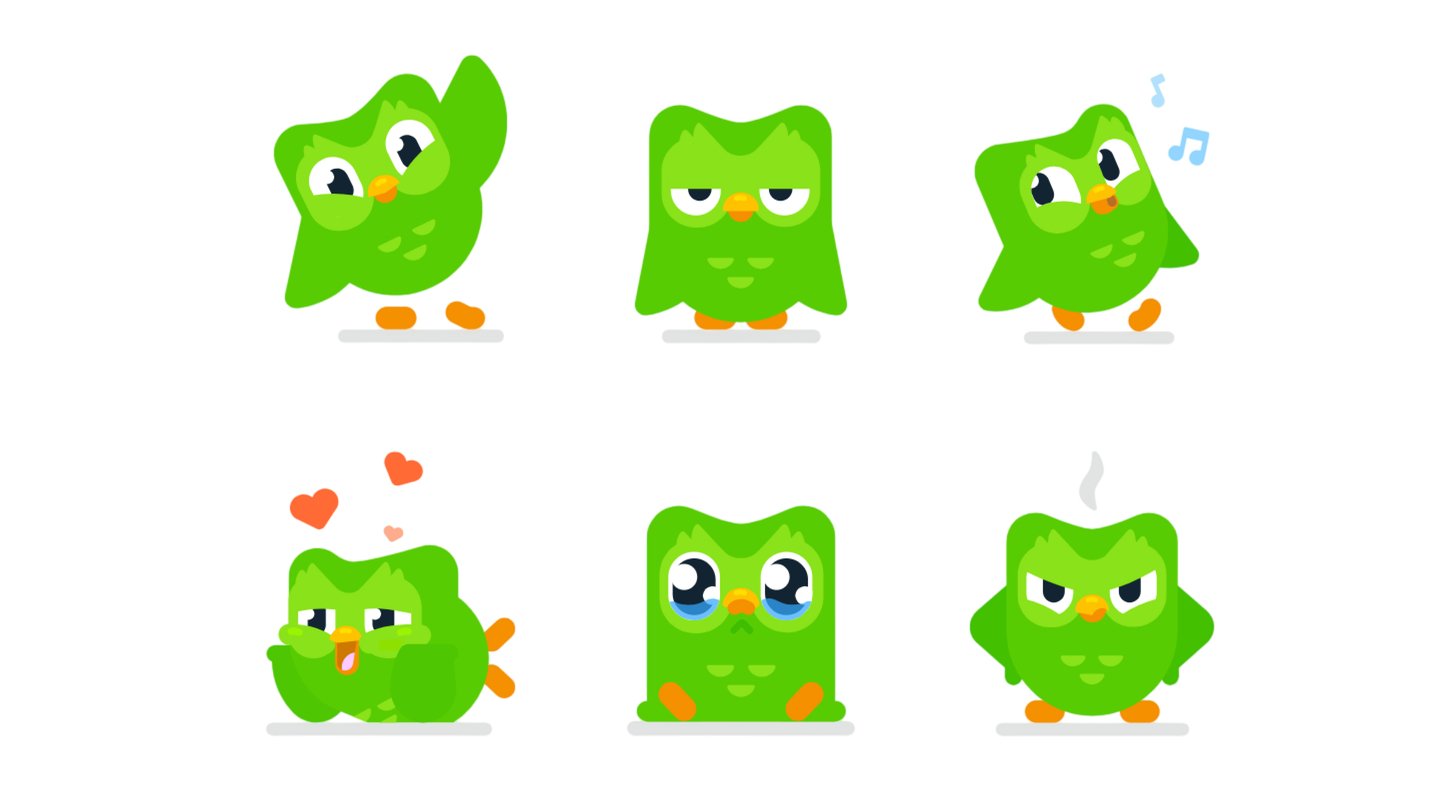
At the centre of the brand sits Duo, a bright-green owl. What began as a friendly reminder to practise has grown into a chaotic, self-aware internet character. The brand voice is deliberately «unhinged» — playful, cheeky and quick to laugh at itself — a tone the team says works because Duolingo has always had a quirky personality. For most people online, this character, not the lessons, is the first thing they meet. Duo is the bridge between an educational product and pop culture, and the engine of almost all of Duolingo’s communication.
Screenshot of the Duolingo app made by the author in 2026.
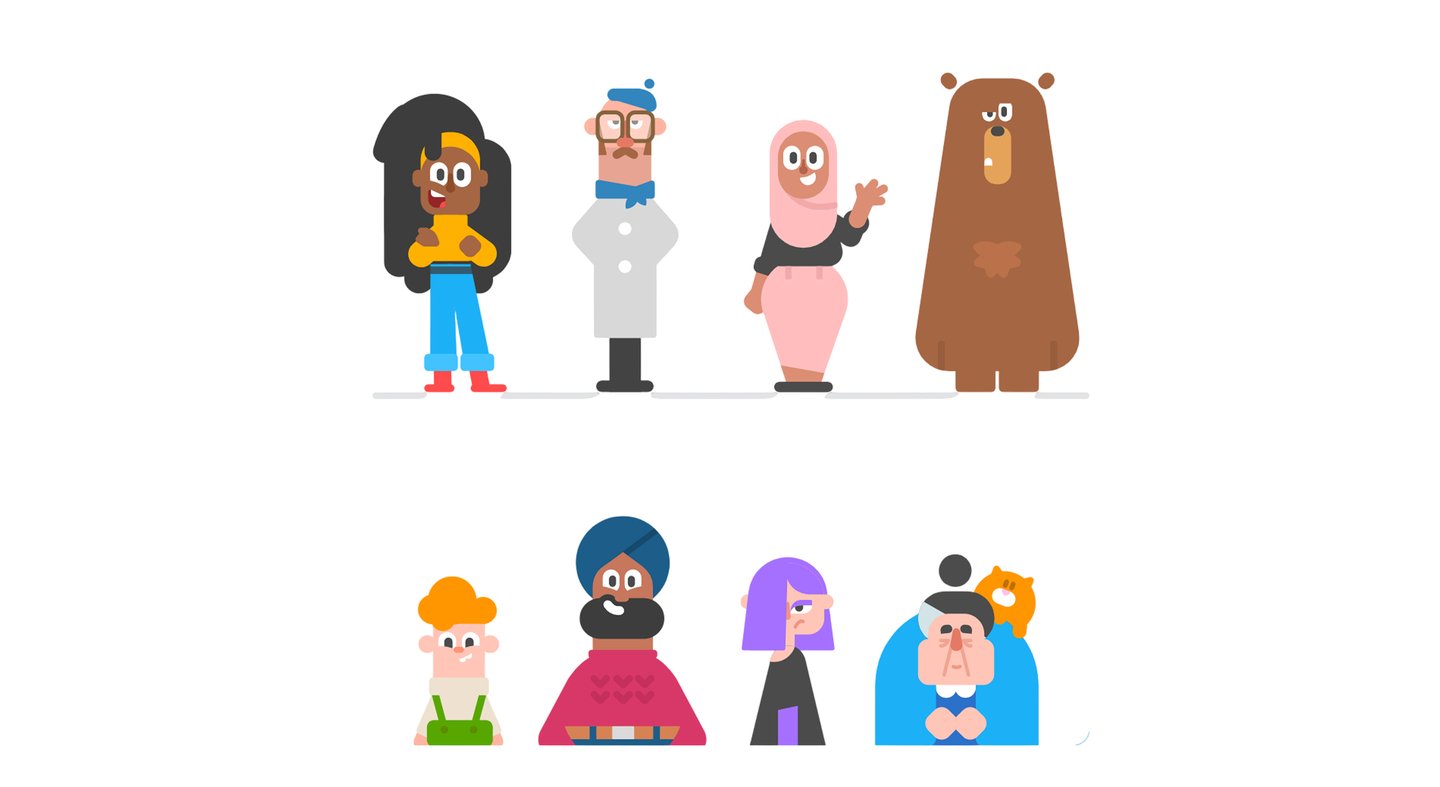
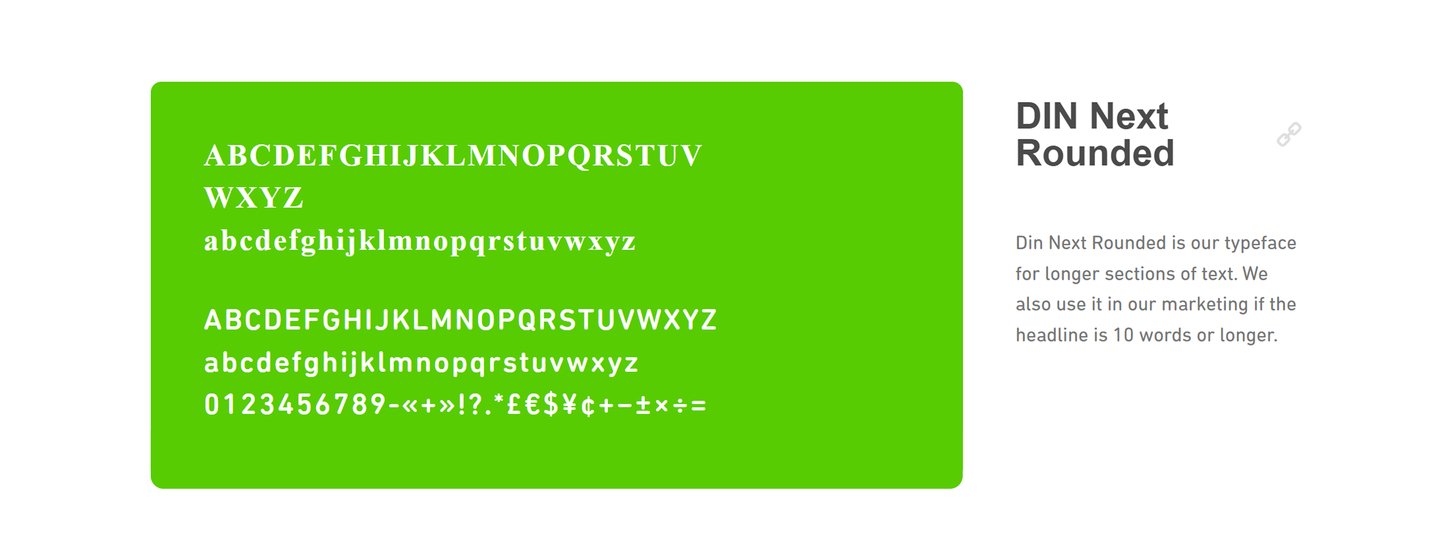
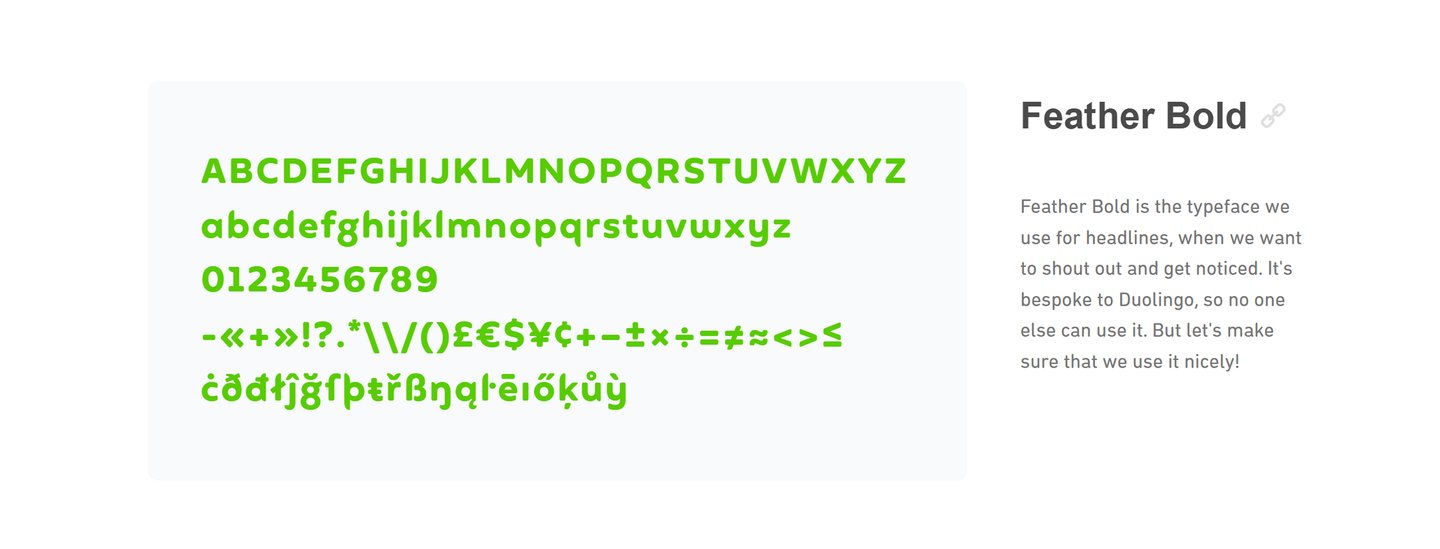
Duolingo’s visual identity is as disciplined as its tone is chaotic. The brand is built around a single owned colour — Feather Green (#58CC02) — taken directly from the mascot; the palette also includes Mask Green, Eel grey for type and Snow white. In 2019 the studio Johnson Banks reimagined Duo as a fully expressive character able to show joy, sadness, anger and even menace, and a custom typeface, Feather Bold, was created whose rounded shapes echo the owl — the flick on the «g» even mirrors Duo’s eyebrow. A wider «cast of characters» supports the idea that everyone can learn. This consistent, friendly design system is the visual half of Duolingo’s communication, and the focus of this visual-research project.
Screenshot from the official Duolingo guide made by the author in 2026.
Duolingo’s signature color
Screenshot from the official Duolingo guide made by the author in 2026.

- Globally distributed — English is the most-studied language in the majority of countries.
- Driven by self-improvement, travel and culture; K-pop and anime have pushed Korean and Japanese up the rankings.
- They prefer irreverent, self-aware entertainment over polished corporate messaging.
- This is exactly the audience Duo’s humour-first, community-driven voice and design are built for.
Duolingo runs an omni-channel presence, but it is social-first. Its public field spans TikTok (the flagship), Instagram, X (formerly Twitter), YouTube and in-app push notifications, amplified by earned media and PR. A key tactic is efficiency: the same short video is often reused across platforms, since a clip that flops on one can go viral on another. Crucially, the brand rarely relies on traditional paid advertising — it earns attention through entertainment. The next screens walk through each channel, then its PR and paid moments.
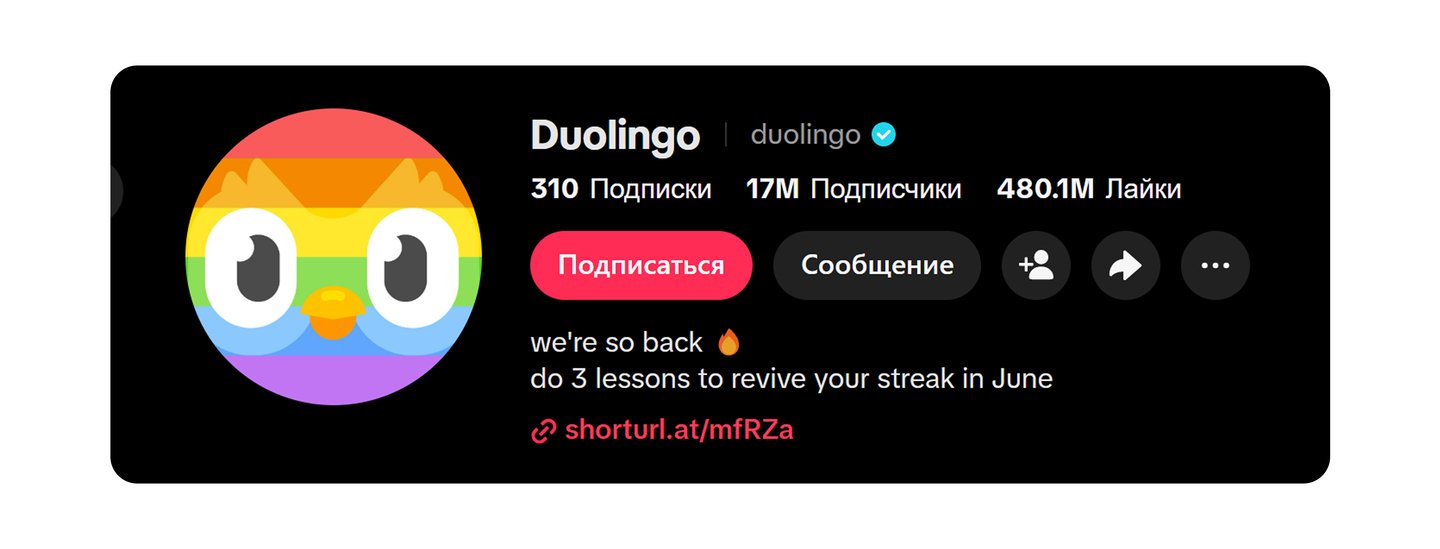
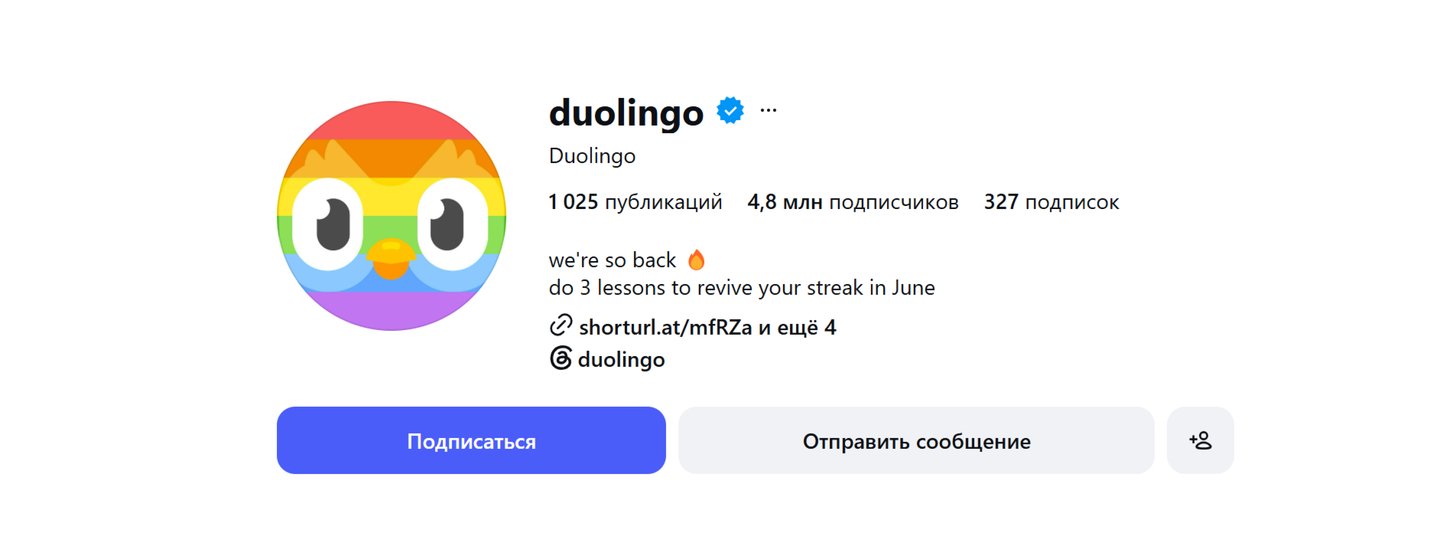
Screenshot of the official Duolingo Instagram/TikTok account, made by the author, in 2026.
TikTok is Duolingo’s flagship channel, with roughly 16.9 million followers. The account was not a top-down corporate project: in 2021 a recent graduate, Zaria Parvez — now global senior social media manager — simply asked to make videos on the brand’s unused account. Her «unhinged», trend-driven content turned Duo into a recognisable internet character rather than a logo. Community management is central: Parvez and her team reply to comments as Duo, sometimes with a video. The result is a channel that entertains first and advertises almost never — yet constantly reminds people the app exists.
Beyond TikTok, Duolingo keeps a consistent multi-platform presence. On Instagram it has around 4.9 million followers and often earns higher engagement per post than on TikTok; on X it trades real-time jokes; on YouTube it hosts longer campaign films. Its most distinctive owned channel, however, is inside the app itself. Push notifications and the streak system are not just product features but communication: the «passive-aggressive owl» that nags users into studying became a meme in its own right, and the brand leaned into it. Every reminder is at once a retention tool and a piece of brand voice.

Public relations at Duolingo is built to earn coverage, not to buy it. Its toolkit includes real-time newsjacking (reacting to awards shows, sport and celebrity news), brand collaborations and crossovers, influencer partnerships, and product-led PR such as the annual Duocon event and the Duolingo Score integration with LinkedIn. The aim is the classic PR goal: free, credible media attention earned through content people genuinely want to share. This places Duolingo close to the two-way symmetrical model (Grunig and Hunt; Week 7, Lecture 7.2), in which organisations listen to their publics and allow that feedback to shape communication.
A selection of articles on the death of Duolingo’s mascot, including examples of merchandise and memes from this promotion, made by the author in 2026.
Duolingo’s boldest PR move was a stunt: the «Death of Duo». On 11 February 2025 the brand announced that Duo had died — supposedly in a hit-and-run involving a Tesla Cybertruck, a jab at Elon Musk — across Instagram, TikTok, X and app notifications. Fans were then invited to a «Bring Back Duolingo» website to earn experience points and revive him; they passed the 50-billion-XP goal (over 50.9 billion XP) across 15 countries. Duo returned on 24 February under the line «Legends never die.» The campaign generated around 450 news articles and coverage from John Oliver’s Last Week Tonight to NPR, with rival brands joining the joke — a textbook case of earned media.
Screenshots of the Duolingo app during the Super Bowl, made by the author.
Although Duolingo is social-first, it also uses sharp paid moments. Its boldest was a five-second Super Bowl spot in 2024 (and again in 2025): a deliberately absurd clip of Duo titled «no buts», designed to «hack» Super Bowl buzz at a fraction of a normal seven-million-dollar slot. The creative was developed in-house and synced with the product: the moment the ad aired, around 4 million learners received a push notification tied to the joke. This shows how Duolingo treats even a paid TV ad as part of one connected, community-first system rather than a standalone advert.
Duolingo. Super Bowl 2024 commercial («no buts»). 2024
As our course puts it, there is nothing more practical than a good theory (Week 7, Lecture 7.1). To analyse Duolingo we use two lenses from the syllabus. The first is Dialogic Theory (Week 7), which explains how an organisation builds relationships by talking with — not at — its publics. The second is the Social Media and Affordances framework, together with the theory of online communities (Week 6), which explains the platform mechanics and the fan base behind Duo’s success. We also keep a semiotic eye on the brand’s visuals.
Dialogic Theory was proposed by Kent and Taylor (1998) and is covered in Week 7, Lecture 7.6. It argues that ethical, effective public relations is built through honest, two-way dialogue. Dialogue has five features: mutuality, propinquity, empathy, risk and commitment. For online communication, Kent and Taylor add five practical principles: the dialogic loop (publics can ask, and the organisation answers), usefulness of information, generation of return visits, ease of interface, and conservation of visitors. On Grunig and Hunt’s four models of public relations (Lecture 7.2), this places Duolingo at the two-way symmetrical end of the spectrum — far from one-way «press agentry».
The scheme was compiled by Kent M. L. and Taylor M., authors of «Building dialogic relationships through the World Wide Web».
Social media, by definition, are Web 2.0 applications built on user-generated content (Kaplan and Haenlein, 2010; Week 6, Lecture 6.1). The second key concept is affordances. First framed by Gibson and adapted to design by Norman, affordances are the action possibilities a technology offers — and, crucially, how users perceive them (Week 6, Lecture 6.6). The course distinguishes social from technological affordances, and perceived from real ones. This lets us ask not just what a platform allows, but how Duo’s audience reads and uses those possibilities.
To explain Duolingo’s fan base we use the distinction between common identity and common bond communities (Week 6, Lectures 6.4–6.5; Ren, Kraut and Kiesler, 2007). In common identity groups people are attached to the group and its shared culture; in common bond groups they are attached to each other as individuals. Online communities thrive on self-disclosure and reciprocity — users contribute and expect some gratification in return. We will use this to read how «Duolingo stans» behave around Duo.
One more lens deserves a mention, because this is a visual-research project. Communication can be studied as the exchange of signs and meanings — Craig’s semiotic tradition (Week 1, Lecture 1.5). Brands rarely state their meaning outright; they encode it in colour, shape and character. We therefore read Duolingo’s visual identity — not only its words — as communication, and we return to this in the analysis.
In this section we map real Duolingo communication onto the frameworks. Each point pairs a concept from the course with concrete evidence — screenshots of posts, replies, ads and campaigns — and explains, from a theoretical standpoint, why it works.
The clearest dialogue is Duo replying to comments in character. Kent and Taylor (1998) call this the dialogic loop: the public can ask, and the organisation answers, keeping the conversation open (Week 7, Lecture 7.6). Parvez’s team treats community management as core work, replying to followers as Duo — sometimes with a custom video. The evidence is measurable: a single Valentine’s Day reply reportedly drew over 1.27 million engagements, and the running «Dua Lipa» joke recurs because fans feed it back. Theoretically, each reply closes the loop and signals that contributions are heard — the opposite of one-way broadcasting.
Screenshots of comments from the official Duolingo account made by the author in 2026
Duo’s voice enacts four of Kent and Taylor’s dialogue features (Lecture 7.6). Mutuality: Duo addresses followers as equals, not as a brand lecturing consumers. Empathy: by inviting jokes and rewarding them, it builds the supportive climate dialogue requires. Risk: self-deprecating posts — the obituary admitting Duo probably died waiting for users to do their lesson — make the brand deliberately vulnerable. Propinquity: content is spontaneous and tied to the present moment, reacting to whatever the internet is discussing that day. Together these turn communication into shared meaning rather than a message pushed outward.
Screenshots of trends from the official Duolingo TikTok account, made by the author, in 2026
Duo’s success is a masterclass in platform affordances — the action possibilities a technology offers, and how users perceive them (Norman; Week 6, Lecture 6.6; Treem and Leonardi, 2012). The team exploits TikTok’s specific affordances: trending sounds, duets and stitches, comment-reply videos and Effect House filters, then reuses the same clip across platforms for reach. In the course’s terms (Lecture 6.8) this is persistent engagement (a steady content stream) plus triggered engagement (reacting to live events). The technological affordance becomes a social one: a duet is not just a feature but an invitation to join Duo’s world.
Screenshots of a response to a comment and a link to the post (using trending sound) on the official Duolingo TikTok account made by the autor in 2026
Duolingo’s visual identity is itself a message. Read semiotically (Craig’s semiotic tradition, Week 1, Lecture 1.5), Feather Green signifies growth and freshness; Duo’s rounded, expressive design signals friendliness and disarms the intimidation of studying; the consistent Feather Bold typeface ties every post to one recognisable «signature». This is where affordance theory meets design: audiences perceive Duo as a personality rather than a logo (a perceived affordance, Lecture 6.6), and that perception is exactly what the brand engineered. In short, the look does the same job as the voice — it makes a corporation feel like a character.
The «Duolingo stans» show both attachments from Lectures 6.4–6.5. There is common identity — a shared in-joke culture around Duo that anyone can join — and common bond — fans who like each other and create content together. The Death of Duo turned passive followers into active participants: people poured over 50 billion experience points into reviving him and flooded feeds with #RIPDuo tributes. By Ren, Kraut and Kiesler (2007), that is reciprocity in textbook form: the community invested effort and received a collective experience in return. Engagement, not advertising, became the product.
Memes created by Duolingo users, about their obsession with, manipulation of, and death of the mascot. Screenshots created by the author in 2026
Through the lens of Relationship Management Theory (Week 7, Lecture 7.5; Ledingham and Bruning, 1998), Duolingo’s strategy succeeds because it builds the right relationship indicators: trust, satisfaction and — above all — affective commitment, the emotional kind, where people stay because they genuinely like the brand. Rather than a transactional exchange relationship, Duo fosters something closer to a communal one, where fans engage even when nothing is being sold. The business results follow: 56.5 million daily active users in Q1 2026 and strong retention. In spirit, this is the two-way symmetrical model the course holds up as best practice.
User growth statistics Duolingo. Screenshots created by the author in 2026
The strategy is strong, but not risk-free. First, virality is not dialogue: the course’s «Beautifully Imperfect» case (Week 7, Lecture 7.9) shows that using social media is not the same as cultivating relationships, and even Duolingo can slip into one-way broadcasting. Second, audience attention does not necessarily translate into user acquisition: management itself described top-of-funnel monthly-active-user growth as «about flat» in Q1 2026, so the memes keep existing users more than they recruit new ones. Third, an «unhinged» tone is fragile in sensitive moments and can threaten brand safety. Fourth, leaning so heavily on one persona and one platform concentrates risk.
Based on this analysis, we suggest four improvements:
1. Extend the dialogic loop beyond TikTok — introduce structured Q&A opportunities, email updates and richer in-app dialogue — to meet Kent and Taylor’s online principles (Lecture 7.6).
2. Be transparent about AI features such as Duolingo Max, to protect the trust and integrity that Relationship Management Theory depends on (Lecture 7.5).
3. Keep a clear tone guardrail for sensitive topics, balancing humour with the empathy and respect dialogue requires (Lecture 7.6).
4. Design campaigns that turn viral attention into new users, not just engagement, to address the flat top-of-funnel growth.
In the end, Duolingo shows that brand communication today is built on dialogue, affordances and community — not on broadcasting at an audience. The same theories we study in Weeks 6 and 7 explain, almost line by line, why a chaotic green owl outperforms polished advertising: a brand is increasingly understood not as something that is announced, but as a relationship that is continuously built, one reply at a time.
Kent M. L., Taylor M. Building dialogic relationships through the World Wide Web // Public Relations Review. — 1998. — Vol. 24, № 3. — P. 321–334.
Kent M. L., Taylor M. Toward a dialogic theory of public relations // Public Relations Review. — 2002. — Vol. 28, № 1. — P. 21–37.
Ledingham J. A., Bruning S. D. Relationship management in public relations: dimensions of an organization–public relationship // Public Relations Review. — 1998. — Vol. 24, № 1. — P. 55–65.
Grunig J. E., Hunt T. Managing Public Relations. — New York: Holt, Rinehart and Winston, 1984. — 550 p.
Kaplan A. M., Haenlein M. Users of the world, unite! The challenges and opportunities of social media // Business Horizons. — 2010. — Vol. 53, № 1. — P. 59–68.
Castells M. The Rise of the Network Society. — Oxford: Blackwell Publishers, 1996. — 594 p.
Ren Y., Kraut R., Kiesler S. Applying common identity and bond theory to design of online communities // Organization Studies. — 2007. — Vol. 28, № 3. — P. 377–408.
Treem J. W., Leonardi P. M. Social media use in organizations: affordances of visibility, editability, persistence, and association // Communication Yearbook. — 2012. — Vol. 36. — P. 143–189.
Norman D. A. The Design of Everyday Things. — Revised and expanded ed. — New York: Basic Books, 2013. — 368 p.
Communication Theory: материалы онлайн-курса (Weeks 1, 6, 7) [Электронный ресурс] // Smart LMS НИУ ВШЭ / Школа коммуникаций НИУ ВШЭ. — URL: https://edu.hse.ru/course/view.php?id=133853 (дата обращения: 04.06.2026).
Hi! It’s Duo: The Marketing Strategy Behind the Internet’s Favorite Green Menace [Электронный ресурс] // Adweek. — URL: https://www.adweek.com/brand-marketing/duolingo-duo-owl-marketing-strategy/ (дата обращения: 05.06.2026).
Duolingo’s TikTok mastermind on its 'unhinged' social strategy and killing its mascot [Электронный ресурс] // The Drum. — URL: https://www.thedrum.com/news/duolingo-s-tiktok-mastermind-its-unhinged-social-strategy-and-killing-its-mascot (дата обращения: 03.06.2026).
How Duolingo is using its 'unhinged content' with Duo the Owl to make people laugh on TikTok [Электронный ресурс] // Digiday. — URL: https://digiday.com/marketing/how-duolingo-is-using-its-unhinged-content-with-duo-the-owl-to-make-people-laugh-on-tiktok/ (дата обращения: 02.06.2026).
Duolingo shares PR secrets of viral 'Death of Duo' campaign [Электронный ресурс] // PR Daily. — URL: https://www.prdaily.com/duolingo-shares-pr-secrets-of-viral-death-of-duo-campaign/ (дата обращения: 05.06.2026).
Duolingo Social Media Strategy: How Effective Is It? Report 2026 [Электронный ресурс] // Brand24 Blog. — URL: https://brand24.com/blog/duolingo-social-media-strategy/ (дата обращения: 04.06.2026).
Everything to know about Duolingo’s five-second Super Bowl ad [Электронный ресурс] // Campaign US. — URL: https://www.campaignlive.com/article/everything-know-duolingos-five-second-super-bowl-ad/1861011 (дата обращения: 05.06.2026).
The Anatomy of Duolingo’s Super Bowl Ad [Электронный ресурс] // Figma Blog. — URL: https://www.figma.com/blog/the-anatomy-of-duolingos-super-bowl-ad/ (дата обращения: 03.06.2026).
Duolingo Q1 2026 Shareholder Letter [Электронный ресурс] // U.S. Securities and Exchange Commission. — URL: https://www.sec.gov/Archives/edgar/data/0001562088/000162828026029790/q1fy26duolingo3-31x26share.htm (дата обращения: 05.06.2026).
2025 Duolingo Language Report [Электронный ресурс] // Duolingo Blog. — URL: https://blog.duolingo.com/2025-duolingo-language-report/ (дата обращения: 02.06.2026).
Duolingo: официальный сайт бренда [Электронный ресурс]. — URL: https://www.duolingo.com (дата обращения: 06.06.2026).
Duolingo Design: фирменный стиль, цвета и маскот [Электронный ресурс] // Duolingo. — URL: https://design.duolingo.com/identity/color (дата обращения: 06.06.2026).
Duolingo (@duolingo): официальный аккаунт [Электронный ресурс] // TikTok. — URL: https://www.tiktok.com/@duolingo (дата обращения: 06.06.2026).
Duolingo (@duolingo): официальный аккаунт [Электронный ресурс] // Instagram. — URL: https://www.instagram.com/duolingo (дата обращения: 06.06.2026).
Duolingo. Super Bowl 2024 commercial («no buts») [Электронный ресурс] // Duolingo Blog. — URL: https://blog.duolingo.com/super-bowl-commercial-2024 (дата обращения: 05.06.2026).
Duolingo Q1 2026 Shareholder Letter (метрики DAU/MAU) [Электронный ресурс] // U.S. Securities and Exchange Commission. — URL: https://www.sec.gov/Archives/edgar/data/0001562088/000162828026029790/q1fy26duolingo3-31x26share.htm (дата обращения: 05.06.2026).
Скриншоты приложения Duolingo: выполнены авторами. 2026.
Пользовательский контент по тегам
duolingo и
RIPDuo [Электронный ресурс] // TikTok. — URL: https://www.tiktok.com/tag/ripduo (дата обращения: 06.06.2026).Медиарепозиторий Wikimedia Commons: категория «Duolingo» [Электронный ресурс]. — URL: https://commons.wikimedia.org/wiki/Category:Duolingo (дата обращения: 04.06.2026).