1. Introduction
Brand Background and Positioning
Drinkit is a coffee shop chain founded in Moscow in August 2020 under the Dodo Brands— the Russian foodservice group also behind Dodo Pizza and Doner 42. The company positions itself as a modern and convenient coffee brand where customers can order drinks through a mobile application, customize recipes, and collect loyalty rewards.
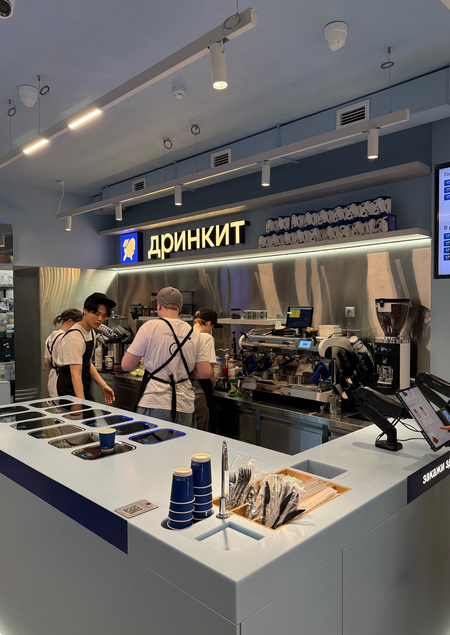
The concept is aimed at urban consumers seeking both convenience and high-quality coffee. The company’s operating model is structured around digital customer interactions. The ordering process is fully digitised: through the app, guests build their drink to their exact preferences (adjusting ingredients, strength, and temperature) and by the time they arrive at the coffee shop, their order is waiting at a dedicated pick-up station, ready to collect without any interaction with a cashier. Through its blue-and-white branding and self-order counters, Drinkit creates an interactive customer experience that embodies its digital-first brand concept.
From a product and assortment standpoint, Drinkit focuses primarily on beverages: espresso and tea based drinks and seasonal specials, with some food offerings (light pastries and packaged snacks). This deliberate narrowness reinforces fast and convenient service, while also allowing for personalized customer experience.
Target Audience
Drinkit primarily targets young urban professionals and students aged 18–35 who are digitally fluent, time-conscious, and familiar with specialty coffee culture. The audience is cosmopolitan and values convenience, contemporary aesthetics, and technology-enabled customer experiences. The brand’s founders articulated this vision clearly: «The future is that our coffee shops will be found not on the street, but on the phone — a user already has the app, has a subscription, likes the coffee."[1] This framing points to a loyalty-first, app-mediated relationship with the customer, rather than spontaneous foot traffic. Sila-uma
2. Communication channels
The Brand’s Public Field
Drinkit’s communication infrastructure is distinctly multichannel and digitally integrated, consistent with its overall brand identity as a tech-first company. The following channels constitute its main public field:
Mobile Application
The Drinkit app is the central part of the brand’s communication strategy — a primary touchpoint for loyalty, personalization, and customer retention. The app enables personalized marketing, allowing the brand to notify users about new products and offers. The app also houses the subscription and pre-order systems, making it a direct communication line between brand and customer. Sila-uma
Social Media
Drinkit maintains active profiles on Instagram, VKontakte (VK), and Telegram. On the Russian market, VK and Telegram are strategically important: VK functions as a community-building and content-distribution platform for a broad domestic audience, while Telegram is used for a more direct, conversational tone: delivering product announcements, limited-time offers, and lifestyle content. Instagram (where accessible) serves as a visual branding channel, showcasing the aesthetic of drinks, interiors, and the brand’s signature blue visual iidentity. The content mix across platforms includes new product launches, seasonal drinks, promotional mechanics (for example, discounts tied to app usage), and reposting of user-generated content, all of which contributes to building a community around the brand rather than simply selling a product.
PR and Partnerships
brand is regularly featured in business and industry media specifically for its digital infrastructure and app-first model. According to Dodo Brands' leadership, IT is not merely a business automation issue — it is «a full-fledged part of the product» and «a significant part of the USP.» [3] This framing is used consistently in public communications to differentiate Drinkit from competitors. The chain has also built PR momentum through international expansion milestones: each new market entry (UAE, Kazakhstan, USA) is presented as a news event, reinforcing brand growth and global ambition.
Website and E-Commerce
The official website (drinkit.ru) functions as an e-commerce and information platform, offering franchise information and store locations.[4] Like the app, it is built as an operational tool rather than a simple brand brochure.
In-Store Communication and Design
Physical space is itself treated as a communication medium. Drinkit treats each location as a standalone design project rather than a replica of a template. While a shared visual vocabulary (steel surfaces, digital interfaces, and distinctive benches) ensures immediate brand recognition, individual stores are adapted to their specific spatial and urban context, producing an experience that feels both familiar and locally rooted.
3. Theoretical framework
To analyze Drinkit’s communication strategy, this project applies two complementary theories: the Elaboration Likelihood Model (ELM) developed by Richard Petty and John Cacioppo (1986), and the Uses and Gratifications Theory (UGT) formulated by Elihu Katz, Jay Blumler, and Michael Gurevitch (1974). The Elaboration Likelihood Model (Petty & Cacioppo, 1986) explains how persuasive messages lead to attitude change through two routes. The central route involves deep cognitive engagement with arguments and produces durable attitude change; the peripheral route relies on surface cues (aesthetics, social proof, scarcity) and produces weaker, more temporary effects. Which route a person takes depends on their motivation and ability to process the message. [6] Drinkit engages both: transparency-driven content targets high-involvement audiences via the central route, while visual content and app-based promotions operate through peripheral cues. The Uses and Gratifications Theory (Katz, Blumler & Gurevitch, 1974) shifts focus from sender to receiver, asking not what media does to people but what people do with media. Audiences are active and goal-oriented: they choose platforms and content to satisfy specific needs: information, entertainment, identity, and social belonging. [5] Applied to Drinkit, UGT explains why users engage differently across channels and what the brand must deliver on each to earn repeated engagement. Together, ELM and UGT provide complementary lenses: one examining how Drinkit constructs persuasive messages, the other explaining why audiences respond to them.
4. Analysis
The Elaboration Likelihood Model in Drinkit’s Communication
Central Route: The Technology Narrative According to ELM, the central route is activated when the audience has both the motivation and ability to process substantive arguments. Drinkit deploys this route primarily for business-oriented audiences: potential franchisees and high-involvement consumers. In long-form PR materials, founder interviews, and business media (for example, Durov’s Code), the brand makes explicit, data-supported claims. These are verifiable propositions that require cognitive engagement and, when processed, produce durable attitude change — the kind of trust that drives franchise investment or brand loyalty.
Peripheral Route: Visuals, Social Proof, and App Mechanics For everyday consumer-facing content (social media posts, in-store interfaces, app promotions) Drinkit operates through peripheral cues, as ELM predicts for low-involvement contexts. Three cues are especially prominent: Aesthetic consistency — the signature blue-and-white palette, minimalist steel interiors, and lighting designed to make drinks look vivid, this signals «quality» and «modern» without requiring conscious evaluation. Social proof — high review scores (Yandex Maps: coffee shops often gain more than a 4.5 rating), user-generated content, and the brand’s expanding international presence all reduce uncertainty through the heuristic «many people approve, therefore it is good.» Scarcity mechanics — app-exclusive promotions, seasonal drinks, and pre-order bonuses trigger impulse responses without rational deliberation. This dual-route structure is not accidental. It reflects deliberate audience segmentation: substantive argument for those who need it, sensory and social cues for everyone else.
Uses and Gratifications Theory Across Drinkit’s Channels
UGT shifts focus to the audience, asking what needs people bring to each platform. Katz, Blumler and Gurevitch (1974) identify five need categories: cognitive, affective, personal integrative (identity), social integrative (belonging), and tension release. Drinkit’s channel structure maps onto these with consistency.
Mobile App — Cognitive and Identity Gratification App users are goal-directed: they seek information (menu, availability, discounts) and efficient transaction completion. This satisfies cognitive needs. But the app also serves identity needs: holding a Drinkit subscription and accumulating loyalty points functions as a marker of belonging to an urban, specialty-coffee-literate community. This identity function is a key driver of habitual use, which translates directly into purchase frequency.
Telegram — Social and Affective Gratification Drinkit’s Telegram channel uses informal language and humor, a register that signals in-group membership rather than corporate authority. Users seeking social belonging and entertainment find both here. The pleasant experience of consuming the content transfers positive affect onto the brand, increasing retention and word-of-mouth.
Instagram and VKontakte — Aspirational and Informational Gratification Instagram serves affective and aspirational needs: users consume product photography and lifestyle imagery for aesthetic pleasure and self-image projection. VKontakte addresses a broader, more heterogeneous audience with primarily informational and community-participation needs.
Synthesis
ELM explains how Drinkit constructs persuasive messages; UGT explains why audiences respond to them. The brand’s most effective communication occurs where the two frameworks converge: when peripheral cues (aesthetic identity, frictionless app design) simultaneously satisfy affective and social gratification needs. In these moments, persuasion feels voluntary rather than manufactured, which is the most durable outcome a consumer brand can achieve.
5. Conclusion and recommendations
Drinkit’s communication strategy is coherent and deliberately constructed. ELM reveals a clear dual-route architecture: data-driven content for high-involvement audiences on one end, aesthetically driven, cue-based content for everyday consumers on the other. UGT shows that this maps consistently onto real audience needs: cognitive and identity needs through the app, affective and social needs through Telegram, aspirational needs through Instagram. Where the two frameworks converge, where a peripheral cue simultaneously gratifies an emotional or social need, Drinkit’s communication is at its most effective.
However, several gaps remain. The brand communicates predominantly in one direction: comment sections go largely unengaged and genuine dialogue with consumers is limited, which weakens social integration gratifications and community depth. Additionally, the transparency Drinkit demonstrates in business-facing communications rarely reaches the everyday consumer: translating this into accessible formats for Instagram or VKontakte would help build the kind of durable, argument-based loyalty that peripheral cues alone cannot sustain. Finally, making the community dimension of the loyalty program more visible in public-facing content would extend identity gratification beyond existing app users, lowering the barrier to first engagement.
Source Links
Овчинников, Ф. История создания мобильного приложения для кофеен Дринкит [Электронный ресурс] / Ф. Овчинников. — 2020. — URL: https://sila-uma.ru/2020/10/05/istoriya-sozdaniya-mobilnogo-prilozheniya-dlya-kofeen-drinkit (дата обращения: 05.06.2026)
Drinkit: официальный сайт [Электронный ресурс] / — URL: http://drinkit.io (дата обращения: 05.06.2026)
Drinkit: per IT ad astra [Электронный ресурс] / Durov’s Code. — 2023. — 27 Mar. — URL: https://durovscode.com/drinkit-per-it-ad-astra(дата обращения: 05.06.2026)
Drinkit: официальный сайт [Электронный ресурс] / Dodo Brands. — URL: https://www.drinkit.ru (дата обращения: 06.06.2026).
Drinkit Business: официальный Telegram-канал [Электронный ресурс] / Dodo Brands. — URL: https://t.me/drinkit_business (дата обращения: 06.06.2026).
Katz E. Uses and Gratifications Research / E. Katz, J. G. Blumler, M. Gurevitch // The Public Opinion Quarterly. — 1973–1974. — Vol. 37, № 4 (Winter). — P. 509–523. — URL: https://www.jstor.org/stable/2747854
Petty R. E. The Elaboration Likelihood Model of Persuasion / R. E. Petty, J. T. Cacioppo // Advances in Experimental Social Psychology. — 1986. — Vol. 19. — P. 123–205.
Drinkit: официальная страница в Instagram [Электронный ресурс] / Dodo Brands. — URL: https://www.instagram.com/drinkitcafe/ (дата обращения: 07.06.2026)
Drinkit: официальная страница ВКонтакте [Электронный ресурс] / Dodo Brands. — URL: https://vk.ru/drinkitcafe(дата обращения: 07.06.2026).
Drinkit: страница сети кофеен на Яндекс Картах [Электронный ресурс] / Dodo Brands. — URL: https://yandex.com/maps/213/moscow/chain/drinkit/207877153219/ (дата обращения: 07.06.2026).
https://filigradmall.ru/news/321?utm_medium=organic&utm_source=yandexsmartcamera (Дата обращения 12.06.2026)
https://coffeestate.ru/info/articles/drinkit_kofeyni_novogo_formata_v_moskve_chem_oni_udivlyaet/?utm_medium=organic&utm_source=yandexsmartcamera (Дата обращения 12.06.2026)
https://guest.drinkit.ru/ru (Дата обращения 12.06.2026)
https://www.instagram.com/drinkitcafe?igsh=ZW42cDRsN (Дата обращения 12.06.2026)
https://restoranoved.ru/articles/news/set-kofeen-drinkit-vhodyashhaya-v-dodo-brands-vyshla-na-rynok-ssha/?utm_medium=organic&utm_source=yandexsmartcamera (Дата обращения 12.06.2026)
https://edagda.ru/samara/article/kofeynya-drinkit-otkroetsya-v-samare?utm_medium=organic&utm_source=yandexsmartcamera (Дата обращения 12.06.2026)