Concept

«Dehumanization is the absence of a humanistic beginning, a humanistic essence.» Tolkov Dictionary by Efremova T.F.
Dehumanization depersonalizes and strips individuals of their individuality; it is often built upon stereotypes and discrimination.
The topic choice is driven by an interest in how the perception of the enemy shifts in the public consciousness through dehumanization. I am also curious to explore the visual representations of «enemies of the people,» how these images transform across various socio-political contexts, and how citizens from different nations viewed one another. I believe the period of World War I is appropriate for analysis because propaganda operated with exceptional intensity during this time—it was the first event of such massive scale in recorded history. Through various visual media, such as posters, postcards, and other materials, people were pitted against one another. In the context of military conflict, these images became an accessible way to disseminate specific ideas and shape public opinion.
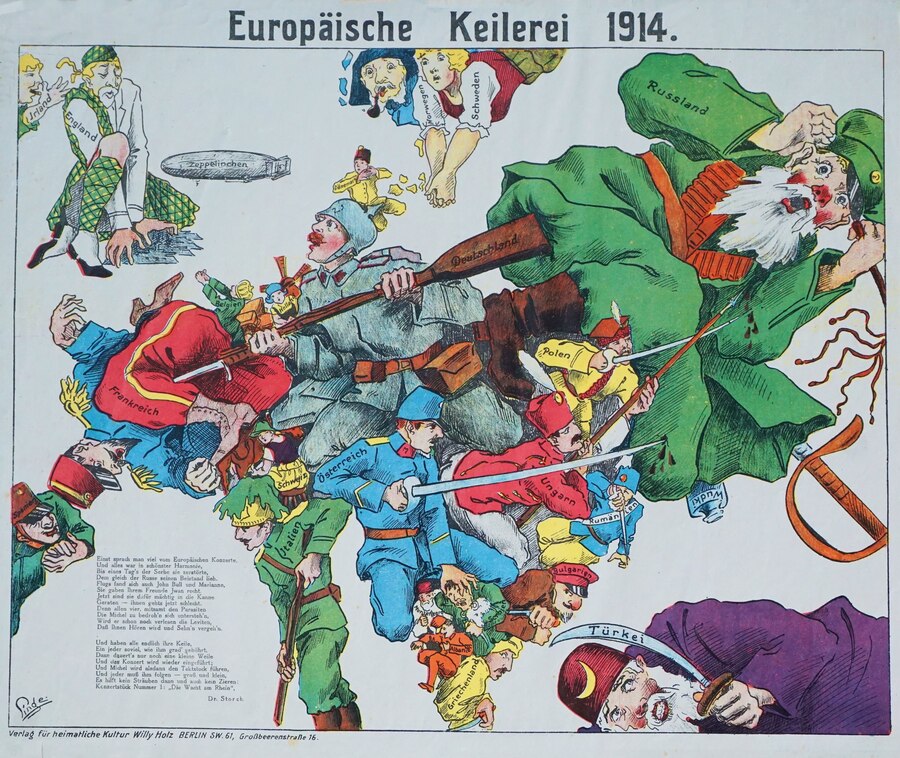
«European Wedge» Germany, 1914
The material for visual investigation was selected from the most striking examples of dehumanization during 1914–1918. The sample includes materials from the United States, Russia, France, the United Kingdom, and Germany. In my selection, I prioritized the quality of the sources. I also classified the examples I found into several groups.
To better understand the research, the chapter is divided by types of dehumanization, with various visual materials examined and analyzed in each section. I structured the visual research this way specifically to delineate the boundaries between the types of dehumanization, explore each one individually, and identify unique characteristics for each.
Visual Research Plan:
1. Concept
2. Types of Dehumanization:
— Animalistic (Zoomorphic)
— Demonization (Attributing infernal traits)
— Barbarization (The image of the uncivilized destroyer)
— Racial and Colonial Caricature
3. Dehumanization as justification and propaganda of violence. Patterns.
4. Conclusion
Textual sources include articles on dehumanization during World War I and books about propaganda posters. I analyze the gathered information through the lens of how the image of the enemy influences society.
Key research question: How were dehumanizing visual images used to portray enemies of the people?
Hypothesis: Dehumanization attempted to distort the image of the enemy in every way, depersonalizing and dehumanizing other people through propaganda.
To align with the concept, a specific color palette was chosen: various shades of gray symbolize the erasure of identity, while red represents bloodshed.
Animalistic Dehumanization
Animalistic or zoomorphic dehumanization is based on transforming a human into an animal or attributing animalistic traits to them.
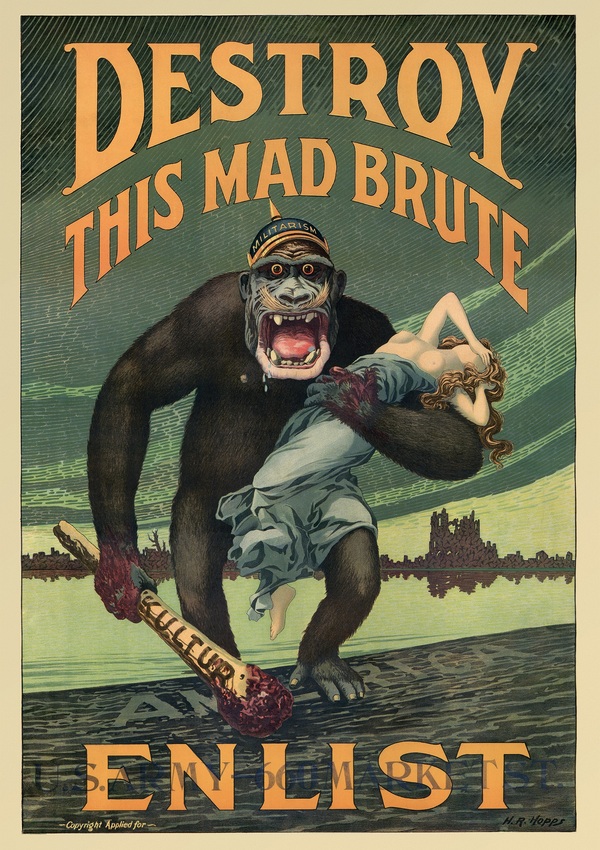
«Destroy This Mad Brute | Enlist» U.S.A., 1917, Harry Riley Hopps.
One of the most famous examples of animalistic dehumanization is «Destroy This Mad Brute | Enlist.» The poster depicts a monkey with a terrifying, wild face, wearing a German helmet. In one hand, it holds a bloody club marked «Kultur» (Culture); in the other, it holds a violated woman. It is equally important to examine the background: ruins of a city are visible, and the monkey is stepping onto American soil, suggesting it will spread violence in another country as well. The poster’s goal is to demonstrate the brutality of German soldiers, to dehumanize them by attributing «savage» traits, and to recruit men into the army.
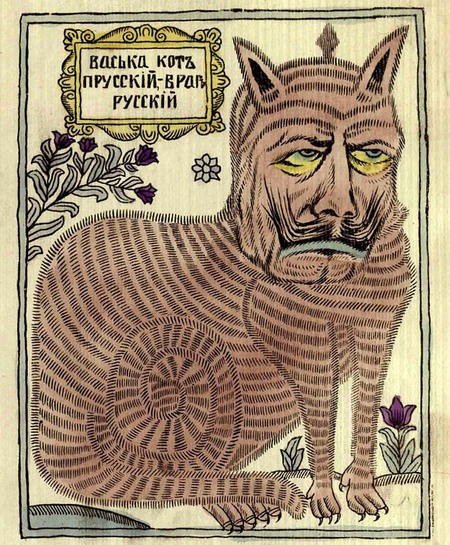
Above is a satirical print titled «Vaska the Cat of Prussia — Enemy of Russia, ” in which the artist depicts Kaiser Wilhelm II as a cat, endowing him with the ruler’s recognizable mustache and facial features. Through this zoomorphic dehumanization, the figure of Wilhelm II—and by extension, all of Germany, since the Kaiser was the face of the nation—is mocked. By naming the cat „Vaska, ” the artist diminished the ruler’s status, subjecting him to ridicule. This work is aimed at denigrating the enemy and exposing his foolishness and absurdity.„Vaska the Cat of Prussia — Enemy of Russia“ Russia, 1914–1915, N. P. Shakhovskoy.
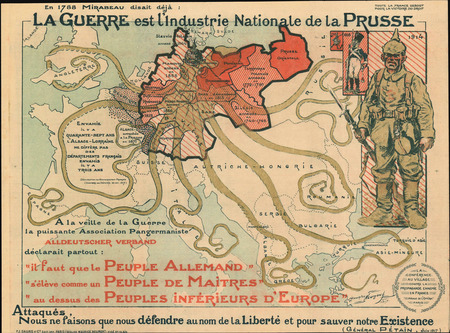
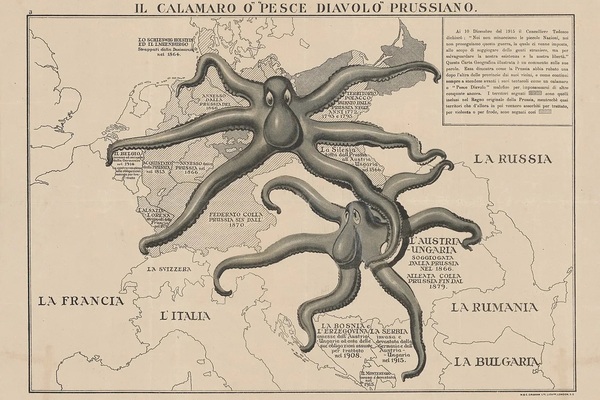
«War is the national industry of Prussia» France, 1917, Maurice Nemon. «The Prussian Octopus» United Kingdom, 1916, H. & C. Graham Ltd.
The image of a predatory octopus became firmly associated with Prussia. Tentacles spreading across Europe symbolized the country’s danger and growing influence. On the poster to the left, the octopus is depicted as more cunning and brutal; this character is evident through its tentacles—they are long, winding, and attempt to cover everything surrounding it. The octopuses on the right are more massive, yet no less threatening. The artists of both works pursued a single goal—to demonstrate the danger of Prussia, to depersonalize the nation, and to reduce its image to that of a cruel and merciless predator.
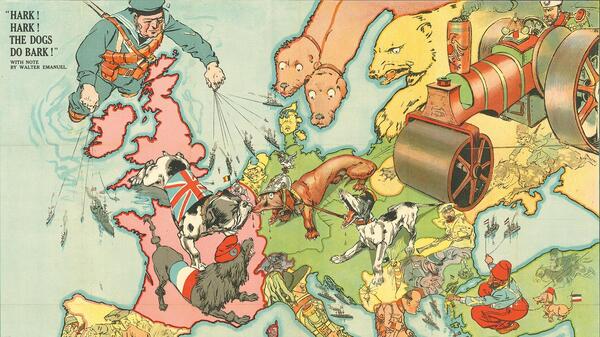
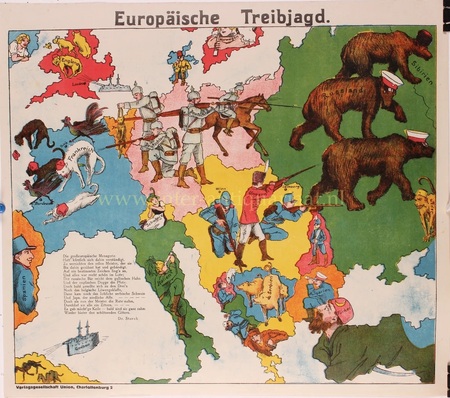
«Hark! Hark! The Dogs Do Bark!» Great Britain, circa 1914 «European Drive Hunt» Germany, 1914
Here are posters from opposing sides sharing a similar theme. In the British poster on the left, the countries are depicted as various animals, primarily dogs. Dachshunds, representing Germany and Austria-Hungary, are tethered together, reflecting their mutual dependence. Other animals attack these dogs: a British bulldog bites a German dachshund on the nose, and a steamroller, driven by Nicholas II, crushes a second tail. This zoomorphic dehumanization is evident through the composite figures representing different nations, clearly contrasting positive and negative imagery. The adversaries are defeated and portrayed as pathetic and helpless. In the German poster on the right, the countries are also largely depicted as specific animals, but the center of the composition features hunters symbolizing Germany and Austria-Hungary. They drive away and destroy the enemies; for instance, one white French cat lies dead, demonstrating the hunters' superiority. This animalistic dehumanization functions on the same principle as in the previous example. The comparison between human and animal illustrates the dominance of the former, while depicting various beasts as fleeing or dead shows their cowardice and insignificance.
Thus, zoomorphic dehumanization was employed to demean the enemy, portraying their image as foolish, irrational, and dissimilar to a human. In some instances, brutality was also attributed to the adversaries, thereby depersonalizing the enemy by imposing a generalized, threatening image onto ordinary citizens.
Demonization
Through demonization, enemies are ascribed absolutely brutal, merciless traits, and they are associated with demons or literally depicted as devils.
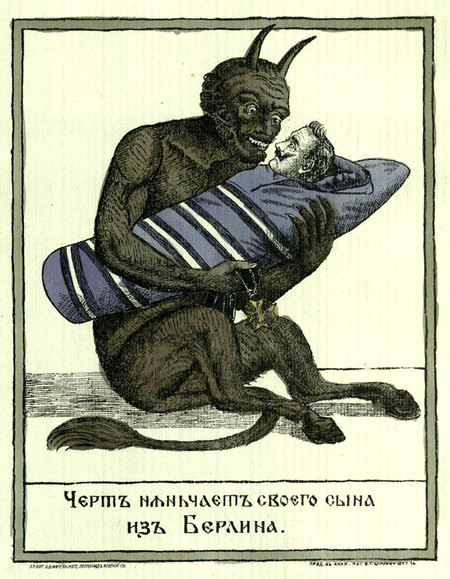
In this case, a different dehumanizing work by Shakhovsky is presented. In this poster, he once again degrades Wilhelm II, this time portraying him as the son of the devil, an embodiment of evil. The devil is depicted as repulsive, with a terrifying expression, nursing his son while holding a German award. Thus, the Kaiser is associated with the cruelty attributed to the devil.
«The Devil Nurses His Son from Berlin» Russia, 1914–1915, N. P. Shakhovsky.
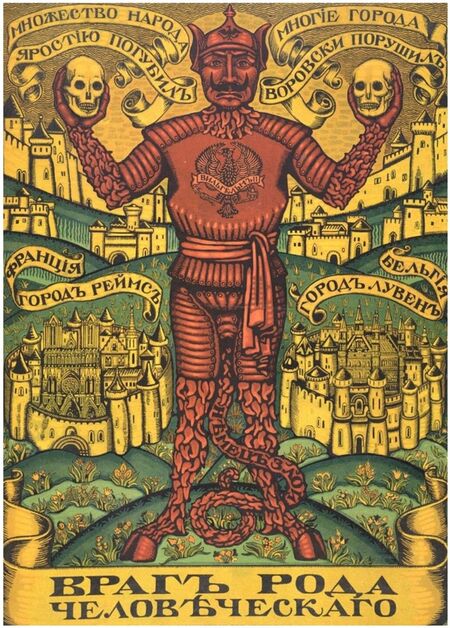
In another work, Shakhovskoy depicts Wilhelm II in the guise of the devil. He is the center of the composition; the red color is associated with the bloodshed for which the Kaiser is accused, and the danger he represents. Wilhelm II holds skulls, and his lower body is literally «demonic"—hooves and a tail point to the image of a fiend. The inscriptions state that the Kaiser «destroyed» peoples and «ruined» cities. The depiction of such a massive figure at the center of the poster aims to warn of danger. This demonization emphasizes the ruler’s cruelty and cold-bloodedness.
«Enemy of the Human Race» Russia, 1914–1915, N. P. Shakhovskoy
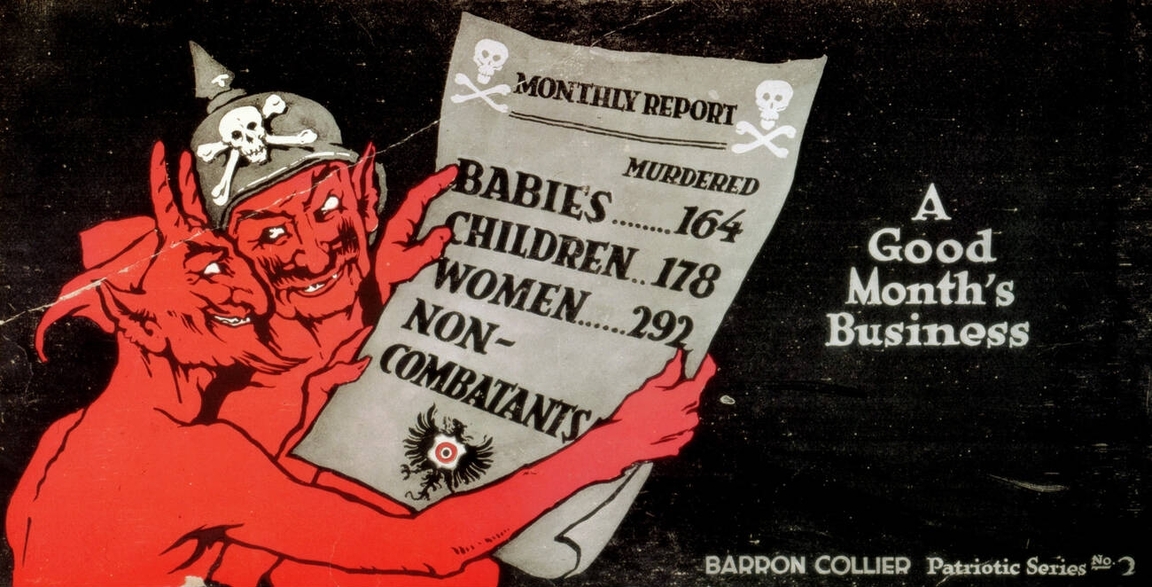
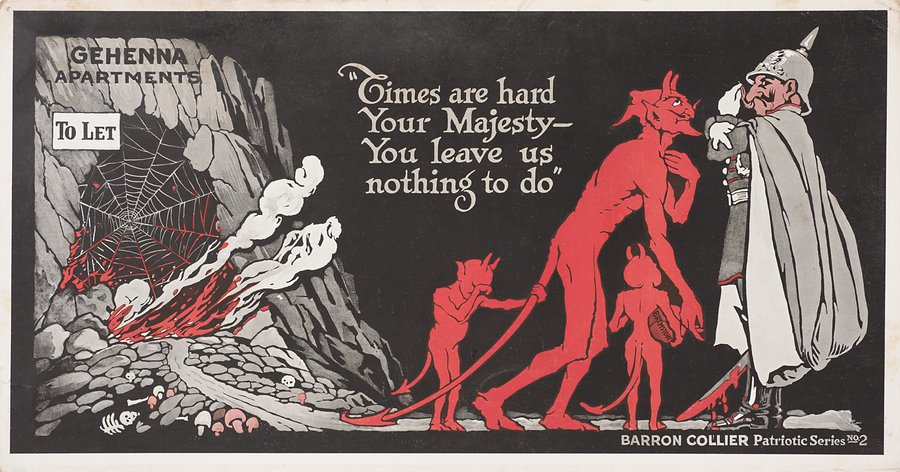
«The times are hard, your majesty—you leave us with nothing to do.» «A Good Month’s Business»
USA, circa 1918, Louis Reamerkers.
Above are presented a pair of satirical works from the series by Louis Raemkers, in which he condemns the merciless nature of Germany. These postcards depict scenes featuring devils and the Kaiser. In the first image, they address Wilhelm II as «Your Highness, ” presenting him as their ruler—that is, as pure evil. The devils complain to the Kaiser about the lack of work, which demonstrates the particular severity of Wilhelm II, who „took“ all the work for himself. In the background of the second image, a cave overgrown with cobwebs is shown, inscribed with „Infernal Apartments, ” signifying that hell has become empty because of the Kaiser, who committed all sorts of atrocities. In this instance, demonization serves as a propaganda tool, aiming to expose Wilhelm II and his ruthlessness. The second poster depicts two devils, one of whom is the Kaiser. They are reviewing a monthly report and are smirking mockingly. The document specifies how many infants, children, and women were killed that month, and a German symbol is also visible. The caption, „Successful business this month, ” reflects the demons’ mindset; they rejoice in the deaths and consider the killings a source of pride. Through the demonization of Wilhelm II, his bloodthirsty character is once again revealed; the association with devils deeply influences perception. The purpose of these posters is to show that the Kaiser is indeed evil.
«The Ideal Social Order» Russia, 1914, published by P. D. Evdokimov.
In this case, the Prussian soldier is the antagonist. He is depicted sitting on a soldier’s helmet, which crushes everyone and everything around him: people (a worker, an elderly woman, a scientist, an artist), books, and a globe. This symbolizes the destruction of the social order and oppression. The Prussian soldier himself is portrayed like a demon: pointed ears, clawed paws instead of feet, red fur, and a vile, menacing expression. He holds a whip in his hands—another symbol of violence and destruction. The demonization turns the enemy figure into the embodiment of tyranny.
Thus, demonization was employed to convey the enemy’s bloodlust and brutality by attributing demonic traits to his image, dehumanizing him, and thereby demonstrating that he was unworthy of being considered human.
Barbarization