Concept
Rationale for Topic Selection
The starting point for this research was the period of Chanel following Karl Lagerfeld’s arrival in 1983.
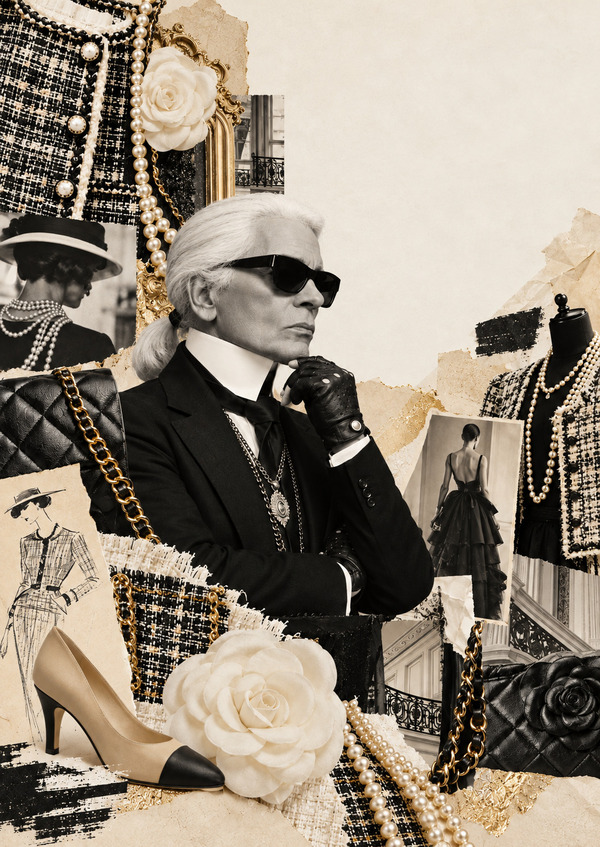
By this point, the fashion house already possessed a recognizable identity, established by Gabrielle Chanel: tweed suits, the little black dress, pearls and costume jewelry, chains, the 2.55 quilted bag, camellias, and other elements that were regularly repeated in collections and gradually came to be associated with Chanel. I became interested in how a designer can work with such a legacy when the brand’s core symbols emerged long before them. Lagerfeld did not attempt to literally reproduce Gabrielle Chanel’s pieces. Instead, he altered familiar elements quite freely—enlarging them, transferring them from accessories to clothing, substituting conventional materials with unexpected ones, or retaining only the recognizable essence of the item. For instance, Chanel’s jewelry might be transformed into embroidery directly on the dress, the silhouette of the 2.55 bag might become part of the garment, the classic black dress might be made of vinyl, or the traditional tweed suit could appear intentionally distressed. This very contradiction became the foundation of the study: how much can a familiar element be altered while still being perceived as part of Chanel’s visual language? The focus is not on the brand symbols themselves, but on the ways Lagerfeld transforms them. In some cases, the form is preserved, but the material changes. In others, a familiar object is turned into an ornament or an image. Sometimes the scale, function, or degree of ornamentation is changed. Therefore, the legacy in this work is viewed not as a set of items that must be precisely replicated, but as a system of elements capable of existing in new combinations. The study examines how the established visual language of the fashion house continues to evolve after a designer change. Through Lagerfeld’s work, it is possible to trace which Chanel hallmarks prove most resilient, which can be altered almost entirely, and what maintains recognizability. This allows his work with the House’s history to be seen not as a mere citation of Gabrielle Chanel, but as a continuous transformation of an existing language.
Material Selection PrincipleTwo groups of visual material were selected for this research. The first group includes works by Gabrielle Chanel from the 1920s–1960s, allowing for the identification of elements that gradually became stable hallmarks of the House. The second group consists of Karl Lagerfeld’s works for Chanel from 1983 to 2019. The focus is on items where the historical element and its new interpretation can be directly compared: the tweed suit, the little black dress, the chains and jewelry, the 2.55 bag, and the camellia. Research Categorization PrincipleThe work is structured not by collection chronology, but by methods of visual code transformation. First, the formation of Chanel’s stable elements is examined. Then, the research moves to the various ways Lagerfeld worked with them: transforming an object into a sign, substituting material while preserving form, imitating material through other means, intentionally deconstructing the original image, altering scale, and combining multiple codes within a single piece. This division allows the comparison of works from different decades not as a sequence of collections, but as different approaches to working with heritage.Textual Source Selection and Analysis PrincipleThe foundation consists of museum catalogs, object cards, and curatorial materials from The Metropolitan Museum of Art and the Victoria and Albert Museum, as well as Chanel archival materials. These are used to clarify dates, materials, the origin of the items, and the historical context. The works of Roland Barthes are employed as the theoretical basis for examining fashion as a system of signs. Particular significance is given to the exhibition catalog The Met Karl Lagerfeld: A Line of Beauty, which is dedicated to Lagerfeld’s creative methodology. The visual analysis is primarily based on a comparison of the objects themselves.
Research QuestionHow did Karl Lagerfeld alter the visual codes of Chanel while maintaining their recognizability?HypothesisLagerfeld did not preserve specific historical forms in their entirety, but rather the most recognizable signifiers of Chanel. By changing their material, scale, placement, or function, he could significantly diverge from the original object. Furthermore, the alteration of one element was compensated for by preserving others. Thanks to this, the Chanel legacy transformed from a collection of historical items into a flexible system capable of creating new images while remaining instantly recognizable.
To Lagerfeld: How the Chanel Code is Formed