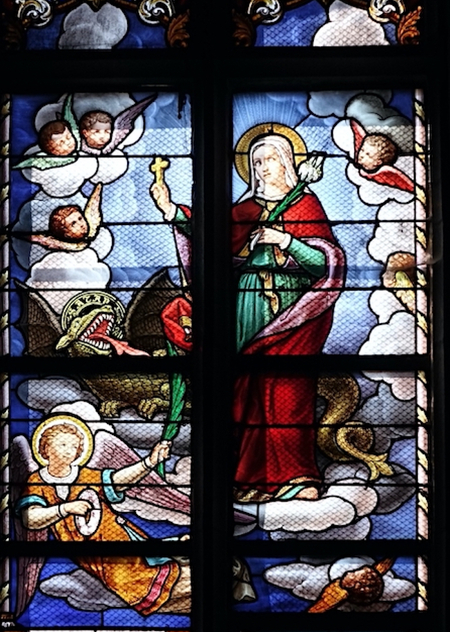
Concept
Animals have always held a significant place in culture and art. During the Middle Ages, their imagery was employed to convey concepts of good and evil, life and death, imbuing them with specific qualities and symbolic meanings. Alongside real animals, artists depicted fantastic creatures that combined traits from various members of the animal kingdom.This theme is particularly fascinating in Gothic stained glass. Here, animals become part of the overall composition, and their expressiveness is created not only by symbolic meaning but also by visual elements: color, silhouette, proportion, posture, and movement. Masters could alter familiar forms, emphasize specific details, and use conventional representations to heighten the expressiveness of the image and its interaction with other figures and elements of the stained glass.This study focuses on the bestiaries of 12th–14th century Gothic stained glass. The central focus is on real animals and fantastic creatures—the particularities of their depiction, and their role in organizing the stained glass composition. The aim of this work is to examine how medieval masters used artistic techniques to create animal images and transmit specific meanings through them, thus forming a unique visual language of Gothic art.
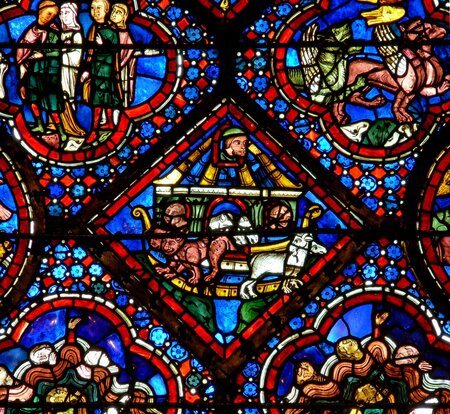
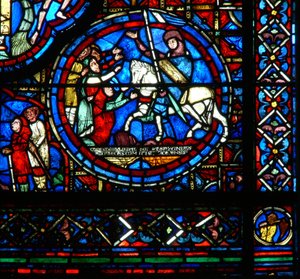
For my visual research, I selected Western European Gothic stained glass from the 12th to 14th centuries, predominantly French. During this period, depictions of animals held a significant place in religious art, serving not only as part of narrative scenes but also as bearers of symbolic meaning. Medieval bestiaries exerted particular influence on the formation of these images, imbuing real and fantastic creatures with moral and religious significance.The primary criterion for selecting visual material was the presence of animals within the composition of the Gothic stained glass. Special attention was paid during selection to works that allowed for a comparison of different ways of depicting real and fantastic creatures, the specific characteristics of their artistic form, and their role within the narrative. The visual sequence was based on the stained glass of Chartres Cathedral, specifically the narrative cycles featuring Noah, St. Eustace, and St. Margaret.The objective of my research is to determine the artistic means by which medieval masters created recognizable animal figures and how these depictions were used to convey meaning and organize the composition of the Gothic stained glass.
For this research, I utilized scholarly publications, museum catalogs, and materials from official cultural institutions. The primary criteria for selecting textual sources were the credibility of the information, its connection to the artworks being examined, and its ability to explain the characteristics of medieval iconography and stained-glass techniques. When analyzing the sources, I compared historical data and existing interpretations with the visual features of the artworks themselves, paying closest attention to silhouette, proportion, color, movement, and the arrangement of figures.
The main research question is this: how did medieval artists create images of animals that varied in character and meaning while preserving recognizable features, and how did their artistic form change depending on their role within the composition?
Navigation Menu
To systematically examine these features, I decided to divide the research into five thematic categories: animal typology, artistic form, the interaction between animal and human, fantastic creatures, and the animal within the stained-glass composition. The basis for this categorization was the gradual transition from analyzing individual images and their characteristic traits to investigating their narrative functions and role in the overall visual structure of the stained glass.
1. Bestiarium as an Image System
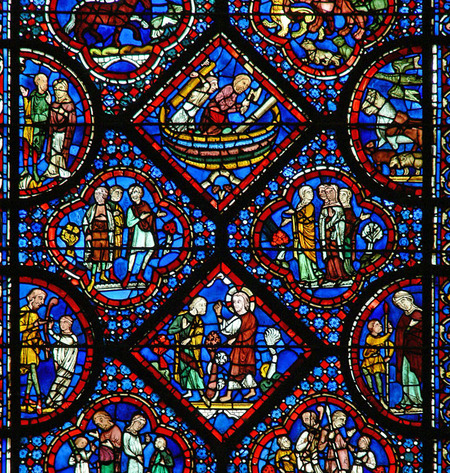
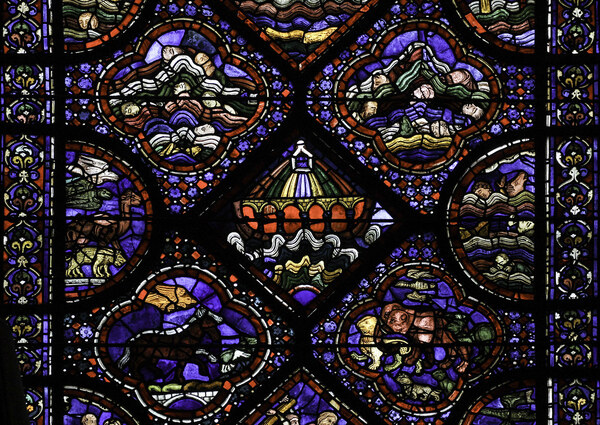
Medieval perceptions of animals were shaped by observations of nature, ancient literature, religious texts, and various legends. Within these views, both real and fantastical creatures could coexist within a unified worldview. Furthermore, animals were perceived not merely as living organisms, but also as carriers of specific qualities that could be interpreted on a moral or religious level.
This characteristic of the culture is reflected in medieval bestiaries. Descriptions of animals frequently combined physical attributes, behavioral characteristics, and allegorical interpretations. A real creature might be endowed with fantastical properties, while the depiction of a nonexistent animal was often built upon recognizable anatomical details.
In Gothic stained glass, this kind of blend is especially noticeable because of the commonality of artistic devices. Real animals and fantastic creatures are rendered using the same techniques: contour lines, planes of color, characteristic bodily curves, and expressive details. Thus, the distinction between the real and the fantastic manifests primarily in the structure of the form itself. While an image of a familiar animal retains a certain anatomical integrity, a fantastic figure may combine parts of different creatures or deliberately disrupt conventional proportions.
When examining real animals in Gothic stained glass, it becomes apparent that their recognizability is not always ensured by anatomical accuracy. In the depiction of a lion, important identifying features can include an enlarged head, mane, tail, and expressive paws. A deer is recognized by its antlers, elongated neck, and characteristic head posture. A bird is identified by the shape of its beak, wings, and tail, even if its body proportions significantly deviate from nature. The master highlights the elements that allow the viewer to identify the creature’s type. Other details may be simplified or altered depending on the size of the image and the nature of the composition. Particularly illustrative is the stained glass of Noah in Chartres Cathedral, dated approximately 1205–1215. Its narrative structure incorporates scenes of the animals arriving at the ark and their exit from it.
Comparing the animals within a single stained-glass cycle allows one to trace recurring modes of representation. Different creatures are unified by a similar rendering of torso, contours, and limbs, yet they retain their characteristic distinctions. This suggests that the master was striving less to accurately depict the anatomy of each species than to form a system of visually discernible motifs.
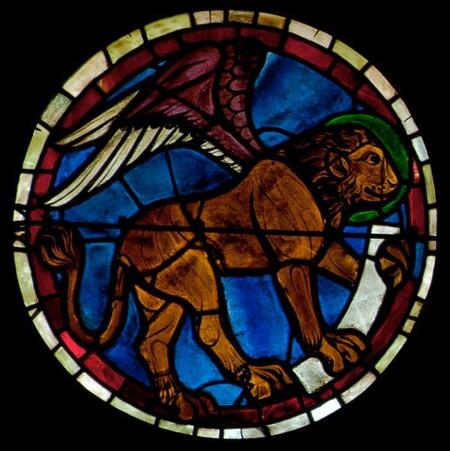
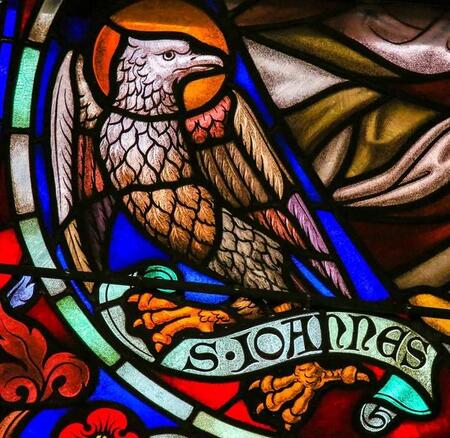
In depictions of animals linked to religious symbolism, recognition is achieved not only through natural characteristics. The winged lion and the winged ox retain the basic features of four-legged animals, but the addition of wings alters the nature of the image. Combined with other attributes, this allows them to be connected to Gospel iconography. The symbol of the evangelist Mark is the winged lion, and the symbol of the evangelist Luke is the winged ox. The eagle corresponds to the evangelist John, and the winged man—to Matthew. Together, these creatures form the tetramorph. From an artistic perspective, it is particularly interesting how a new element is added to the conventional anatomical structure. The wings change the external silhouette, increase the visual volume of the figure, and create additional directions within the composition. Moreover, the symbolic meaning depends on the iconographic context. The mere presence of wings is not enough to definitively identify the image as the symbol of a specific evangelist.
Birds form a distinctive group because their silhouette can change significantly depending on wing posture. When the wings are folded, the form becomes compact and elongated. The primary focus shifts to the neck, head, beak, and tail. Conversely, spread wings expand the image horizontally, creating a pronounced symmetrical or asymmetrical structure. The position of the feathers helps emphasize the direction of movement, and the repeating lines form their own rhythm.
When depicting a bird within a small medallion, the wings may be curved or adapted to the frame’s shape. Thus, compositional constraints sometimes lead to noticeable alterations in anatomy.
Unlike precise naturalistic depictions, the medieval bird can be constructed primarily from geometrically clear elements: a small body, an extended neck, a triangular beak, and a fan-like wing.
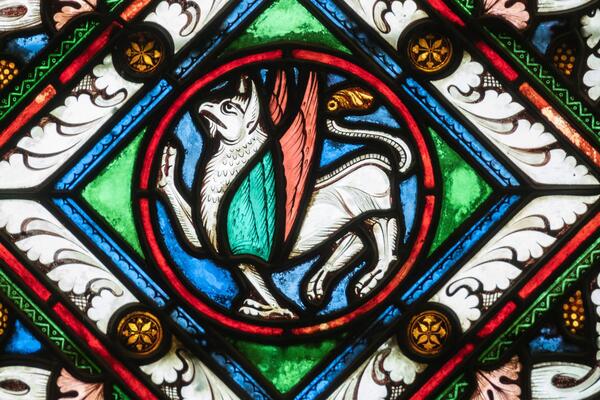
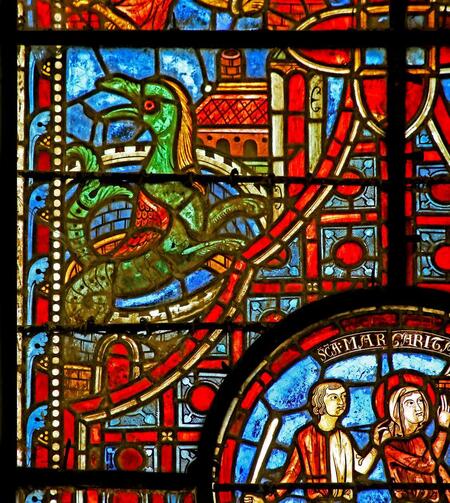
Images of serpents and dragons illustrate a different model for constructing animal forms. The principal expressive element becomes not the ratio of the body to the limbs, but the overall line of the body. This elongated figure allows for the creation of complex curves, filling space between other characters, and forming tense directions of movement.
Unlike many four-legged animals, the dragon is able to occupy several areas of the composition simultaneously: its head may be near a human figure, its body may curve along the edge of the scene, and its tail may extend in the opposite direction. This transforms the creature’s body into a means of organizing the image.
Hybrid animals demonstrate another way to transform natural forms—the combination of familiar anatomical elements. In the image of a griffin, the features of a bird and a large quadrupedal beast are combined. Such a combination allows for the creation of a new figure in which individual details remain recognizable.
A comparison of various animal types reveals that the medieval bestiary is not a simple juxtaposition of the real and the fantastic. Both real and imagined creatures can be depicted schematically, with natural proportions being altered. Their recognizability is established by highlighting characteristic features, while their expressiveness derives from silhouette, movement, and placement within the composition. Consequently, the foundation of the bestiary as a visual system lies not in the accuracy of the depiction, but in the form’s ability to convey the character, type, and meaning of the creature.
2. Form and the Visual Language of Animals
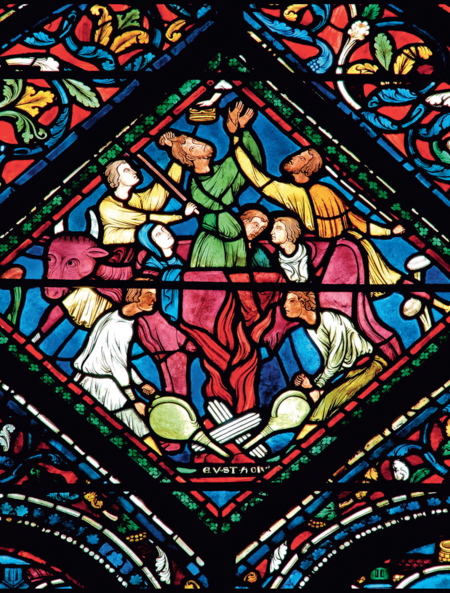
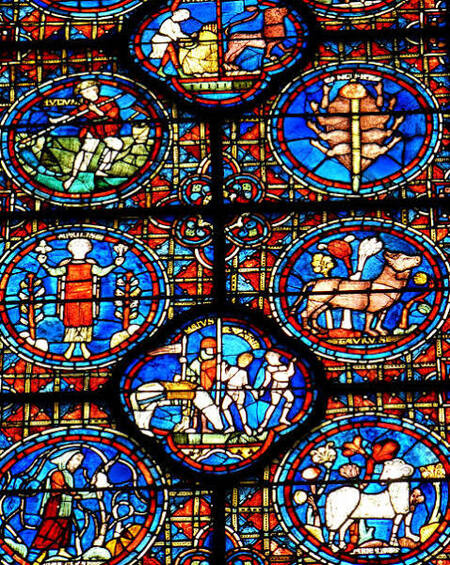
One of the primary means of creating an animal image in Gothic stained glass is the silhouette. It is the external contour that determines the initial impression of the figure and allows the viewer to recognize the creature even before examining the internal details.
This takes on special significance within the context of stained glass technique. The image exists as separate segments of glass joined by lead cames. In this process, the boundaries of the colored sections become an important part of the artistic structure, helping to distinguish the figure against the background and accentuating its essential outlines.
Comparing images of different animals illustrates the wide variety of ways a silhouette can be constructed. For a quadruped, recognition is achieved through the combination of the body, head, limbs, and tail. In a bird, the wings play a major role, while the elongated body line becomes the primary expressive element in a snake.
To conduct this study, it is particularly important to compare images that are rendered to the same scale and stripped of internal details. In this case, it becomes evident that most animals maintain recognizability thanks to a limited set of characteristic features.
Thus, the silhouette functions as a kind of visual formula, allowing the complex anatomical structure to be distilled into a relatively simple and expressive image.
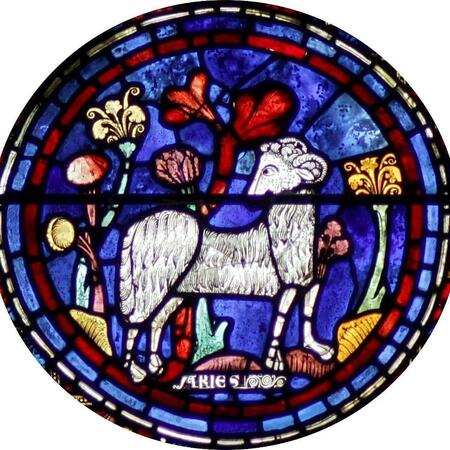
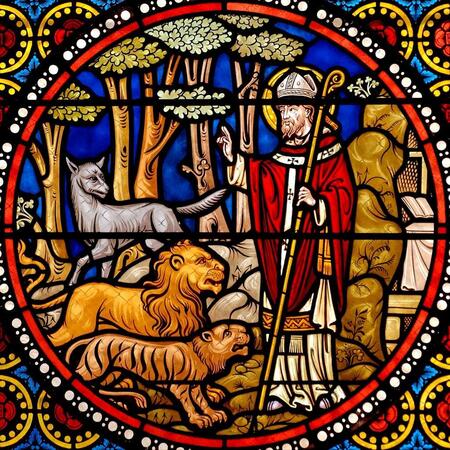
The head is one of the most informative elements of an animal depiction. This is where the features that allow us to distinguish species are concentrated: the shape of the muzzle, the placement of the ears, the length of the beak, the presence of horns, and the structure of the mouth.
With a small image size, the artist can intentionally emphasize these details. As a result, the head becomes the primary element of recognizability. The angle of the head is equally important. An animal turned toward another character is perceived as an active participant in an interaction. Conversely, turning the animal toward the viewer can make the image feel more autonomous.
The direction of the gaze deserves special attention. Even abstractly drawn eyes can create a sense of connection between characters. In narrative compositions, an animal’s gaze can link two figures, highlight the semantic center, or indicate the direction of the action.
This allows us to view the head not merely as an anatomical part, but as a tool for visual communication.
3. Animal and Human: The Interaction of Imagery