Concept
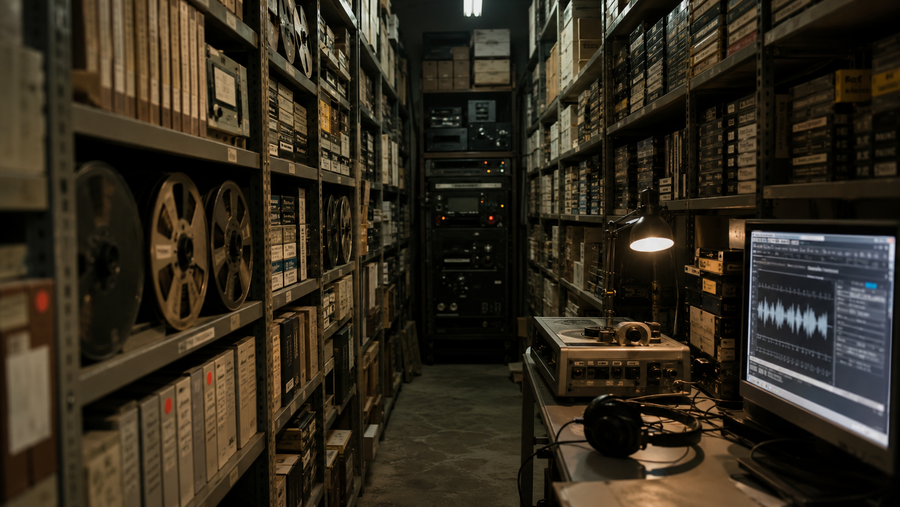
Generated by the author using ChatGPT based on the original text prompt. 2026.
The selection of the topic stems from the perspective that, within sound studies, the archive is viewed not merely as a technical repository of information, but also as a form of cultural power—a means of organizing memory and listener experience. Sound cannot be preserved in its original form; it vanishes the moment it occurs. However, recording and digital distribution technologies allow a sound event to be transformed into an archival object. In this sense, the audio archive functions as a mechanism for selection, classification, and the interpretation of cultural reality.
The theoretical foundation of this study is the article by E. Yumasheva, «Audiovisual Archives on the Internet, ” which describes internet archives as a new form of distributed cultural storage that merges state institutions, private collections, and user practices. The article emphasizes that the modern digital archive functions not only as a storage space but also as a media environment that demands interactivity, open access, user participation, and novel methods of material cataloging. This research builds upon that concept, translating it into practice by examining the archive as an acoustic territory where sound exists simultaneously as a document, a cultural artifact, and a media experience.
Key foundational works for this research include those of Raymond Murray Schafer, Brandon LaBelle, and Jonathan Sterne. Schafer introduces the concept of the soundscape—an acoustic environment that can be analyzed as a cultural setting. LaBelle examines sound as a method of organizing space and social relations. Sterne demonstrates that the history of sound recording is simultaneously the history of modes of listening. These ideas are particularly relevant in the context of internet archives because the digital medium alters not only the methods of sound preservation but also the very model of perceiving audio experience.
The key research question is:
Why and how is contemporary digital culture striving to archive liminal and hard-to-classify sounds?
Under «liminal» here are understood to be recordings of paranormal phenomena, séances, noise experiments, industrial environments, field recordings of abandoned spaces, radio broadcasts, mechanical interference, archives of deceased voices, ritual practices, and anonymous domestic noises. These materials often exist outside of official musical culture, intersecting instead with art, documentary, anthropology, and digital archaeology.
The research hypothesis posits that internet audio archives currently function as the «acoustic memory» of the digital age. They preserve not only sounds as such but also the ways of perceiving the world through listening. Of particular value are unstable, noisy, and marginal recordings, as these are what allow us to capture the elusive states of the environment, society, and technology. The archive of strange sounds becomes a means of preserving cultural anxieties, myths, and collective imagination.
The principle for selecting visual material is structured around several types of archives: state and institutional sound archives, online platforms for collective storage of field recordings, archives of occult and paranormal audio material, noise archives, and collections of industrial soundscapes, urban sound maps, and acoustic databases, as well as archives of experimental sound art.
Particular attention will be given to archive interfaces—the structure of catalogs, the visual language of websites, sound mapping, metadata methodologies, and navigation. The visual narrative of the research must demonstrate that sound archiving is simultaneously a technical, aesthetic, and ideological process. For instance, state archives strive for scientific systematization and historical representation, whereas independent online archives often operate on the principle of open user accumulation and chaotic digital collection.
A central case study will be the analysis of global and urban sound maps—projects where the user can «listen to space.» Such platforms transform geography into acoustic territory and demonstrate a shift from visual mapping to aural mapping. Yumasheva’s article also emphasizes the significance of interactive sound maps as a new form of archival practice.
The research will be structured to progressively move from institutional archives toward decentralized digital noise. Initially, it will examine state archives and their models for cultural heritage preservation; next, it will address independent field recording databases and sound map projects; the final section will be dedicated to archives of «strange sound»: EVP recordings (Electronic Voice Phenomena), occult audio collections, cassette noise archives, forgotten media, and digital decay recordings.
The work features the following sections:
- Concept
- Institutional Archives as Memory
- Independent Archives and Sound Maps
- Archives of «Strange Sound»
- Conclusion
A distinct component of this study will involve analyzing the aesthetics of archival interfaces. Many of these utilize a visual language comprised of darkness, spectrograms, noise textures, archival interference, and VHS artifacts. This cultivates a specific kind of «archival imagination, ” where the user perceives sound as the trace of a vanished event. Consequently, the archive transcends its role as a passive repository and transforms into a mediated experience.
The visual investigation also addresses the tension between private and public sound. Numerous online archives contain materials that were never intended for widespread release—home tapes, recordings of radio intercepts, field interviews, and the ambient noise of closed spaces. The digital publication of such materials alters the status of sound, converting a personal auditory experience into part of the collective memory.
The practical aim of this research is to demonstrate that sound studies enable the analysis of the internet not merely as a visual entity, but as an acoustic environment. The modern digital archive thus becomes a space where sound serves as a mechanism for exploring memory, power, technology, and the culture of everyday life.
The conclusion of the study proposes the finding that internet audio archives represent one of the key modes of contemporary sound culture. They not only preserve vanishing auditory phenomena but also shape new modes of listening, new models of memory, and new conceptions of cultural heritage. Archives of noise—strange and liminal recordings in particular—prove especially significant, as it is through them that the instability and multilayered nature of modern media reality become evident.
Institutional Archives as Memory
Institutional audio archives are the foundational layer of sound memory. Unlike ad-hoc user collections or artistic projects, these are constructed according to a documentary principle: every recording must be identified, described, placed within a storage system, and furnished with metadata—transforming an ephemeral sonic event into a stable historical resource. In this chapter, we examine three types of such structures—national sound libraries, university media archives, and museum field recordings collections—to understand how the disciplinary logic of the archive shapes what we subsequently come to recognize as valuable sound heritage.
1.1 National Sound Archives: Constructing Audiovisual Heritage
National sound libraries emerge as a response to a fundamental contradiction: sound is ephemeral, yet states and cultural institutions strive to fix it as part of the collective identity. Unlike written archives, where the unit of preservation is a document with clear boundaries, a sound archive faces the problem of acoustic continuity: where does one recording end and another begin? How does one separate «noise» from «content»?
The Austrian Media Library serves as an example of a solution to this problem, boasting an archive of over 2 million items. The interest here lies not so much in the sheer volume, but in the principle of thematic grouping: sections such as «Acoustic Chronicle of the Last 100 Years, ” „Women’s Voices, ” or „Mozart“ transform sound from a neutral carrier of information into a carrier of cultural identity. By choosing which voices and events to archive, the institution is simultaneously deciding which version of the past is worthy of preservation. Also noteworthy is the clear division by year, featuring photographs of women from that era, their work, and the historical context preceding the audio recordings.
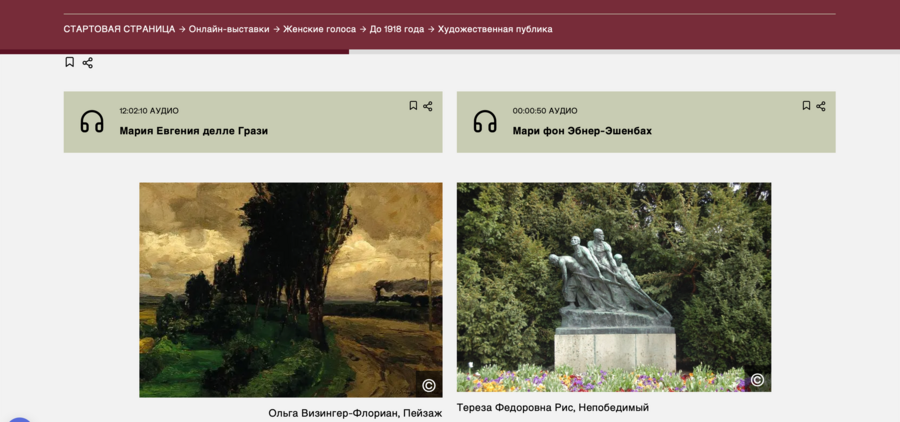
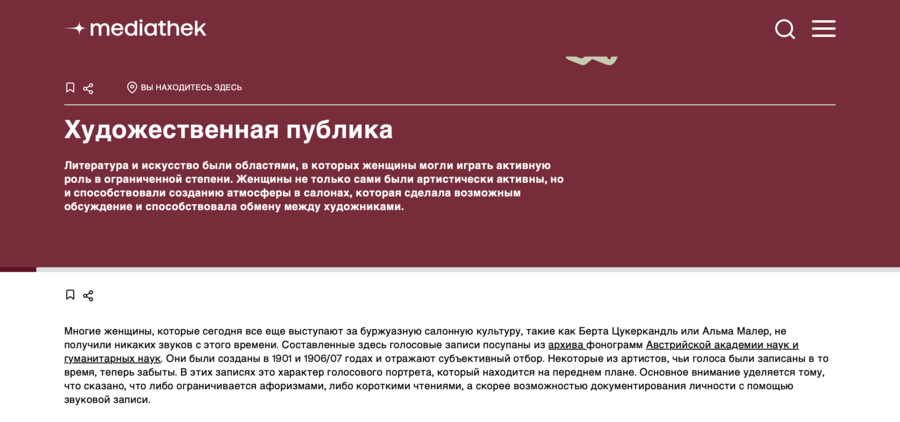
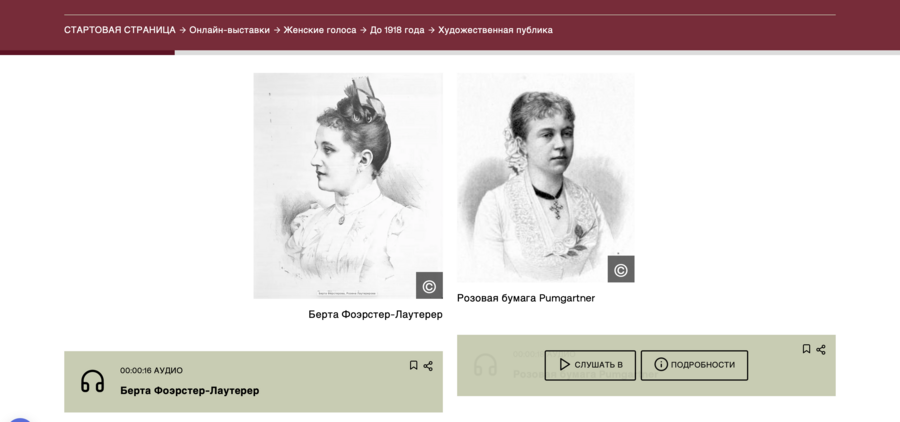
Screenshot of the «Frauenstimmen» page from the Austrian Media Library, 2026. Fair use for educational/research purposes.
The National Sound Archive of Mexico performs a similar function, where one of its collection strategies involves direct acquisition of recordings from network users. Formally, this is the democratization of the archive, but in practice, it is a redistribution of responsibility: the institution retains control over cataloging and access, while content creation is delegated to the public. This creates an interesting tension between the «archive as a collection of expertly curated documents» and the «archive as a platform for user creativity.»
Screenshot of the Fonoteca Nacional page. Direct collection of entries from users for the «National Sound Library of Mexico (Fonoteca Nacional).» 2026. This is followed by a video featuring a sound map from the public.
National sound archives strive for totality, but they inevitably encounter limitations: physical (media degrade), legal (copyright), and epistemological (not all sounds are deemed worthy of archiving). It is within these limitations that what we subsequently perceive as the «official sound history» is formed.
1.2 University Media Archives: Field Recording as a Scholarly Tool
If national libraries work with existing commercial or broadcast recordings, university archives possess a fundamentally different specificity: they generate sound themselves during the process of scholarly research. Field recording here functions not merely as a data collection method, but as an act of acoustic translation—transforming live, situational sound into a stable archival object.
The Phonogram Archive of the Austrian Academy of Sciences, established in 1899, is the oldest sound archive in the world, initially created to record languages, music, and oral traditions. The technical limitations of early recordings (wax cylinders) defined their epistemological characteristics: the limited playback time compelled researchers to approach what needed to be preserved with extreme selectivity. This was not passive recording, but active construction—the choice of a fragment intended to represent the whole.
The archive’s collection, which comprises about 14,000 hours of audio, is dominated by the humanities: field linguistics, dialectology, ethnomusicology, and cultural anthropology. Notably, recordings of political figures are virtually absent; the university archive is oriented not toward «great voices, ” but toward typical manifestations: dialects, ritual chants, and the sound of mechanical musical instruments. This establishes a specific model of listening, where the value of a recording is determined not by the uniqueness of the performer, but by its representativeness for scientific classification.
The University of Leeds' Sound Map project is advancing by implementing the principle of geographical referencing: historical recordings from English villages allow users to study pronunciation features and traditional vocabulary through sound mapping. The user navigates not by chronology or genre, but by space—accents and dialects of Great Britain, traditional music of counties, and recordings from rural settlements are «distributed» across the territory. This visualizes the concept of the soundscape as a continuous, geographically determined environment, thereby transforming the very way one navigates an audio archive.
Screenshot of the page. The Dialect and Heritage Project / University of Leeds. 2026. Used for educational and research purposes under fair use principles.
However, a key limitation remains here as well: a significant portion of the most valuable recordings (including the unique collection of accents and dialects) is only accessible in reading rooms. The digital archive is not a substitute for the physical one, but rather its showcase—a window to a restricted repository. This brings us back to the question of archival power: who, and under what conditions, gains access to the «complete» sonic heritage?
1.3 Museum Collections of Field Notes: Ethnography versus Aesthetics
Museum audio collections occupy a space between a scientific archive and an artistic exhibition. Unlike a library, where the recording exists primarily as a source of information, a museum tends to present sound as an artifact—an object that possesses aesthetic, material, or commemorative value. This shift in focus generates specific forms of presentation.
The Royal Museum for Central Africa in Belgium, as part of the DEKKMMA project, digitized its ethnomusicological collection, establishing navigation along two axes: musical instruments and the recordings themselves. It is important here that the instrument (the material object) is given equal standing to the audio file (the recorded event). A user can study the physical structure of the instrument and then hear its sound in the field—the museum’s logic of the «item series» overlays the archival logic of «documentary evidence.»
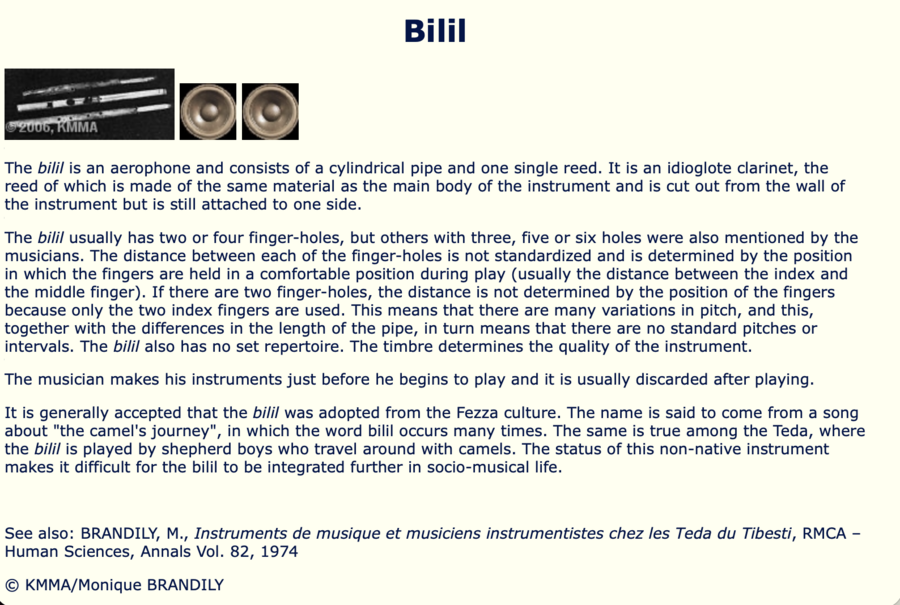
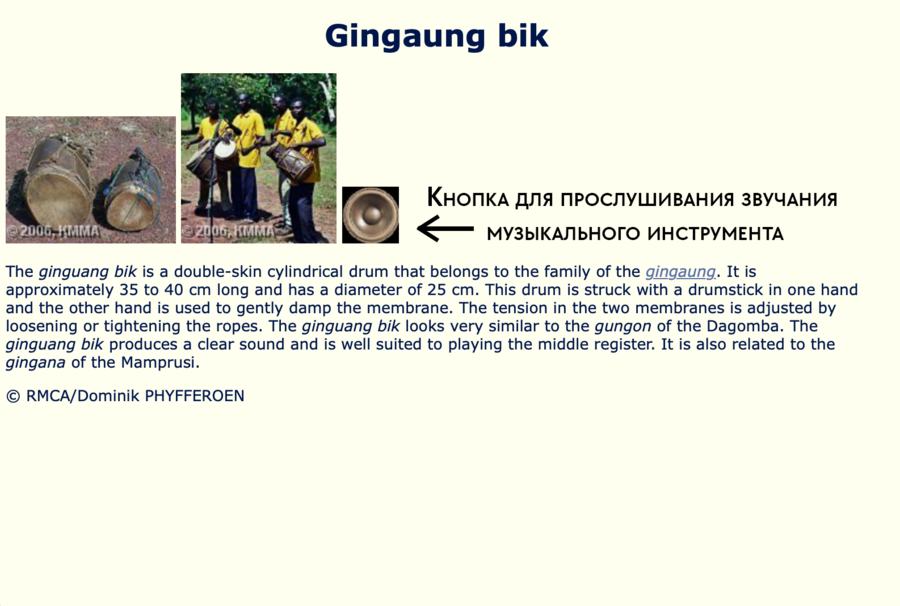
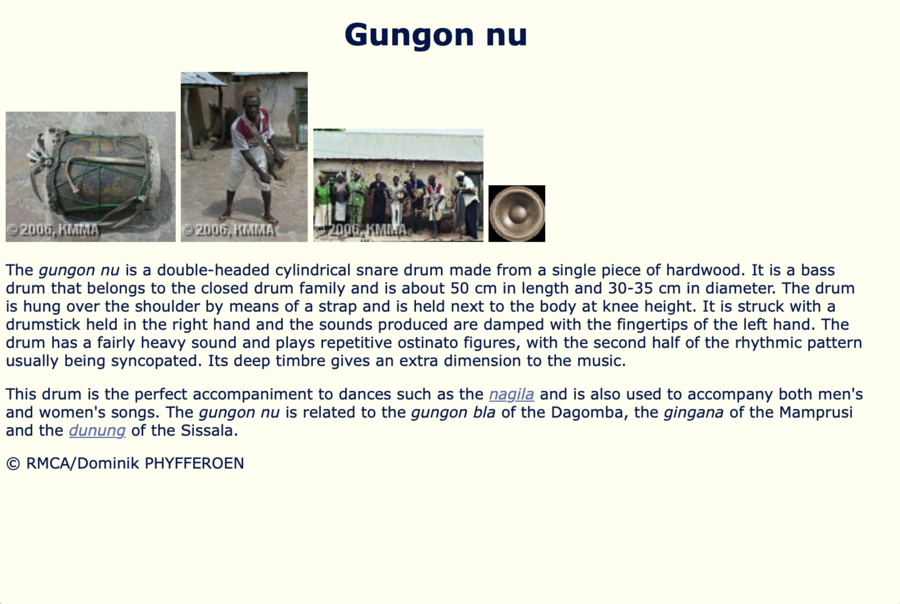
Screenshot of the page. Collection from the Royal Museum of Central Africa (DEKKMMA project), 2026. Used for educational and research purposes under the principles of fair use.
The Italian portal «Network of Sound Archives of Folk Music» (ArchivioSonoro) goes even further: its goal is not merely to collect, preserve, and present audio recordings, but to capture the entire cultural traditions of six provinces in their totality. Sound is just one of several channels, alongside photographic documents and video footage. This approach fundamentally decentralizes auditory perception—music or a ritual is not isolated onto a separate «audio track» but remains part of a complex sensory environment. The listener, in this setting, is deprived of a fully immersive experience—they observe the sound from the outside, much like a museum visitor viewing an exhibit in a display case.