
Introduction
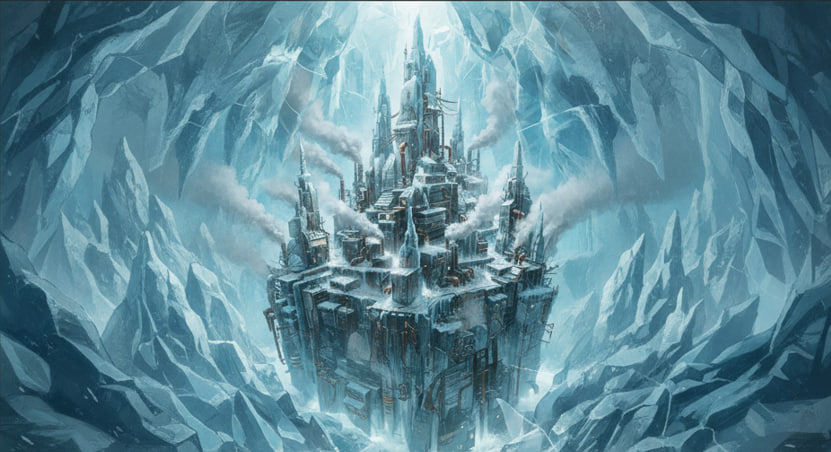
Ice in the world of frostpunk is not merely a climatic condition—it is a universal architect. It dictates the form of buildings, the topology of streets, building density, and even social relationships. The architecture of survival transforms into a visual language: stressed structures, thermal insulation layers, and industrial steam swirling like a sign of fragile warmth. The cover frames this thesis: a city in the face of cold is not built—it freezes, is squeezed by the climate, and becomes the body politic’s response to the ceaseless pressure of the elements.

Research Context
Frostpunk is a world of technological fallout from the industrial age, where architecture ceases to be aesthetics and becomes an instrument of survival. The landscape dictates strict rules: circular planning, extreme density, and energy centralization. The research timeline shows: climate collapse → crisis in building codes → transition from architecture of comfort to architecture of necessity → the formation of thermal societies.
Key Questions
What architectural principles does perpetual winter engender? How does the distribution of heat shape the structure of a city? Why does a circular form become not an aesthetic choice, but a destiny? These questions lead to a core schema: climate → heat → urban planning → social structure → the city’s visual identity.
Theoretical Foundations
The research is grounded in three disciplinary bodies: — architecture of extreme environments—principles of Antarctic stations, underground shelters, and dome structures; — urbanism of crisis territories—camps, temporary settlements, and reactive cities; — the visual culture of the industrial age of cold—smoke, steam, metal, leather, and kerosene torches as elements of architectural language.
Frost as Architect
Cold as a Form
Temperature acts as the primary designer. Materials lose their plasticity, structures strive to minimize thermal bridges, surfaces become coated in frost, and nature itself dictates: the forms must be rounded, dense, and consolidated so that the wind does not destroy the structure.
Environmental Pressure
Constant storms necessitate low-profile structures and the connection of buildings to one another, forming dense «nests» of architecture. Cold pushes architecture closer to biology—the city becomes a fused organism, bound together to preserve warmth.
Ice as Material and Adversary
Ice simultaneously supports and destroys. — It is used as an insulation layer. — It fractures beams, forcing them apart from within. Architecture is compelled to account for this dual nature of the material, resulting in the creation of anti-icing frames and steam conduits.
Thermal Signature
Every building is a source of heat; every window is a leak. Architecture transforms into a map of thermal stress, where the visible material is not brick, but temperature.
Warmth as an Urbanistic Principle
Generator as the Center
In a frostpunk setting, the heat source is the absolute point of gravity. Everything distant from it perishes. This forms a radial structure where the distance to the core determines the status, comfort, and lifespan of the buildings.
Thermal Rings
The city is built in rings, much like a biological organism. The inner rings are the warmest and densest. The outer rings are frozen, temporary, and susceptible to decay. This geometry is not a choice—it is a physical necessity.
Thanatozones
The outer sectors are zones of inevitable architectural death. The architecture here is temporary: barracks, tent modules, prefabricated structures. The city intentionally constructs sectors of decay, accepting ruin as part of its rhythm.
Temperature as a Social Marker
The closer you are to warmth—the higher the quality of the housing. Social structure materializes in space. Warmth becomes currency, and architecture reflects the hierarchy of access to it.
Principles of Construction in Extreme Climates
Surface Minimization
Any exterior surface equals heat loss. Therefore, buildings are: — rounded, — low-profile, — devoid of decorative elements. Architecture acquires a functional severity.