Anatomy of Intimacy: Gestures of Love in Roman Art of the 2nd–3rd Centuries AD
Sometimes a single touch is enough to perceive closeness between two people. A hand on the shoulder, an embrace, a turn of the head or body toward another—these gestures seem understandable without words.But do they always signify what we see in them?
Research Problem:
When looking at Roman artworks, we tend to interpret the depicted gestures the same way we would today. For example, an embrace appears to be an expression of love, and clasped hands signify closeness between people.
However, in Ancient Rome, these same gestures might have held different meanings. They could have been linked to marriage, a specific myth, or a tradition of character portrayal.
This suggests that our initial impression does not always lead to a correct understanding of a piece. Therefore, I am interested in investigating precisely which details create a sense of intimacy and how closely that sense relates to the original meaning of the image.
Relevance of the Study:
I am interested in how artists convey relationships between people without words. Sometimes, a small gesture or a turn of the head is enough.Such details are particularly fascinating to examine in Roman art because we see familiar movements, but we don’t always know what significance they held for people of that era.This study allows us to look at ancient works not only from the perspective of their narrative but also from the perspective of composition, gesture, and figure interaction.Research Question:
How do gestures, body positioning, gazes, and the distance between characters convey intimacy in Roman art of the 2nd–3rd centuries CE?And does our perception of these gestures always align with the meaning they held in antiquity?Research Hypothesis:
I hypothesize that the sense of closeness between characters arises not only from physical contact. Body posture, the direction of gazes, movement, and the distance between figures also influence this perception.
Furthermore, identical gestures can be interpreted differently depending on the composition’s structure and the narrative being depicted.
Research Objective:
To determine which visual techniques in Roman art from the 2nd–3rd centuries CE are used to convey intimacy between characters, and to compare one’s own perception of the images with their historical significance.
Research Objectives
1. To select works of Roman art from the 2nd–3rd centuries CE that depict interaction between characters. 2. To examine how touches, gazes, movements, and body positioning are portrayed in these works. 3. To compare images that employ similar gestures. 4. To study the narratives and significance of the selected works using museum descriptions and scholarly sources. 5. To determine in which cases the initial impression of an image aligns with its historical meaning, and in which cases it deviates.Research Object
Works of Roman art from the 2nd–3rd centuries CE that depict the relationships and interactions between characters.
Area of Investigation
Gestures, touches, gazes, body positioning, and the distance between figures as methods of depicting intimacy.
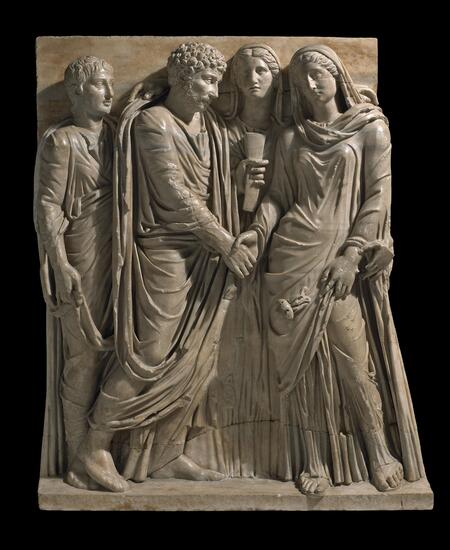
Fragment of a sarcophagus with a marriage scene Roman Art, 2nd Century CE *World History Encyclopedia, held at the British Museum
When I first looked at this relief, I didn’t feel any emotional closeness between the man and the woman. Although they are holding hands, the scene doesn’t strike me as romantic. Rather, it conveys a sense of formality—as if what we are seeing is not an expression of love, but the ratification of a bond that must be established.This contradiction interested me. After all, clasped hands are a gesture I usually associate with trust and affection. Why does it evoke a completely different impression here?Perhaps the issue isn’t the touch itself, but how it is depicted and the situation in which it occurs.
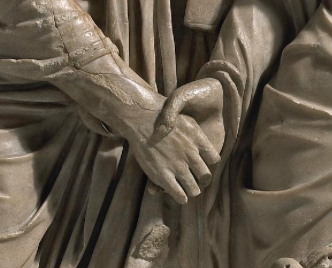
Close-up shot of hand gestures
If we focus only on the couple’s hands, the gesture becomes even more intriguing. By itself, it suggests physical closeness: two people making contact, a connection forming between them. But I don’t perceive this touch as particularly tender.It reminds me more of a handshake, used to confirm an agreement. In such a gesture, the significance of the action itself is more important than the desire to touch another person.Of course, this is a modern association, and it would be incorrect to assume that the Romans viewed the scene as the conclusion of a deal. However, it is this impression that leads me to wonder: can the same gesture simultaneously denote intimacy while remaining emotionally restrained?
Dextrarum iunctio — the joining of right hands
In Roman art, the gesture of joining right hands was a symbol of agreement and union. In depictions of married couples, it signified matrimonial bond and could express the concept of marital consent.
This allows for a new perspective on the relief. The touch here does not necessarily need to convey a specific emotion or personal moment between two people. Instead, it serves a symbolic function: it makes the marital union recognizable to the viewer.
It is particularly significant that the scene is depicted on a sarcophagus. In funerary art, this gesture could preserve the memory not only of the couple themselves but also of their relationship as a socially meaningful bond.
It follows that my initial sense of formality does not contradict the historical significance of the gesture. However, it does not prove the absence of love—the image simply employs a different way of speaking about intimacy.
When I look at the relief as a whole again, my attention is drawn not only to the touch but also to how it is integrated into the composition. The couple is not depicted alone. There is another figure between them, and the scene itself appears solemn and organized. Therefore, the joining of hands is perceived as a central action, the significance of which extends beyond the relationship between two specific individuals. I think this is what alters the emotional perception of the image. The touch does not become any less meaningful; rather, its significance becomes more symbolic than intimate. Here, closeness is expressed through the acknowledgment of union, not through an overt display of tenderness.
This bas-relief helped me understand that the presence of physical contact does not automatically mean the image will be perceived as tender or romantic.
Joined hands can signify fidelity, agreement, and the strength of a relationship, even if the scene itself remains emotionally restrained. For me, this image is primarily about union, rather than the experience of love.
But a new question arises: what needs to change in the image for a similar touch to begin being perceived as an expression of tenderness?
Is it enough to alter the body positions, the direction of movement, or the distance between the faces? Or does the narrative surrounding the touch play the decisive role?
To explore this, I want to compare this bas-relief with other works of Roman art where the intimacy between two people is depicted differently.
Sarcophagus with scenes of military and civilian life
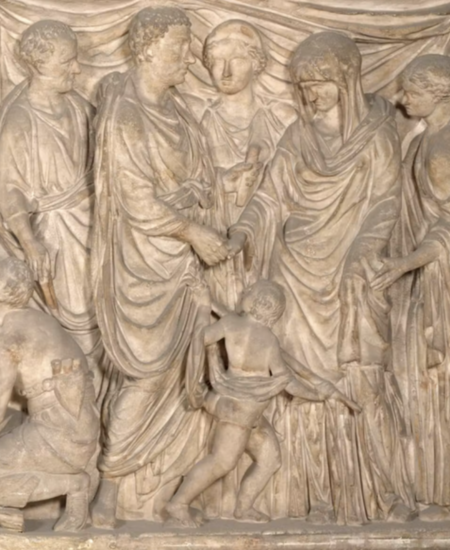
Sarcophagus with scenes of military and civilian life Roman art, late 2nd century AD. Marble. Uffizi Gallery, Florence.
Marriage as Part of Public Life
In the first relief, the joining of hands reminded me of the conclusion of an agreement. I wanted to understand whether this impression was specific to the features of that particular composition or to the role the depiction of marriage played in Roman art.
Therefore, for comparison, I chose a sarcophagus where the marital union is presented among other significant events in a person’s life.
I was interested in the fact that marriage here turns out to be part of a broader narrative—alongside social and military achievements. This alters the perception of the gesture: it might speak not only of the relationship between two people but also of marriage’s place in the concept of a successful, worthy life.
If I perceived a formality in the touch itself in the first relief, here I want to test how much that impression is tied to the context in which the couple is depicted.
In the second relief, I encounter the familiar gesture of clasped hands once again. But this time, it is not depicted as a standalone scene of marriage, but as one episode within a larger composition dedicated to the life of an individual.This compels me to reconsider the meaning of touch. In the first work, I felt the couple was confirming their union more than expressing emotion. Here, this impression is even stronger: marriage is placed alongside military feats, religious rites, and other events through which a Roman might wish to make his life worthy of remembrance.It follows that the joining of hands here is important not merely as a sign of a relationship between two people. It becomes part of a narrative about one’s standing in society and the values one wished to uphold after death.
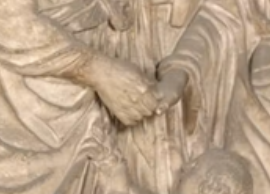
If we mentally isolate the joined hands from the rest of the relief, we find a gesture that could easily be perceived as an expression of affection. However, once it is reintegrated into the overall composition, the impression changes.
The couple is not left alone here. Their union is presented in the presence of other figures, among whom there are characters of symbolic significance. Therefore, the touch is perceived not as a spontaneous desire for closeness, but as an important, almost ceremonial act.It seems to me that the setting itself makes the gesture so formal. This is not to say that the couple did not love each other. It is simply that the image does not invite us to look into their private emotions. Instead, it portrays marriage as an event of importance to the family, the community, and the memory of the individual.
The description of the sarcophagus in the Uffizi catalog helps to understand why the marriage scene occupies such a prominent place in the composition.
The relief unifies events that might have characterized the virtues and social standing of the deceased. The scene of joining hands concludes the narrative on the front face of the monument. Beside the couple are figures associated with marriage and consent.
The museum, however, allows for two interpretations: the depicted wedding might have belonged to the deceased themselves or to their son. Consequently, this is not necessarily a sequential narrative of one person’s private life.
This is particularly important for my research. The marriage scene here is valuable not as evidence of specific romantic feelings, but as an image of consent and familial continuity, worthy of depiction on a funerary monument.
In both reliefs, I see the same gesture—the joining of the couple’s right hands. In both instances, however, it does not evoke a feeling of intimate tenderness in me.
Yet, the reasons for this impression differ slightly.
In the first piece, my attention was focused on the touch itself: it felt to me like the confirmation of an agreement. In the second, the gesture’s meaning unfolds primarily through the surrounding narrative. The wedding becomes one of the events illustrating a person’s virtues and family connections.
Thus, the two images help me reach a more precise conclusion: formality arises not solely from the gesture itself. It is created by the combination of the touch, the composition, the presence of other characters, and the work’s intended purpose.
But does this mean that the joining of hands can never convey tenderness? To answer that, one must examine images where physical closeness becomes the main subject of the scene.
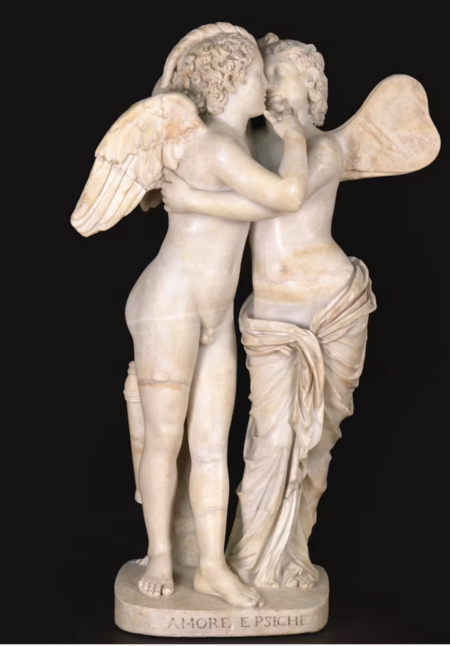
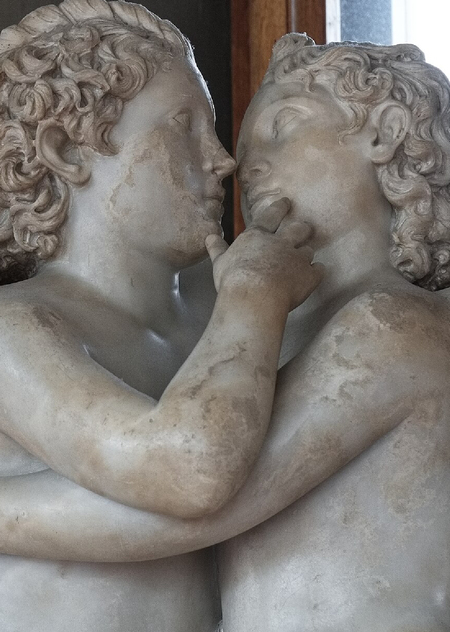
Eros and Psyche Roman Sculpture, 150–200 AD. Marble. In the Hellenistic style. Uffizi Gallery, Florence.
After the two wedding reliefs, this sculpture evokes an entirely different feeling in me. Here, I don’t see formality or the need to validate a relationship in front of others; rather, I see the desire of two people to be closer to each other.
It is interesting that physical contact was present in the previous works as well. But if there, it resembled a handshake or the sealing of an agreement, here it is perceived as an expression of tenderness.
I think it’s not just about Eros and Psyche hugging. More important is how the embrace itself is structured: both figures are turned toward each other, their movements intertwine, and the distance between them almost disappears.
I want to understand exactly which details create this sense of reciprocity and why, here, I perceive the touch as an expression of feeling.
In the previous images, the joining of hands was the primary sign of a marital union. In the case of Eros and Psyche, the touch is structured differently: it is not limited to a single point of contact but integrates the figures into an embrace.I believe this is the crucial difference. A handshake can be performed while maintaining a certain distance between oneself and another person. An embrace, by contrast, implies the reduction of that distance. Here, the touch becomes not a separate action, but part of the combined movement of two bodies.Therefore, I interpret it not as confirmation of an existing bond, but as the very manifestation of the desire to be close.However, it is important not to consider an embrace as a universal proof of love. In this sculpture, the impression of tenderness arises from the combination of touch, posture, and subject matter, not solely from a single gesture.
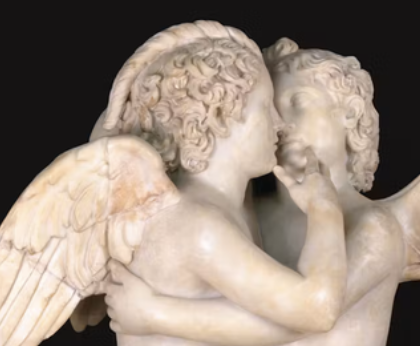
If in the first marital relief I tried to understand the relationship between the spouses through the direction of their gazes, here attention is immediately drawn to the closeness of the faces.
Eros and Psyche are not merely positioned near each other: their poses are oriented toward one another. What is important is not just the kiss itself, but the fact that both characters participate in this movement. This is why the scene is perceived as mutual rather than as one person touching another.
For me, the very sense of space between the figures changes here. In marriage reliefs, this space was preserved even when hands were joined. Here, it almost vanishes: the bodies and faces form a single composition.
It turns out that tenderness is conveyed not so much through facial expressions as through the relationship between the two figures. The sculptor portrays intimacy through their shared movement.