Navigation Menu
- Concept
- Opposing Elements
- Unstable Architecture
- Impossibility of Exit
- Conclusion
I. Concept
In the black-and-white animation of the Fleischer Brothers Studio from the late 1920s to the early 1930s, the boundary between the living and the inanimate is constantly violated. Objects take on faces, architecture morphs on the fly, and the entire surrounding world intervenes in the character’s actions. The Fleischer Brothers Studio developed concurrently with Walt Disney’s studio and other American animation studios that utilized metamorphosis and anthropomorphism. Animating objects and free form transformation were part of the common language of animation at that time, so these techniques cannot be considered exclusive to the Fleischers themselves. My interest lies in their application: how the plastic form of the drawn world is constructed to evoke a sense of danger.
Key research question: How does space in Fleisher’s cartoons assume the function of an antagonist through visual devices?
To answer this, you must differentiate between the animation of the environment and its hostility. An object that moves or possesses human characteristics does not necessarily threaten the character. The space will be considered an antagonist in cases where it independently initiates an obstacle, limits the hero’s choices, or transforms a rescue attempt into a new perilous situation.
The research is divided into three chapters. The first examines the elements: how they become animated and begin to threaten the hero, take on forms, attack, or give chase. The second shifts focus to the setting itself. Here, scenes are analyzed where walls deform, the floor gives way, and passageways change size. The third chapter is dedicated to the escape: where the character is heading, what obstructs their path, and whether they succeed in getting out. This structure allows for a separate examination of the source of the threat, the alterations to the surrounding space, and the hero’s attempts to leave it. Each chapter also accounts for how shadows, contrasts, and perspective make the events more terrifying.
Four Fleischer Studio cartoons were selected for analysis: *Swing You Sinners! * (1930), Bimbo’s Initiation (1931), Minnie the Moocher (1932), and Snow-White (1933). They allow for an examination of various ways a character interacts with a changing environment. Since all four films belong to the studio’s early sound black-and-white animation period, music and rhythm will also be considered where they determine the movement of surrounding objects and the character’s interactions with them.
The research hypothesis is that the hostility of the surrounding world arises from its inherent activity and unpredictability. Anthropomorphism and deformation render the environment unpredictable, forcing the viewer and the protagonist to constantly guess where danger will originate. This analysis will examine when these techniques transform space into an active adversary and in what circumstances the protagonist can confront the space.
II. Antagonistic Subjects
In Flaysher cartoons, objects can act on par with the characters. However, the mere appearance of a voice or face on an object does not mean it becomes an enemy to the hero. To establish this, the motive must be captured: the object must begin to threaten the character, obstruct their actions, or participate in coercion.
«Metamorphosis—the transformation of one object into another—is not a new idea; it formed the basis of Emil Kolya’s early animated experiments at the beginning of the century. However, Fleischer animators used this technique at the edge of surrealism.» [1]
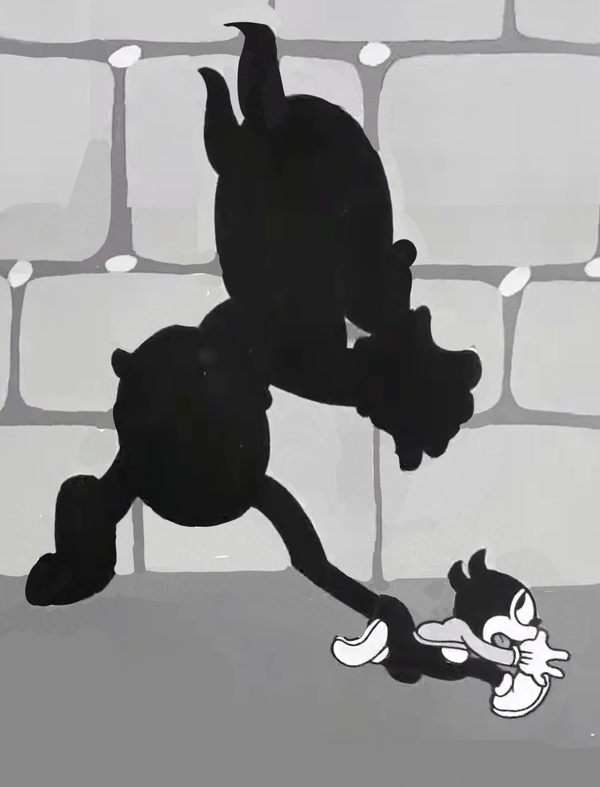
In Swing You Sinners! (1930), there is a striking scene set in a graveyard. After evading the police following an attempt to steal a chicken, Bimbo finds himself among animated gravestones. They interact with him, addressing him with warnings and condemnation.
III. Unstable Architecture
IV. Inability to Exit