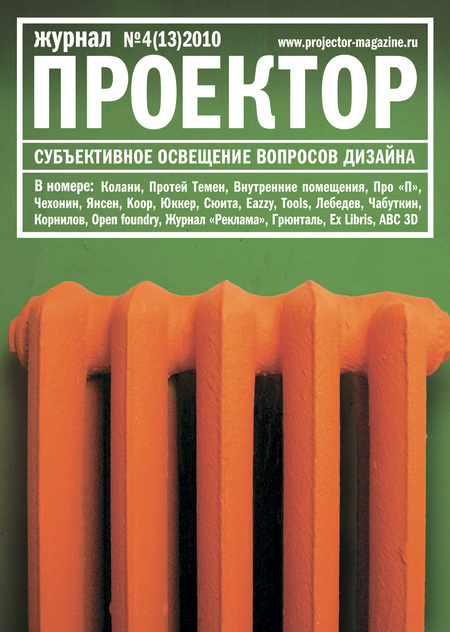
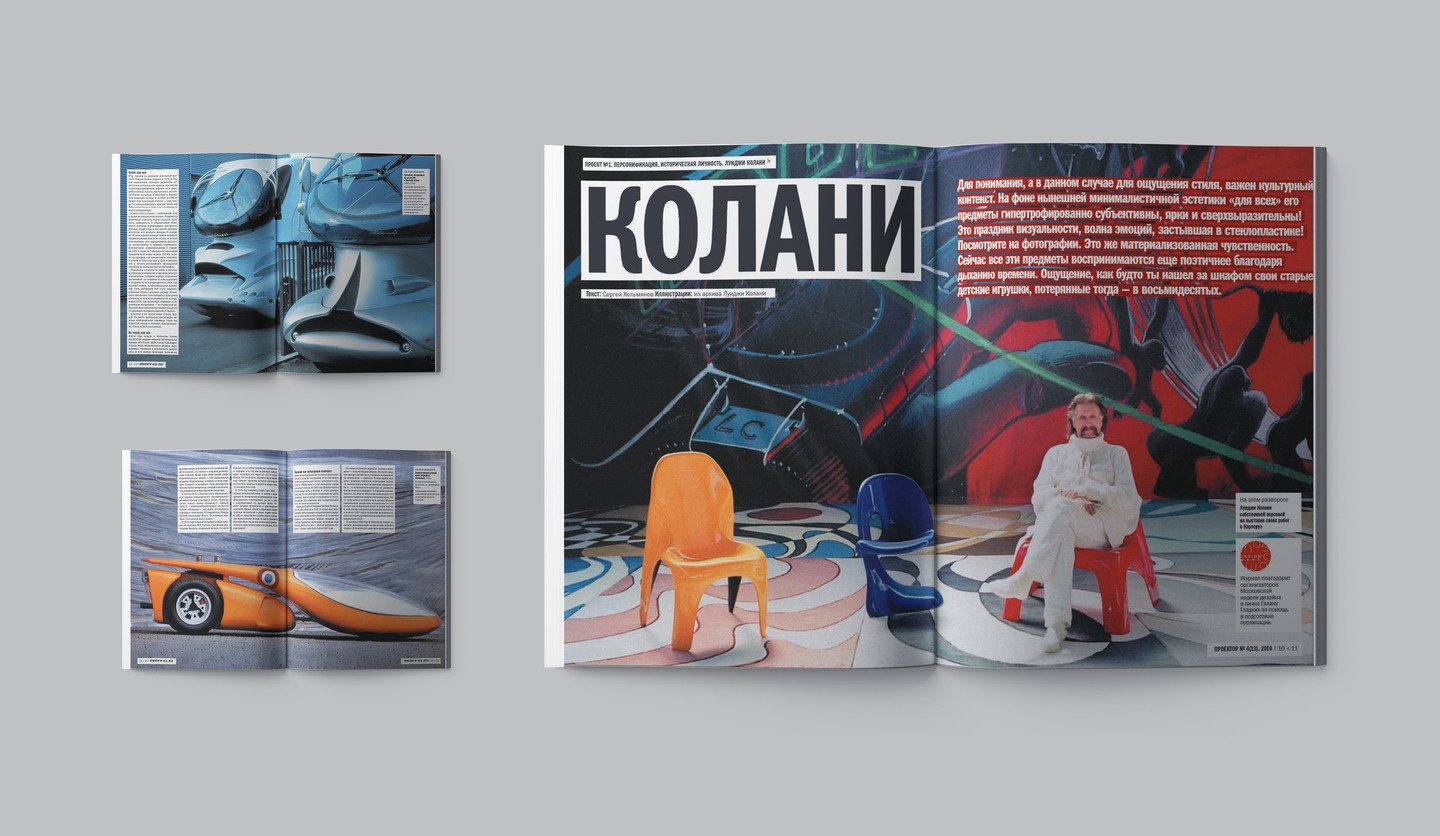
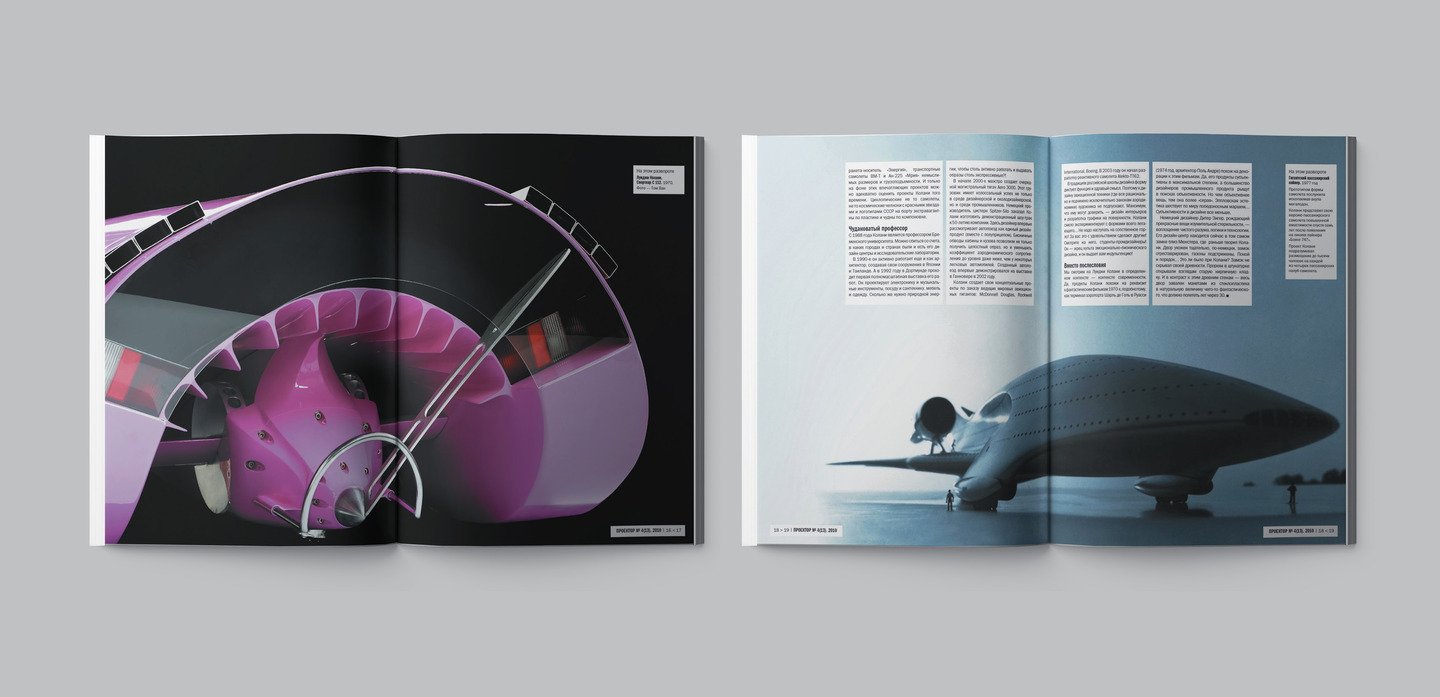
The exhibition of Luigi Colani was held within Moscow Design Week in the autumn of 2010. Projector couldn’t have ignored this landmark event and devoted the main publication to maestro Colani. The text was written by our regular contributor and expert Sergey Helmyanov: «We look at Luigi Colani from the perspective of nowadays. Right, his designs are like props in science fiction films of the 1970s, just as the terminal of Charles de Gaulle airport in Roissy looks like the scenery for them. Yes, his products are subjective to the maximal extent, while most industrial designers seek for objectivity. But the more objective a thing is, the more „blank“ it is. „Apple“ aesthetics is triumphally marching around the world… There’s less and less subjectivity in design».
Next comes our unpredictable column «Self-service». Invited guests design their publications by themselves, and I do not interfere them at all. This time we feature probably the most extraterrestrial character in Russian graphic design — Protey Temen. You must see what he did on his four spreads! He simply drew the answers to the questions of our interviewer Olga Bezruchko. However, the text was also included into the publication — on the very last page Protey put all the answers to the interviewer’s questions. As for the publication itself, he called it «Questions Expo». No wonder Anna Naumova, who we featured in one of the previous publications of this column, called Protey a genius and confessed she was his fan.
I give a low bow to Alexey Dombrovsky for such a deep and thorough study of the works by one of the most prominent Russian type designers of the first half of the XX century. Quote: «Sergey Chekhonine experimented with different techniques and styles all over his life. The range of his type demands was unusually wide: from the Byzantine cursive writing to the latest Art-Deco discoveries. Meanwhile, many people only consider the term „Chehonine’s graphics“ as his „agitation“ drawings and lettering — so bright, fresh, groundbreaking was this phenomenon, fully reflecting the romantic pathos of the first years of the Russian Revolution».
This time section «Object» is full of unique publications more than usual. The column opens with the interview our correspondent Leta Gordeeva had with Theo Jansen exclusively for Projector. Theo Jansen is a true wizzard, a «homo inventing». He’s the designer and sculptor whose works combine advanced engineering solutions and the objects of incredibly expressive plastique. Jansen’s kinetic sculpture, walking along the coast, are a miracle which awakens the joy of children in quite adult people. His objects are a pure emotion, almost the embodiment of Leonardo da Vinci’s passion for invention. Amazing, but it works!
Since this issue, «Object» has had a new column. We’ve made friends with the wonderful Finnish design company Martela. They working with world-famous stars. Some of them, such as Eero Aarnio, have already been featured in Projector, and some haven’t, but are likely to. The first publication of our joint column is a story about the new Koop chair, the object designed for Martela by Karim Rashid. Undoubtedly, we’re going to feature many more achievements of Martela’s design cuisine.
The publication devoted to Günther Uecker goes on with the story of another object. It might be surprising: how come he is a designer, when he mostly is an artist to fingerprints!? But I have a reason to place the article about Uecker and views into the issue. In my opinion, designers will also get a lot out of the works by this German artist. All his objects are a naked, concentrated emotion. Isn’t it the main point the consumer is waiting for from object design?
Section «Environment» opens with the publication about the constructor toy Eazzy by Alexander Matveyev. Anna Kozhara on the subtleties of the environmental object: «Eazzy is a modular object, which consists of four cardboard hexagons, interconnected with hinges and forming a kind of a „snake“ for children. Turning Eazzy’s modules and using your own imagination, you can easily and quickly create shapes of different utility levels».
To continue on the environmental design, here are Tools by Claes Oldenburg and Coosje van Bruggen. «Oldenburg’s main feature is insanely exaggerated everyday life objects. It will just suffice to mention his giant clothespin, established in Philadelphia, or the stamp with the word „Free“ in Cleveland. Each of these sculptures is a familiar household item, magnified a thousandfold. This is how, Oldenburg and van Bruggen erect monuments to everyday life, which are the obvious embodyment of postmodern sculpture».
Section «Photography» has almost become Anna Kozhara’s barony: she meets most wonderful photographers of St.Petersburg, getting to know their skill secrets. In this issue, read her story about the works by Igor Lebedev: «The „Passing by“ series was shot on the camera Boyer between 1999 and 2003. This camera was produced in France in 1947, which, depending on what the author wants or the situation requires, allows to press the shutter button up to 50 times while shooting one frame. The result is out-of-focus, or, rather, even a blurred image, often with repetitive details of the reality being shot».
Together with Sergey Helmyanov, we’ve made a publication on one of the brightest teachers of Stieglitz Academy in the 1970—80s: my grandfather Igor Kornilov, who taught at the Department of Industrial design for many years. «When we appeal to the people who are the essence of our school, we can see they are always protean personalities, showing themselves at various creative fields. <…> Igor Kornilov (1926—1987) was one of them. The architect, who worked in various fields, from urban planning to interior design; a graphic artist; an industrial designer; an educator, who headed the Department of Industrial design at St.Petersburg Art and Industry Academy from 1975 to 1977».
And the student project Open Foundry by Soren Vibrou, also published «School» section, is a kind of a bridge, connecting this and the following issue, which will be entirely devoted to Dutch design. «The project is very interesting. It’s a kind of proper ruffian design, pure lettering fun. Besides, the author actively quotes Massimo Vignelli’s: it’s not the black form that matters about the type, but the white space between the letters. Turning to a photogram, the favorite technique of the Constructivists of the 1920s, such as Laszlo Moholy-Nagy & Co, Soren Vibrou literally pulls the essence of the letter outside — the unity of black and white, the game of forms and counterforms».
Section «Books» opens with the publication by Serge Serov. Vladimir Chaika, featured there, imposed it into pages. It’s all not surprising because we are talking about «Reklama» (Advertising), the cult magazine of the 1980s. Its' covers, designed by Chaika, have already become the classics of design. This publication continues the digest on the recent history of design periodicals in Russia. There have already been the stories about [kAk), Yes! , Greatis, the Guild of Designers. This is the fifth publication in the series, but we still haven’t run out of design magazines of nowadays.
Our expert Mikhail Karasik continues the series of publications on the history of Soviet books of the 1920—30s. This issue features Vladimir Gryuntal. «Soviet photobook of 1920—1930s owes much to formalist artists and photographers, as they were called at the time. Many of them, including Gryuntal, were part of the group „October“. In their practice, they used photomosaics techniques, angle shots, sharp composition, but due to the certain circumstances not a single publication was issued those years — a publication which could be called Pure Photoavantgarde».